Aquatera is a specialized Russian company focused on irrigation pumping solutions for large-scale agriculture. Its core mission is to move water efficiently and reliably from the source to the irrigation system, ensuring that farms get the right pressure and flow to match their irrigation technologies.
Company Background: Aquatera’s Role in Irrigation
Aquatera is dedicated to supplying components for irrigation systems, with a particular focus on water delivery infrastructure.
Key aspects of Aquatera’s profile:
- Core business: Supplying pumps and related control systems for irrigation
- Products:
- Centrifugal pumps
- Multi‑stage and single‑stage pumps
- Motor pumps and electric pumps
- VFD (variable frequency drive) / VD control panels for pumps
- Main function: Ensure the correct pressure and volume of water to serve different irrigation systems
Although Aquatera as a company is around five years old, the founder and co‑owner has about 20 years of experience in irrigation. He previously worked for a large irrigation company until 2017, building deep expertise in pump selection, system design, and troubleshooting across diverse farm conditions.
The company operates as a 50/50 partnership, with the founder and his partner each holding half the shares. Alongside Aquatera, they also run Agre Guidra Ta, a nine‑year‑old company focused on soil moisture solutions, particularly soil moisture probes that support better irrigation scheduling.
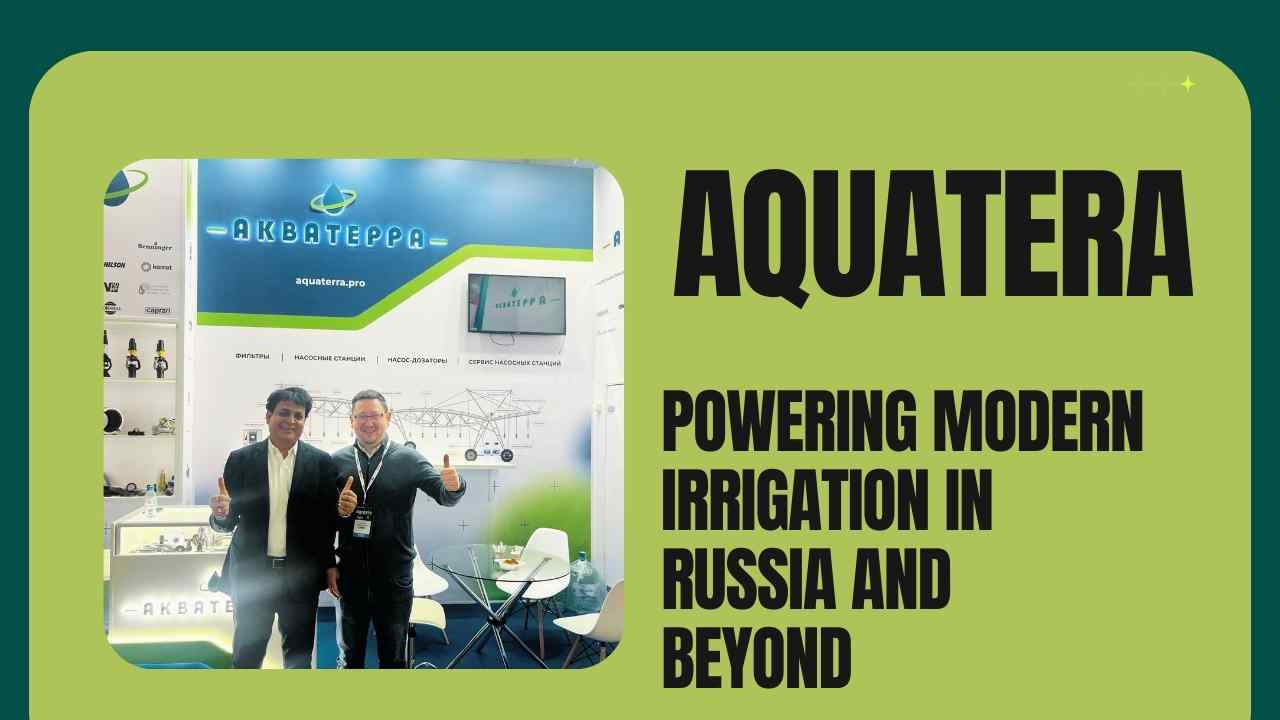
In January 2026, Devendra K Jha visited Aquatera during his trip to the Agravia Exhibition in Moscow, which he attended as part of the International Potato Tour promoted by Viktor Kovalev. During this visit, he interacted directly with Aquatera’s leadership, discussing the company’s technology, experience, and vision for the future of irrigation in Russia and neighboring markets and this information is based on his intercation with Aquatera team
Market Context: Large Farms and Preferred Irrigation Systems
Russian agriculture, especially for potatoes and other broadacre crops, is characterized by very large farm sizes, often in the range of 500–600 hectares and sometimes much more. Aquatera’s solutions are therefore tailored to these large fields, where robust, high‑capacity irrigation infrastructure is essential.
Main irrigation types served:
- Pivot systems (center pivot and linear/line systems)
- The most common systems for large fields in Russia.
- Aquatera’s pumps are frequently used to feed these pivots and linears with the required pressure and flow.
- Drip irrigation systems
- Used in certain crops and regions where precise water application is needed.
- Aquatera’s pumps can be configured for drip lines and drip tape systems.
- Sprinkler (portable/moveable) systems
- Far less common in the Russian context.
- One major reason is the high labor requirement for assembly and disassembly, making them less practical for very large fields.
Why Not Submersible Pumps?
Aquatera does not focus on submersible or deep well pumps, and there are clear reasons for this strategic decision:
- Small share of agricultural irrigation
- Deep well pumps make up only about 5% of the irrigation market in Russian agriculture.
- High costs and bureaucracy
- Drilling wells is expensive.
- Farmers must obtain extensive documentation and licenses to pump groundwater, a process that is often complex and costly.
- Different primary use cases
- Deep wells are more commonly associated with municipal drinking water and other non‑agricultural purposes.
Given these factors, Aquatera concentrates on surface or near‑surface water sources and pumping stations that support pivot and drip irrigation, where the majority of demand lies.
Soil Moisture Monitoring: Probes vs Satellite Data
Through its related company, Aquatera’s team is actively involved in soil moisture monitoring using in‑field probes. This work intersects directly with decisions on when and how much to irrigate.
Their perspective on satellite imagery versus soil moisture probes is clear and pragmatic:
- Limitations of satellite imagery for soil moisture:
- Current satellite data is not accurate enough for precise soil moisture measurement at root‑zone level.
- Many “small details” in the field—variations in soil type, compaction, or local micro‑conditions—cannot be fully captured from space.
- Satellites can indicate differences in crop vigor or color, but they cannot reliably pinpoint why a problem is occurring.
- Need for physical soil probes:
- To truly understand soil moisture, probes must be installed directly in the soil, at appropriate depths and in representative zones.
- Even then, they are tools, not magic devices; their value depends on correct placement and informed interpretation.
- Diagnosing crop problems:
- When satellite images show stressed areas, the underlying cause might be:
- Water deficit or excess
- Nutrient deficiency
- Planting issues
- Soil structure or compaction problems
- To distinguish among these, agronomists still need to go to the field, dig, and inspect the soil and roots.
- When satellite images show stressed areas, the underlying cause might be:
Thus, while satellites are valuable for crop health monitoring at a broader scale, they cannot replace ground‑based probes for accurate irrigation scheduling.
Agronomic Insights: Soil Structure and Fertilizer Management
The discussion with Devendra also highlighted Aquatera’s understanding of broader agronomic factors that influence yield, especially in potatoes and other field crops.
Soil structure and deep ploughing:
- Long periods without deep ploughing can lead to significant soil compaction.
- Compacted layers restrict water infiltration and root growth, undermining crop performance despite good irrigation.
- In some regions, deep ploughing followed by winter frost action improves soil structure; in others, soil types respond differently and require tailored cultivation strategies.
Fertilizer application through pivots:
- Aquatera offers fertilizer injection systems for applying liquid fertilizers and chemicals via pivot irrigation.
- Fertilizer companies are increasingly producing fertilizers in liquid form, enabling precise fertigation.
- Applying fertilizers in small, frequent doses throughout the season through pivots often delivers significantly higher yields than:
- Single or limited dry applications
- Large doses only at springtime
This integrated approach—optimizing water, nutrients, and soil—aligns strongly with the objectives of the International Potato Tour, where participants study best practices for maximizing yield and quality.
Technology Outlook: AI, Satellites, and Smart Farming
With growing interest in AI, satellite imagery, and digital agriculture, Devendra raised questions about how such tools might transform irrigation and crop management.
Aquatera’s founder adopts a balanced stance:
- Potential roles for AI and satellites:
- Monitoring crop health trends
- Providing early indications of diseases or pest pressure
- Supporting weather‑linked forecasts and risk planning
- Need for caution and more study:
- Agricultural outcomes depend on many interrelated factors: seed varieties, soil types, weather patterns, cultivation methods, and more.
- It is too early to rely solely on AI or satellite outputs without combining them with field measurements and expert judgment.
In practice, these technologies are best seen as decision‑support tools, complementing, not replacing, agronomic knowledge and on‑farm experience.
Market Education: Managing Expectations Around Soil Probes
One of the biggest challenges in the soil moisture probe business is farmer expectations. Many customers imagine a fully automatic solution:
- They buy a probe.
- They install it—sometimes in a non‑representative spot.
- They expect it to tell them exactly when and how much to irrigate across thousands of hectares.
Aquatera emphasizes that:
- A probe is a measurement device, not an autopilot for irrigation.
- It must be installed in the right locations and depths, and often more than one probe is needed—certainly not just a single device for something like 15,000 hectares.
- Data must be analyzed and interpreted, and then human decisions are still required.
Educating the market on these realities is a central part of Aquatera’s current and future work.
Vision for the Next Five Years
Aquatera’s five‑year vision, discussed during the interaction at Agravia, focuses on both technical and geographic growth:
- Product quality and portfolio
- Enhance the quality, durability, and performance of pump systems and control panels.
- Broaden the range and volume of products to better match different farm scales and irrigation methods.
- Regional expansion
- Extend operations into neighboring markets, including:
- Belarus
- Kazakhstan
- Uzbekistan
- These countries share similar large‑scale farming structures and increasing demand for efficient irrigation and fertigation.
- Extend operations into neighboring markets, including:
- Development of soil moisture and digital tools
- Grow the soil moisture probe business and related advisory services.
- Gradually integrate more data analysis and digital decision support, while continuing to stress correct usage and realistic expectations.
- Integrated, high‑yield systems
- Promote solutions that combine:
- Reliable pumping and water delivery
- Smart fertigation via pivots
- Sound soil and cultivation practices
- Supportive use of digital monitoring tools
- Promote solutions that combine:
Conclusion
The interaction between Devendra K Jha and Aquatera at the Agravia Exhibition in Moscow, during the International Potato Tour promoted by Viktor Kovalev, highlighted how modern irrigation companies are evolving in Russia and beyond. With strong foundations in pump technology, an expanding role in soil moisture monitoring, and a grounded view of digital agriculture, Aquatera is well positioned to help farmers achieve higher, more stable yields.
For visitors like Devendra, the visit underscored the importance of integrating infrastructure, agronomy, and emerging technologies in large‑scale potato and field crop systems—insights that carry relevance far outside Moscow and into global agricultural practice.