1. Introduction: Initial Context and the Formation of a Perfect Storm in the Agricultural Sector
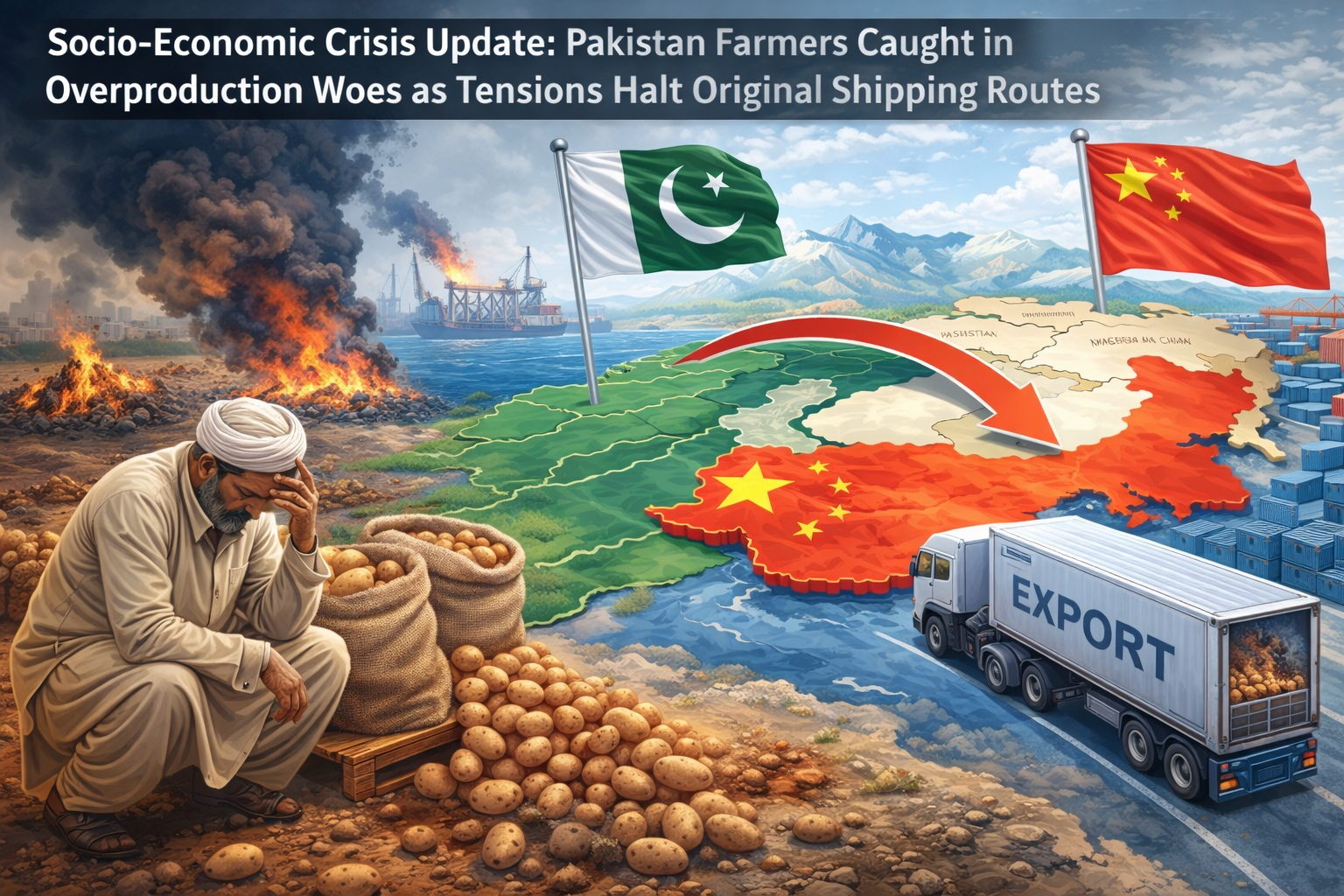
This analytical report is initiated based on the study of the provided news clipping titled “Pakistan considers China route to boost potato exports,” as well as an extensive array of current data reflecting the economic and geopolitical agenda of early 2026. The examined document explicitly indicates that the Government of Pakistan is exploring a fundamentally new logistical route through China to export potatoes to Central Asian countries. The material highlights that traditional trade routes have become exceedingly difficult due to mounting regional tensions, border issues, and a significant surge in transportation costs. A committee chaired by Rana Tanveer Hussain, responsible for overseeing exports, noted that the unstable situation in Iran and the closure of the border with Afghanistan have severely limited land access to Central Asian markets, forcing the state to consider providing freight subsidies to keep Pakistani potatoes competitive globally.
This seemingly localized news is a symptom of a colossal structural shift. In the first quarter of 2026, Pakistan’s agro-industrial complex—historically a fundamental driver of the national economy (contributing 24% to the Gross Domestic Product and employing over 37% of the total labor force)—faced an existential crisis.1 This crisis is a complex superposition of three destructive factors: record-breaking domestic overproduction of key crops, the blockade of critically important land transit arteries, and the sudden outbreak of a full-scale war in the Middle East that paralyzed global supply chains.
Historically, the potato has ranked as the fourth most important agricultural crop in Pakistan, trailing only wheat, rice, and sugarcane.3 Thanks to active state support and the adoption of new agronomic practices, the sector experienced exponential growth over the past decade, securing Pakistan a solid spot among the world’s top ten potato producers, ranking ninth according to the Food and Agriculture Organization (FAO).5 However, the 2025–2026 season exposed critical systemic vulnerabilities in the country’s export-oriented model. A model that relied for decades on the transit capacity of a single hub—Afghanistan—to access the lucrative markets of Central Asia and the Russian Federation proved unsustainable amidst geopolitical turbulence.
A comprehensive analysis of the current macroeconomic environment requires a deep dive into domestic agronomic statistics, an assessment of the logistical collapse triggered by the escalation of the Iran-Israel conflict in late February 2026, and a thorough examination of Islamabad’s adaptive strategies. In response to unprecedented challenges, Pakistan’s state institutions and national logistics operators initiated a strategic pivot, redirecting commodity flows through the high-altitude passes of China—a move that could permanently alter the trade architecture of South and Central Asia.
2. Internal Structural Crisis: Anomalous Hyper-production and Storage Infrastructure Collapse
The fundamental trigger of the current domestic economic disaster in Pakistan was a phenomenon classified in behavioral economics as the “bandwagon effect” among farming communities.7 In previous years, potato cultivation demonstrated high profit margins compared to traditional grain crops. Inspired by these high returns, farmers in the Punjab and Khyber Pakhtunkhwa provinces began a massive and uncoordinated expansion of cultivated areas, ignoring the limited capacity of the domestic market and storage infrastructure.
2.1. Production Dynamics and Agricultural Statistics
Statistical data for the 2024–2025 season already served as a clear indicator of an impending overproduction crisis. During this period, the total national production volume reached 9.9 million metric tons, exceeding the Federal Committee on Agriculture’s (FCA) official target of 6.8 million tons by 44.7%.4 The agricultural land dedicated to potatoes expanded nationwide by 41%, reaching 378,100 hectares. Punjab province, the absolute leader accounting for about 95% of national production, expanded its area by 14.8%, while the average yield in the region rose from 25,341 kg to 26,308 kg per hectare due to favorable weather conditions and improved crop management.5
In the 2025–2026 season, this trend not only continued but took on an avalanche-like character. The total harvested crop reached an all-time high, estimated by relevant departments at between 12 and 13 million metric tons.10
| Indicator / Season | FCA Target Forecast | Actual Production | Domestic Consumption | Potential Surplus |
| 2024–2025 | 6.8 million tons | 9.9 million tons | ~4.5 – 6.2 million tons | ~3.7 – 5.4 million tons |
| 2025–2026 | 8.92 million tons | 12.0 – 13.0 million tons | ~4.5 – 6.2 million tons | ~5.8 – 8.5 million tons |
Aggregated structural data based on reports from the National Assembly and the Ministry of National Food Security.4
Given that domestic consumption is strictly estimated within a narrow corridor of 4.5 to 6.2 million tons annually, a colossal unrealized surplus formed on the domestic market, exceeding consumption capacity twofold.8
2.2. Cold Chain Logistics Deficit and Financial Ruin of Producers
The critical catalyst that transformed the crop surplus from a potential export boon into an economic catastrophe was the acute shortage of cold storage infrastructure. The total nominal capacity of specialized storage facilities in Pakistan is strictly limited to a maximum of 7–8 million metric tons.1 As a result of this infrastructural deficit, between 25% and 30% of all harvested potatoes spoil annually (post-harvest loss) due to inadequate temperature controls.12 According to agritech experts, only about 15% of the harvested crop enters modern refrigeration complexes capable of extending shelf life beyond 90 days—a fundamental requirement for international markets.12
The situation was exacerbated by the fact that stocks from the previous year remained unsold in cold storage due to export halts in the second half of 2025. When the new, record-breaking harvest flooded wholesale markets in February and March 2026, prices instantly collapsed.11 Wholesale prices plummeted well below production costs, triggering a chain reaction of bankruptcies.
A financial profitability analysis paints a disastrous picture for small and medium producers:
- Production Costs: Independent audits and estimates by farmers’ associations (such as Pakistan Kisan Ittehad) show that actual cultivation costs exceed 300,000 Pakistani rupees per acre, significantly higher than the government’s estimate of 266,000 rupees, factoring in the rising costs of seeds and fertilizers.8
- Market Value: At the peak of the crisis, the price of a standard 50-kilogram bag of potatoes crashed to an unprecedented 550 rupees, and open retail prices fell to 10–25 rupees per kilogram.8 Meanwhile, basic transportation costs from the farm to the market or port (about 400 rupees per bag) consume almost all potential revenue.17
- Farmers’ Losses: Independent researchers estimate the net financial loss for farmers ranges between 235,000 and 250,000 rupees per cultivated acre.16 In most cases, market returns fail to cover even 20% of total production costs.15
Faced with negative logistics profitability, many farmers in key agricultural districts—such as Sahiwal, Okara, Pakpattan, Vehari, and Kasur—were forced to take drastic measures. Instead of harvesting, they fed quality potatoes to livestock or used heavy machinery to plow the unharvested crops back into the fields, aiming to avoid additional losses tied to hiring labor and paying for cold storage.14 In many instances, storage rent exceeded the market value of the stored produce, making stock release economically pointless.15
3. Blockade of Traditional Transport Arteries: The Afghan Barrier and Russian Sanctions
Historically, Pakistan relied on a simple and relatively inexpensive logistical framework. The country exported between 400,000 and 500,000 tons of potatoes, with Afghanistan serving not only as the primary end consumer but also as an indispensable transit hub for overland access to the developing markets of the Commonwealth of Independent States (CIS), including Tajikistan, Kazakhstan, Kyrgyzstan, Turkmenistan, and Uzbekistan.1 Statistics confirm this dependency: in 2023, Pakistan exported potatoes worth $140 million, with 41% absorbed by Afghanistan; in 2024, exports totaled $138 million, with Afghanistan again accounting for 42%.7
3.1. Geopolitical Closure of Afghan Corridors
In the autumn of 2025, this established trade architecture collapsed. In October, following a series of fierce armed border clashes between Pakistani security forces and Afghan Taliban factions resulting in heavy casualties, Islamabad decided to completely block key border crossings—Chaman and Torkham.1 This move instantly cut off Pakistani vegetable exporters from their most viable and historically proven transit corridor.
Islamabad argued that the continuous attacks by militants from the neighboring territory made normal commercial relations impossible, stating that “war and trade with Afghanistan cannot go hand in hand.”7 The physical isolation of millions of tons of export-bound potatoes within the country was the direct consequence of this political decision.2 Meanwhile, Afghanistan, seeking to reduce its economic reliance on Pakistan amid growing tensions, reoriented its logistics, actively leveraging trade routes via Iran and Central Asian states.13
3.2. Phytosanitary Ban by the Russian Federation
The export crisis was critically compounded by the loss of the Russian market, previously viewed as one of the most promising destinations for Pakistani agricultural exports. Russia’s Federal Service for Veterinary and Phytosanitary Surveillance (Rosselkhoznadzor) imposed strict restrictions on potato imports from Punjab, the key producing province.23 The embargo was based on the alleged detection of quarantine pests and pathogens, specifically the Potato Tuber Moth and Tomato Wilt virus.23
Despite strong pushback from Pakistan’s Department of Plant Protection (DPP)—which officially contested the ban and provided laboratory diagnostics and certificates proving the absence of these pathogens in export batches—shipments to Russia were completely frozen.23 The parties initiated diplomatic and technical consultations to resume trade; however, during the peak of the crisis in early 2026, this market remained inaccessible.
The combined negative effect of the Afghan closure and the Russian embargo slashed Pakistan’s total physical potato export volume by nearly 50%.10 The remaining traditional markets in the Middle East (UAE, Saudi Arabia, Qatar) and South Asia (Sri Lanka, Bangladesh), while operational, physically lacked the capacity to absorb the massive 4-million-ton domestic surplus.12
4. Global Geopolitical Shock: War in the Middle East and Macro-regional Logistics Paralysis
With the Afghan border impassable, Pakistani logistics and trading companies attempted to redirect export flows to the CIS through Iran, utilizing the arid Zahedan-Taftan land route.1 Acknowledging the critical situation, the State Bank of Pakistan (SBP), at the request of the Ministry of Commerce, took unprecedented measures in early December 2025. Exporters of potatoes and kinnow (mandarins) were granted a special, time-limited exemption from providing mandatory Financial Instruments (FI) for shipments to Central Asia via Iranian territory.25
However, the execution of this alternative plan was abruptly interrupted by the catastrophic collapse of the regional security architecture in late February 2026.
4.1. Escalation of the US, Israel, and Iran Conflict (February–March 2026)
On February 28, 2026, the United States and Israel launched a massive, coordinated military campaign against the Islamic Republic of Iran.27 The military operations—codenamed “Roaring Lion” (Israel) and “Epic Fury” (US)—aimed to physically destroy the country’s nuclear infrastructure, air defense systems, ballistic missile bases, and top political and military leadership. The campaign resulted in the assassination of Iran’s Supreme Leader Ali Khamenei, rendering diplomatic resolution impossible.27
In retaliation, Tehran launched Operation “True Promise IV,” executing massive strikes using ballistic missiles and “Shahed” drones against US military installations and allied infrastructure across the Middle East. Targets included airports, ports, and military bases in Bahrain, Kuwait, Qatar, Oman, the UAE, Iraq, Jordan, and Cyprus.27 Economically, Iran’s most devastating move was the official closure of the Strait of Hormuz—one of the world’s most critical maritime arteries.27
4.2. Consequences for Taftan Transit and Global Freight
The outbreak of intense hostilities in Iran and the Persian Gulf rendered the use of Iranian overland transit highly dangerous and economically ruinous.31 Pakistan’s National Assembly and specialized committees were officially briefed that the prevailing “war-like situation” had de facto closed this route.33
- Collapse at the Taftan Border Crossing: Starting March 1, 2026, Pakistani authorities were forced to close major pedestrian and commercial crossings on the Iranian border, including Taftan and Gabd-Rimdan, due to escalating threats.35 A wave of refugees surged through Taftan: over 2,000 Pakistanis, including students, diplomats, and merchants, were urgently evacuated from Iranian cities, sparking humanitarian and logistical chaos at the terminals.36 Trade operations were fully halted. Local markets in border areas of Balochistan faced acute shortages of consumer goods, causing food prices to skyrocket (vegetable prices jumped from 130–150 to 250–400 rupees per kg) alongside shortages of LPG.37
- Land Freight Hyperinflation: Even prior to the total blockade, the Taftan route was fraught with long transit times (around 23 days) and high risks of spoilage for perishable goods.11 The conflict escalation caused the transportation cost of a single refrigerated container via this corridor to explode from a baseline of $4,000 to an astronomical $13,000.15 At these freight rates, exporting a cheap, bulky commodity like potatoes loses all economic viability without direct state subsidies.15
- Paralysis of Maritime Shipping and Insurance Withdrawals: The blockade of the Strait of Hormuz, which handles nearly a fifth of global oil and LNG consumption 40, dealt a lethal blow to alternative sea routes. Major international P&I Clubs (e.g., Norway’s Gard and Skuld, UK’s NorthStandard, and the American Club), which cover 90% of global tonnage, universally canceled war risk insurance for vessels entering the Persian Gulf, the Gulf of Oman, and adjacent waters off the coasts of Iran and Pakistan.42 Global container shipping giants (Maersk, Hapag-Lloyd, CMA-CGM, MSC) suspended bookings, rerouted vessels, and imposed Emergency Conflict Surcharges ranging from $2,000 to $4,000 per reefer container.41
A comparative analysis of Pakistan’s export corridors as of March 2026 reveals the following:
| Transit Corridor | Operational Status | Reason for Blockade/Restriction | Impact on Export Logistics |
| Afghanistan (Torkham, Chaman) | Fully blocked | Armed border incidents, diplomatic failure | Zero throughput, loss of 40% of the market 1 |
| Iran (Overland, Taftan) | Extremely dangerous / Closed | Full-scale war (US-Israel-Iran), threat of strikes | Freight inflation from $4,000 to $13,000 per container; refugee chaos 15 |
| Maritime (Persian Gulf) | Paralyzed | Strait of Hormuz blockade, vessel attacks | War Risk Cover withdrawn, major shipping lines cancel voyages 40 |
4.3. Cascading Macroeconomic Impacts on Pakistan’s Economy
The agricultural crisis in Pakistan is exponentially compounded by macroeconomic shocks stemming from the Middle Eastern war. First, the closure of the Strait of Hormuz drove Brent crude oil prices above $80–$84 per barrel, with analysts forecasting a potential surge to $100 or higher if the conflict drags on.30 For Pakistan, structurally dependent on hydrocarbon imports, every $10 increase in oil prices widens the current account deficit by $1.5 to $2 billion.35 The government has already been forced to hike domestic petrol and diesel prices by a staggering 55 rupees per liter.47 This surge in energy costs directly inflates the operating expenses of agricultural machinery (tractors, water pumps) and diesel generators powering cold storage and reefer trucks, rendering the agrisector even more unprofitable.30
Second, the logistics paralysis hit other flagship exports beyond potatoes. The export of premium basmati rice went into freefall. Approximately 400,000 metric tons of Pakistani and Indian rice were trapped at ports or on transit vessels, unable to reach markets in Saudi Arabia, Iraq, and the UAE.49 Rice exporters are urgently shifting to FOB (Free on Board) contracts to transfer insurance risks to buyers, reducing the commodity’s overall appeal.50
Third, a long-term threat of a global fertilizer shock is emerging. The Persian Gulf region accounts for about a third of the world’s urea and ammonia exports. Disruptions in natural gas supplies and petrochemical plant operations amidst the fighting have already caused fertilizer prices to spike globally (ammonia futures in Europe hit $725 per ton).53 For Pakistani farmers, whose crops (such as potatoes and sugarcane) heavily deplete the soil, the unavailability of affordable fertilizers in the 2026-2027 season could prove fatal, potentially transitioning the crisis from overproduction to an acute food deficit.53
5. Strategic Rescue Vector: Development of the Transit Corridor via China
Cornered by unprecedented geographic isolation, with western and southern routes blocked by war and politics, Pakistan’s top leadership initiated an accelerated strategic pivot to the northeast—leveraging the transit corridor through the People’s Republic of China to access Central Asian markets.31 This scenario was heavily discussed as the most viable alternative during the Fourth Meeting of the Committee on Potato Export, held on March 4, 2026, under the chairmanship of Minister Rana Tanveer Hussain.31
5.1. Year-Round Operation of the Khunjerab Pass
The foundation for realizing this plan was a recent historic shift in bilateral relations between Beijing and Islamabad under the China-Pakistan Economic Corridor (CPEC) framework. The famous Khunjerab Pass, located at an altitude of over 4,600 meters and connecting Pakistan’s Gilgit-Baltistan region with China’s Xinjiang Uygur Autonomous Region (XUAR), traditionally operated on a seasonal basis. Due to heavy snowfall and extreme sub-zero temperatures, the border was only open from April to November, halting trade during the winter months.57
However, following high-level agreements reached late last year, Chinese authorities officially agreed to transition the Khunjerab Pass to year-round operation (24/7/365) starting December 1, 2024.57 To ensure uninterrupted traffic, Pakistan’s National Logistics Corporation (NLC) and other agencies invested heavily in the infrastructure of the Sost Dry Port, installing modern central heating systems and scanners, expanding warehousing capacities, and deploying heavy machinery to keep the Karakoram Highway clear of snow.57 This transformation turned a previously blocked winter route into a reliable, year-round artery. Logistics experts estimate that transit time from Karachi to Kashgar via this highway has been reduced to just 8 days, making land freight highly competitive.59
5.2. Logistics Vanguard: NLC Operations and the TIR System
The physical execution of the China transit corridor has been spearheaded by Pakistan’s National Logistics Corporation (NLC). Anticipating the crisis, the NLC foresightedly expanded its specialized fleet to 500 modern prime movers, a significant portion of which are equipped with high-tech refrigerated units.62
The critical mechanism enabling rapid delivery is the global transit system TIR (Transports Internationaux Routiers). The TIR system allows sealed cargo to cross the borders of transit states (in this case, China) without undergoing lengthy and costly manual customs inspections.63
The efficiency of this model has been proven in practice. The NLC successfully executed a historic pilot project: a convoy of trucks loaded with Pakistani potatoes harvested in Okara and Rahim Yar Khan traversed Chinese territory and successfully arrived in Dushanbe, the capital of Tajikistan. The 1,400-kilometer journey was completed in just 7 days.65 To mark the arrival of the first shipment, a grand ceremony was held at the customs terminal in Dushanbe, attended by Tajikistan’s Minister of Transport Azim Ibrohim and NLC leadership, officially inaugurating the new trade gateway.65
Beyond vegetables, the NLC has initiated large-scale exports of premium Pakistani meat (beef) to China and Central Asia via the Kashgar logistics hub. Transporting meat requires rigorous temperature control, and the ability of NLC’s 26-ton reefers to maintain product integrity throughout this route convincingly proves that exporting potatoes—which also require specific microclimates to prevent winter freezing and summer rotting—is entirely viable.68
5.3. Overcoming Barriers: Fuel, Visas, and Coordination
Despite a successful launch, the Chinese corridor presents unique operational challenges. First, transporting goods through the difficult mountainous terrain of the Karakoram Highway entails higher diesel fuel consumption.1 Second, China’s strict migration laws make securing multiple-entry transit visas for Pakistani drivers a lengthy and complex process.13
To resolve these bottlenecks, the Prime Minister directed the formation of a high-level committee led by Deputy Prime Minister Ishaq Dar.55 This committee is conducting emergency inter-departmental consultations with the Ministry of Foreign Affairs (MoFA), the Ministry of Commerce, and Chinese authorities under the Quadrilateral Traffic in Transit Agreement (QTTA between China, Pakistan, Kyrgyzstan, and Kazakhstan) to streamline visa regimes, standardize customs procedures, and lower logistical hurdles.21
6. Mechanisms of State Anti-Crisis Support: Transport Subsidies
Redirecting massive freight volumes through new, longer, and more complex overland routes inevitably drove up baseline freight costs. To maintain the price competitiveness of Pakistani potatoes in the highly contested CIS markets (where suppliers from Russia, China, Iran, and Turkey operate), the government had to devise mechanisms for direct financial intervention.
Recognizing the scale of the threat to social stability in agrarian regions, the Government of Punjab, led by Chief Minister Maryam Nawaz Sharif, spearheaded an emergency relief package.71 In an official letter to Prime Minister Shehbaz Sharif, she urgently requested that the federal center implement a special 25 percent subsidy on freight charges for exporters of potatoes and kinnow (mandarins).17 The logic behind this move is straightforward: lowering logistics costs will allow exporters to purchase produce from farmers at viable prices, preventing agricultural bankruptcies and stimulating the outflow of surplus goods abroad.
At the federal level, the Ministry of Commerce, under Minister Jam Kamal Khan, endorsed the concept of targeted assistance. During March meetings, it was determined that state intervention must focus explicitly on offsetting logistics costs (via a time-bound freight facilitation mechanism) rather than artificially regulating domestic market prices, which could lead to long-term market distortions.74
Additionally, to inject immediate liquidity into the sector, the National Committee on Potato Export proposed adopting a financial model previously used successfully to support the wheat market. The mechanism involves private commercial banks providing targeted loans to cold storage operators and exporters for the mass procurement of surplus potatoes from farmers during the peak harvest. The federal government would assume the responsibility of paying the interest (markup) on these loans.10 This measure aims to prevent distress sales and enable exporters to distribute shipments to Central Asia evenly throughout the year. Furthermore, the Ministry of National Food Security reduced the state fee for issuing phytosanitary certificates to a nominal 2,500 rupees, removing another bureaucratic hurdle.75
7. Central Asian Market Dynamics: Supply Vacuum and New Contracts
While Pakistan struggled to manage its 13-million-ton harvest, nations in Central Asia—particularly Kazakhstan and Uzbekistan—faced the exact opposite economic scenario: localized food deficits and soaring prices. This market asymmetry created ideal conditions for absorbing Pakistan’s surplus.
7.1. Supply Crisis in Kazakhstan and Export Ban
The Republic of Kazakhstan, endowed with vast arable lands in its northern and eastern regions (Akmola, Karaganda), is traditionally a major potato producer (yielding roughly 2–2.9 million tons) and a key supplier to neighboring republics.76 However, in early 2025, Kazakhstan encountered a severe imbalance. A sharp spike in demand from Uzbekistan led to a 1.5-fold increase in Kazakh potato exports (from 411,000 tons to 605,000 tons), crossing a critical threshold that threatened national food security.78
This mass outflow triggered a domestic market deficit: wholesale prices among local producers surged from 170 to 270 tenge per kilogram, while retail prices climbed by 19.3%.78 The crisis was exacerbated by the discovery of massive discrepancies in the country’s stabilization funds. Government inspections revealed colossal gaps between paper records and actual physical reserves. For instance, in the Mangystau region, only 25 tons of potatoes were found in warehouses instead of the reported 2,500 tons; similar shortfalls were recorded in East Kazakhstan and the Zhambyl region.79
To curb food inflation, Kazakhstan’s Interdepartmental Commission took drastic action: a six-month ban was imposed on potato exports to countries outside the Eurasian Economic Union (EAEU), effectively cutting off supplies to Uzbekistan. Simultaneously, the issuance of export phytosanitary certificates was entirely suspended.78 To replenish its depleted reserves and stabilize prices, Kazakhstan was forced to urgently turn to external markets, including China and Pakistan.79
7.2. Historic Contract for 50,000 Tons
Pakistani diplomacy moved swiftly to capitalize on this window of opportunity. In early February 2026, following direct talks between Pakistan’s Prime Minister Shehbaz Sharif and the President of Kazakhstan, a breakthrough bilateral trade agreement was achieved.47 Kazakhstan committed to importing 50,000 tons of high-quality Pakistani potatoes for a total value of approximately $25 million USD.12
The export delivery schedule was strategically set for April to June 2026, providing an optimal window for Pakistani farmers to seamlessly export the produce stored in cold facilities during the peak harvest.47 This 50,000-ton volume represents a potential 33% increase in Pakistan’s total exports compared to traditional markets like the UAE or Bangladesh (which consume 60,000 and 35,000 tons, respectively).12 Both sides successfully completed technical consultations regarding phytosanitary protocols (SPS), ensuring smooth cargo transit.12
7.3. The Uzbek Vacuum and Multimodal Network Formation
The halt in Kazakh exports dealt a severe blow to Uzbekistan’s food market. Historically, Kazakhstan had been Uzbekistan’s primary supplier (providing up to 95.4% of all Uzbek potato imports during certain periods).82 Cut off from Kazakh supplies, Tashkent began searching for alternatives.
Pakistani potatoes are already familiar to Uzbek consumers; in previous years (e.g., 2022), Uzbekistan imported substantial volumes from Pakistan, up to 257,900 tons.83 Relaunching export flows through China using the NLC’s logistical capabilities allows Pakistan to reclaim a dominant position in the Uzbek market and fill the resulting vacuum.84 The development of new multimodal routes, including pilot container trains (such as the UTK International Logistics joint venture project connecting China to Tajikistan and Uzbekistan 85), lays a robust infrastructure foundation for Pakistan’s long-term entrenchment in the region.
8. Technological Modernization of the Agrisector (Agritech) as a Prerequisite for Expansion
Analysis reveals that the geopolitical reorientation of logistics flows is insufficient on its own to secure sustainable agricultural export growth. To firmly establish a foothold in Central Asia and potentially access markets in Europe or mainland China (which has previously expressed interest in importing Pakistani potatoes subject to strict sanitary compliance 87), Pakistan’s potato sector requires profound technological transformation. The current crisis has proven that outdated farming methods—relying purely on the extensive expansion of crop areas without rigorous quality control or post-harvest processing—lead directly to collapse.
According to reports from specialized agritech firms (such as Concave AGRI), the industry’s survival hinges on the systemic integration of innovations across the entire value chain 12:
- Precision Agriculture: To meet the strict standards of international buyers (e.g., calibrating tubers to a 45–65 mm size), digital soil health mapping technologies are essential. This allows farmers to maintain the optimal nutrient balance necessary for uniform yields. Utilizing AI-driven predictive models to monitor weather conditions and forecast diseases (like late blight or scab) is critical, as any external tuber defects can result in the rejection of entire shipments at customs.12
- Digital Cold Chain Management: The solution to the storage deficit (which causes 30% crop loss) lies in investing in decentralized, small-scale modular cold rooms (5–10 ton capacity) accessible to local farming cooperatives. Integrating these facilities with NLC reefers equipped with temperature and humidity sensors linked to GPS tracking will guarantee international clients the required shelf life of over 90 days.12
- Processing and Value Addition: The strategic exit from the raw commodity overproduction trap is the domestic development of deep processing facilities. Producing French fries, chips, potato starch, and dehydrated products not only absorbs surpluses during peak supply but also generates high-margin, value-added goods that bypass stringent phytosanitary risks and feature an unlimited shelf life for transport.12
9. Conclusion and Takeaways
The 2026 agro-industrial crisis in Pakistan, centered on the potato sector, serves as a textbook example of a developing economy’s vulnerability to global geopolitical shocks and internal structural imbalances. Analyzing the situation yields the following key takeaways:
- Failure of Single-Route Models: Pakistan’s absolute reliance on Afghanistan’s transit capacity proved to be a fatal strategic error. The outbreak of violence on the Afghan border, coupled with the full-scale war in the Middle East (US, Israel, Iran) that paralyzed both maritime routes via the Strait of Hormuz and overland transit via Taftan, endangered the nation’s entire agricultural export infrastructure.
- Success of the Strategic Pivot: The decision to reroute logistics through the Chinese corridor—leveraging the newly year-round Khunjerab Pass and the robust capabilities of the National Logistics Corporation (NLC)—emerged as the only viable anti-crisis response. Integration into the TIR system and the NLC’s ability to execute multimodal refrigerated transport have proven highly effective, granting Islamabad safe and controlled access to Central Asia.
- The Necessity of State Paternalism: Amidst anomalous spikes in transportation costs (freight rates tripled due to the cancellation of war risk insurance), the government’s initiative to provide a 25 percent freight subsidy is a vital lifeline. This measure prevents mass farmer bankruptcies and secures Pakistan’s market share in the CIS.
- Synchronization of Market Potentials: The 13-million-ton potato overproduction crisis in Pakistan paradoxically aligned with severe shortages in Central Asia (triggered by Kazakhstan’s export embargo). The landmark contract to supply 50,000 tons to Kazakhstan, alongside the potential to replace Kazakh volumes in Uzbekistan, presents unprecedented opportunities for Pakistan to solidify its economic presence in the macro-region.
- The Imperative for Deep Modernization: For temporary anti-crisis measures to evolve into sustainable economic growth, Pakistan’s agricultural sector must transition from an extensive model of uncoordinated area expansion to an intensive, Agritech-driven model. Directive crop planning, the rollout of a decentralized digital cold chain, and massive investments in the food processing industry represent the only viable path to ensuring the Islamic Republic’s food security and macroeconomic stability in an era of perpetual global turbulence.
source
- Pakistan Plans Iran Corridor to Export Surplus Potatoes After Afghan, дата последнего обращения: марта 8, 2026, https://potatoinsights.com/pakistan-plans-iran-corridor-to-export-surplus-potatoes-after-afghan-border-closure/
- Pakistan explores other markets for potato export amid closure of, дата последнего обращения: марта 8, 2026, https://dunyanews.tv/en/Business/933598-pakistan-explores-other-markets-for-potato-export-amid-closure-of-trad
- Pakistan Achieves Record Potato Output Beyond Target, дата последнего обращения: марта 8, 2026, https://thedailycpec.com/pakistan-achieves-record-potato-output-beyond-target/
- Pakistan surpasses national potato production target by 44.7%, дата последнего обращения: марта 8, 2026, https://www.app.com.pk/national/pakistan-surpasses-national-potato-production-target-by-44-7/
- Pakistan potato harvest exceeds target by 44% – FreshPlaza, дата последнего обращения: марта 8, 2026, https://www.freshplaza.com/asia/article/9784223/pakistan-potato-harvest-exceeds-target-by-44/
- Record potato harvest in Pakistan driven by higher yields and, дата последнего обращения: марта 8, 2026, https://www.potatopro.com/news/2025/record-potato-harvest-pakistan-driven-higher-yields-and-expanded-cultivation
- Potato glut — Pakistan’s export wake-up call – Business – DAWN.COM, дата последнего обращения: марта 8, 2026, https://www.dawn.com/news/1958325
- Stakeholders call for govt intervention after potato market crash – Dawn, дата последнего обращения: марта 8, 2026, https://www.dawn.com/news/1965543
- Pakistan potato output up 19%, onion crop up 19% in 2024-25, дата последнего обращения: марта 8, 2026, https://www.freshplaza.com/asia/article/9789532/pakistan-potato-output-up-19-onion-crop-up-19-in-2024-25/
- NA body informed: Border closure, Russia ban cut potato exports by …, дата последнего обращения: марта 8, 2026, https://www.brecorder.com/news/40408699/na-body-informed-border-closure-russia-ban-cut-potato-exports-by-50pc
- Potato glut exposes planning gaps as NA body seeks urgent relief, дата последнего обращения: марта 8, 2026, https://www.brecorder.com/news/40408622
- Potato Exports of Pakistan: From Farms to Global Markets, дата последнего обращения: марта 8, 2026, https://concaveagri.com/potato-exports-of-pakistan-2026/
- Pakistan eyes Iran route for potato exports as price slump persists …, дата последнего обращения: марта 8, 2026, https://www.arabnews.com/node/2634126/amp
- Agriculture: Anatomy of Pakistan’s potato crisis – Business – Dawn, дата последнего обращения: марта 8, 2026, https://www.dawn.com/news/1970471
- Punjab proposes 25% freight subsidy to facilitate potato, kinnow, дата последнего обращения: марта 8, 2026, https://www.inp.net.pk/ur/news-detail/inp-wealthpk/punjab-proposes-25-freight-subsidy-to-facilitate-potato-kinnow-exports
- Punjab potato growers face collapse as oversupply deepens – Dawn, дата последнего обращения: марта 8, 2026, https://www.dawn.com/news/1965459
- CM urges PM for measures to up potato exports – Newspaper – Dawn, дата последнего обращения: марта 8, 2026, https://www.dawn.com/news/1973251
- Punjab proposes 25% freight subsidy to facilitate potato, kinnow, дата последнего обращения: марта 8, 2026, https://www.inp.net.pk/article-detail/inp-wealthpk/punjab-proposes-25-freight-subsidy-to-facilitate-potato-kinnow-exports
- Potato Prices Plunge in Pakistan Following Export Halt to Afghanistan, дата последнего обращения: марта 8, 2026, https://atlaspress.news/en/2026/02/02/potato-prices-pakistan-export-halt-afghanistan/
- Potato exports – Newspaper – DAWN.COM, дата последнего обращения: марта 8, 2026, https://www.dawn.com/news/1967019
- Pakistan Seeks To Link Ports To Central Asia Via China, дата последнего обращения: марта 8, 2026, https://www.afintl.com/en/202602047442
- Pakistan explores other export markets as potato price slump, дата последнего обращения: марта 8, 2026, https://www.arabnews.com/node/2631721/pakistan
- Pakistani potato exports fall 50% after Afghan closure and Russia ban, дата последнего обращения: марта 8, 2026, https://www.freshplaza.com/europe/article/9813815/pakistani-potato-exports-fall-50-after-afghan-closure-and-russia-ban/
- Pakistan becomes member of top global potato growers club, дата последнего обращения: марта 8, 2026, https://www.samaa.tv/2087310894-pakistan-becomes-member-of-top-global-potato-growers-club
- Pakistan allows kinnow and potato exports to CIS via Iran route, дата последнего обращения: марта 8, 2026, https://www.freshplaza.com/asia/article/9794952/pakistan-allows-kinnow-and-potato-exports-to-cis-via-iran-route/
- Pakistan okays export of kinnows, potatoes through Iran, дата последнего обращения: марта 8, 2026, https://www.brecorder.com/news/40397673/pakistan-okays-export-of-kinnows-potatoes-through-iran
- 2026 Iran war – Wikipedia, дата последнего обращения: марта 8, 2026, https://en.wikipedia.org/wiki/2026_Iran_conflict
- Policy Brief – March 2026 | US-Israel-Iran Conflict 2026, дата последнего обращения: марта 8, 2026, https://ciss.org.pk/policy-brief-march-2026-us-israel-iran-conflict-2026/
- US-Israel strikes on Iran: February/March 2026 – Commons Library, дата последнего обращения: марта 8, 2026, https://commonslibrary.parliament.uk/research-briefings/cbp-10521/
- Israel-Iran war’s ‘Strait’ fight can damage one of India’s well-built firewalls, дата последнего обращения: марта 8, 2026, https://m.economictimes.com/news/economy/indicators/israel-iran-us-wars-strait-of-hormuz-fight-can-damage-one-of-indias-inflation-game-and-rupee-markets-trade-deficit-at-risk-as-missiles-hit-midde-east-gulf-bases/articleshow/128934773.cms
- Pakistan considers Chinese route for potato exports to Central Asia, дата последнего обращения: марта 8, 2026, https://www.freshplaza.com/asia/article/9816975/pakistan-considers-chinese-route-for-potato-exports-to-central-asia/
- Pakistan Considers China Transit Route to Keep Potato Exports, дата последнего обращения: марта 8, 2026, https://lcci.pk/pakistan-considers-china-transit-route-to-keep-potato-exports-moving/
- Pakistan Eyes China Transit Option to Save Potato Exports, дата последнего обращения: марта 8, 2026, https://propakistani.pk/2026/03/05/pakistan-eyes-china-transit-option-to-save-potato-exports/
- Pakistan Considers China Route to Protect Its Potato Exports to, дата последнего обращения: марта 8, 2026, https://raisedbynumbers.com/pakistan-considers-china-route-to-protect-its-potato-exports-to-central-asia/
- Pakistan-Iran Trade Crisis 2026: Supply Chain Survival Guide, дата последнего обращения: марта 8, 2026, https://maalbardaar.com/pakistan-iran-trade-crisis-2026-logistics-guide/
- Balochistan on alert as thousands cross border from Iran – Pakistan, дата последнего обращения: марта 8, 2026, https://www.dawn.com/news/1978923
- Pakistanis return through Taftan as Iran war disrupts border trade, дата последнего обращения: марта 8, 2026, https://www.pakistantv.com/article/pakistanis-return-through-taftan-as-iran-war-disrupts-border-trade
- Pakistanis Rush to Taftan Border Amid Iran Strikes – Pakistan Today, дата последнего обращения: марта 8, 2026, https://www.pakistantoday.com.pk/2026/03/03/pakistanis-in-iran-rush-to-taftan-border-amid-strikes-in-iran
- Middle East tensions halt Pakistan-Iran border trade, send food, дата последнего обращения: марта 8, 2026, https://www.arabnews.com/node/2635462/pakistan
- Iran conflict causes severe disruptions to global ocean freight and air cargo flows: Report, дата последнего обращения: марта 8, 2026, https://www.businesstoday.in/world/middle-east/story/iran-conflict-causes-severe-disruptions-to-global-ocean-freight-and-air-cargo-flows-report-519113-2026-03-04
- US-Iran war sends shockwaves! Most crude via Strait of Hormuz heads to China, India – how vulnerable are they after closure?, дата последнего обращения: марта 8, 2026, https://timesofindia.indiatimes.com/business/india-business/us-iran-war-sends-shockwaves-most-crude-via-strait-of-hormuz-heads-to-china-india-how-vulnerable-are-they-after-closure/articleshow/129020947.cms
- Maritime insurers cancel war risk cover in Gulf as Iran conflict disrupts shipping, дата последнего обращения: марта 8, 2026, https://www.theguardian.com/business/2026/mar/02/maritime-insurers-war-risk-cover-gulf-iran-shipping-strait-of-hormuz
- Iran-Israel War: The Gulf waters turn riskier as insurers pull the war-risk plug, дата последнего обращения: марта 8, 2026, https://m.economictimes.com/industry/energy/oil-gas/iran-israel-gulf-war-risk-maritime-insurance-shipping-strait-of-hormuz-middle-east-waters-turn-riskier-risk-cover-disappears/articleshow/128938613.cms
- Markets begin to react as Trump’s attack on Iran risks hitting American pocketbooks, дата последнего обращения: марта 8, 2026, https://www.washingtonpost.com/business/2026/03/01/iran-strikes-economic-costs-usa-middle-east-trump/
- Iran war disrupts trade routes; freight indexes tick up – SeafoodSource, дата последнего обращения: марта 8, 2026, https://www.seafoodsource.com/news/supply-trade/iran-war-disrupts-trade-routes-freight-indexes-tick-up
- War with Iran chokes flows of oil and natural gas, highlighting energy security risks for Asia, дата последнего обращения: марта 8, 2026, https://apnews.com/article/middle-east-wars-energy-asia-gas-oil-8041a26142b8b7ce122c8b548f375924
- Kazakhstan shows interest in importing 50000 tonnes of potatoes, дата последнего обращения: марта 8, 2026, https://www.brecorder.com/news/40405674/kazakhstan-shows-interest-in-importing-50000-tonnes-of-potatoes-from-pakistan-ministry
- Beyond oil: How US-Iran war & Middle East crisis may hit India’s economy – sector-wise impact explained, дата последнего обращения: марта 8, 2026, https://timesofindia.indiatimes.com/business/india-business/beyond-oil-how-us-iran-war-middle-east-crisis-may-hit-indias-economy-sector-wise-impact-explained/articleshow/129098557.cms
- Irans threat halts Punjab basmati rice exports through Strait of Hormuz, дата последнего обращения: марта 8, 2026, https://timesofindia.indiatimes.com/city/chandigarh/irans-threat-halts-punjab-basmati-rice-exports-through-strait-of-hormuz/articleshow/129170600.cms
- Iran–US conflict puts India’s basmati exports at risk, farmers fear losses, дата последнего обращения: марта 8, 2026, https://www.indiatoday.in/business/story/iran-us-conflict-puts-indias-basmati-exports-at-risk-farmers-fear-losses-2877061-2026-03-03
- Basmati exports hit by Middle East war as 4 lakh metric tonnes pile up at ports, дата последнего обращения: марта 8, 2026, https://timesofindia.indiatimes.com/business/india-business/basmati-exports-hit-by-middle-east-war-as-4-lakh-tonnes-pile-up-at-ports/articleshow/128980514.cms
- Middle East turns up the heat: Here’s how Iran-Israel conflict may impact your kitchen bill, from staples to dessert, дата последнего обращения: марта 8, 2026, https://timesofindia.indiatimes.com/business/india-business/middle-east-turns-up-the-heat-heres-how-iran-israel-conflict-may-impact-your-kitchen-bill-from-staples-to-dessert/articleshow/128962524.cms
- Forget oil and gas, a bigger Iran war risk is shaping up, дата последнего обращения: марта 8, 2026, https://m.economictimes.com/news/economy/foreign-trade/forget-oil-and-gas-a-bigger-iran-war-risk-is-shaping-up/articleshow/129207761.cms
- Global | Implications of Iran conflict for food security – Dow Jones, дата последнего обращения: марта 8, 2026, https://www.dowjones.com/business-intelligence/blog/global-implications-of-iran-conflict-for-food-security/
- Pakistan Reroutes Potato Exports to Central Asia via China, дата последнего обращения: марта 8, 2026, https://thedailycpec.com/pakistan-reroutes-potato-exports-to-central-asia-via-china/
- China route considered for potato exports | The Express Tribune, дата последнего обращения: марта 8, 2026, https://tribune.com.pk/story/2595868/china-route-considered-for-potato-exports
- Traders welcome decision to keep Khunjerab Pass linking Pakistan, дата последнего обращения: марта 8, 2026, https://www.arabnews.com/node/2581513/pakistan
- Khunjerab Pass opens for year-round trade and travel – Pakistan, дата последнего обращения: марта 8, 2026, https://www.dawn.com/news/1906063
- China-Pakistan trade surges as Khunjerab Pass opens year-round, дата последнего обращения: марта 8, 2026, https://www.nation.com.pk/28-Mar-2025/china-pakistan-trade-surges-as-khunjerab-pass-opens-year-round
- Khunjerab Pass opened for year-round trade operations – samaa tv, дата последнего обращения: марта 8, 2026, https://www.samaa.tv/2087325098-khunjerab-pass-opened-for-year-round-trade-operations
- China-Pakistan trade surges as Khunjerab Pass opens year-round, дата последнего обращения: марта 8, 2026, https://cpecinfo.com/china-pakistan-trade-surges-as-khunjerab-pass-opens-year-round/
- NLC added 200 modern trucks and reefers to boost trade with, дата последнего обращения: марта 8, 2026, https://www.nlc.com.pk/media/details.php?slug=NLC-has-added-200-modern-and-state-of-the-art-trucks-and-reefers-to-boost-trade-with-Central-Asia
- Pakistan launches landmark trade route linking China to UAE via, дата последнего обращения: марта 8, 2026, https://www.arabnews.com/node/2584552/pakistan
- Transit of goods from China to UAE via Pakistan begins – Dawn, дата последнего обращения: марта 8, 2026, https://www.dawn.com/news/1881747
- Pakistan opens trade gateway to Central Asia with first potato, дата последнего обращения: марта 8, 2026, https://www.arabnews.com/node/2487431/%7B%7B
- Pakistan Breaks Ground on Central Asian Trade with First Direct, дата последнего обращения: марта 8, 2026, https://www.newscentralasia.net/2024/04/05/pakistan-breaks-ground-on-central-asian-trade-with-first-direct-shipment-to-tajikistan/
- NLC successfully transports Pakistan’s potato export consignment to, дата последнего обращения: марта 8, 2026, https://www.nation.com.pk/04-Apr-2024/nlc-successfully-transports-pakistan-s-potato-export-consignment-to-tajikistan
- NLC starts transportation of meat to regional countries via Khunjerab, дата последнего обращения: марта 8, 2026, https://www.nlc.com.pk/media/details.php?slug=NLC-starts-transportation-of-meat-to-regional-countries-via-KhunjerabPass
- NLC begins beef exports to China, Central Asia via Khunjerab Pass, дата последнего обращения: марта 8, 2026, https://gwadarpro.pk/investment/2002919301540380673/nlc-begins-beef-exports-to-china-central-asia-via-khunjerab-pass
- Pakistan redirects potato exports to Central Asia via China, дата последнего обращения: марта 8, 2026, https://www.thenews.pk/print/1401201-pakistan-redirects-potato-exports-to-central-asia-via-china
- Punjab Relief Package For Potato And Kinnow Farmers, дата последнего обращения: марта 8, 2026, https://paves.com.pk/punjab-relief-package-for-potato-and-kinnow-farmers/
- CM seeks urgent steps to boost potato exports – Pakistan – Business …, дата последнего обращения: марта 8, 2026, https://www.brecorder.com/news/40407229
- CM Maryam calls for immediate steps to increase farmers’ profits, дата последнего обращения: марта 8, 2026, https://www.nation.com.pk/15-Feb-2026/cm-maryam-calls-immediate-steps-increase-farmers-profits-exports
- PR No. 191 Jam Kamal Khan Chairs High-Level Meeting on … – PID, дата последнего обращения: марта 8, 2026, https://pid.gov.pk/site/press_detail/31968
- Pakistan explores new export markets after potato price slump, дата последнего обращения: марта 8, 2026, https://mettisglobal.news/Pakistan-explores-new-export-markets-after-potato-price-slump-58223
- Kazakhstan May Reimpose Potato Export Ban, дата последнего обращения: марта 8, 2026, https://timesca.com/kazakhstan-may-reimpose-potato-export-ban/
- Potato Market in Kazakhstan and Potential for Pakistani Exporters, дата последнего обращения: марта 8, 2026, https://phdec.gov.pk/wp-content/uploads/2024/11/Kazakhistan-TIC-Potato_Market-Intelligence-Report_2024.pdf
- Kazakhstan suspends potato exports to Uzbekistan for six months, дата последнего обращения: марта 8, 2026, https://kun.uz/en/news/2025/01/20/kazakhstan-suspends-potato-exports-to-uzbekistan-for-six-months
- Kazakhstan Boosts Potato Imports from China and Pakistan Amid, дата последнего обращения: марта 8, 2026, https://potatoes.news/kazakhstan-boosts-potato-imports-from-china-and-pakistan-amid-domestic-shortage/
- Kazakhstan suspends potato exports amid price surge, дата последнего обращения: марта 8, 2026, https://newsline.kz/article/1187623/
- Kazakhstan plans to import 50,000 tonnes of Pakistani potatoes, дата последнего обращения: марта 8, 2026, https://profit.pakistantoday.com.pk/2026/02/04/kazakhstan-plans-to-import-50000-tonnes-of-pakistani-potatoes/
- Kazakhstan significantly increases potato exports to Uzbekistan, дата последнего обращения: марта 8, 2026, https://kun.uz/en/73399214#!
- Uzbekistan increases potato imports – Kun.uz, дата последнего обращения: марта 8, 2026, https://kun.uz/en/33918938
- Uzbekistan and Pakistan: Building an Industrial and Investment, дата последнего обращения: марта 8, 2026, https://islamabadpost.com.pk/uzbekistan-and-pakistan-building-an-industrial-and-investment-corridor-between-central-and-south-asia/
- Four countries launch cross-border freight trains – Seetao, дата последнего обращения: марта 8, 2026, https://www.seetaoe.com/details/259640.html
- New China-Central Asia Corridor Sees First Pilot Shipment Via, дата последнего обращения: марта 8, 2026, https://menafn.com/1110747294/New-China-Central-Asia-Corridor-Sees-First-Pilot-Shipment-Via-Uzbekistan
- Pakistan government urged to help export of potatoes to China, дата последнего обращения: марта 8, 2026, https://www.freshplaza.com/asia/article/9062675/pakistan-government-urged-to-help-export-of-potatoes-to-china/