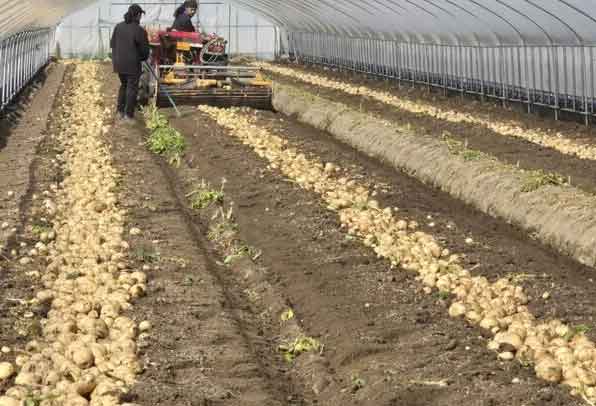
The city of Namwon in North Jeolla Province has announced the beginning of the shipment season for its renowned ‘Chunhyang-gol’ early potatoes, which are now arriving on consumer tables. According to the city government on the 5th, the harvest is underway in the main production areas of Geumji-myeon, Songdong-myeon, and Suji-myeon. Following a rigorous sorting process at the Agricultural Products Processing Center (APC), the potatoes are being distributed to large discount stores and retail networks across the country. Favorable climate conditions compared to last year have resulted in a robust harvest, with an average yield of about 100 boxes (based on 20kg) per greenhouse.
The market response has been strong, with transaction prices on the rise. Top-grade potatoes are currently trading at over 70,000 won per box, with an average price of 65,000 won. This represents a significant increase of 5,000 to 6,000 won per box compared to the previous year, and some projections suggest prices could reach as high as 80,000 won. Industry insiders note that these early potatoes are trading at two to three times the price of autumn-stored potatoes, providing a substantial boost to farm incomes. The high value of Chunhyang-gol potatoes is attributed to superior cultivation conditions, including well-drained silt soil in the alluvial plains, and the long-standing expertise of local farmers, which ensures a crunchy texture and consistent quality.
The competitive edge of the produce is further strengthened by the seed potatoes used. Supplied by the Namwon Agricultural Technology Center and a local seed potato cooperative, these seeds are cultivated in the Jirisan Mountain region. They have a shorter dormant period than seeds from other regions like Gangwon-do, making them ideally suited for winter greenhouse cultivation and highly favored by local farmers. The city anticipates that over 60 farming households, cultivating more than 200 greenhouses, will generate a gross income of approximately 1.5 billion won from this year’s potato crop. Looking ahead, farmers plan to maintain a stable annual income by planting subsequent crops such as watermelons and melons after the potato harvest concludes in mid-April. Kim Yeon-ju, head of the Namwon Agricultural Technology Center, stated, “Starting with the shipment of this year’s greenhouse potatoes, we will continue our technical support and administrative efforts to ensure that Namwon’s agricultural and livestock products are recognized as the best in the country across various sectors, including horticulture, fruits, and livestock.”