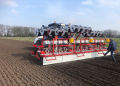
The French potato sector entered the 2025/2026 campaign with what agronomists term a “yield paradox”: stable productivity with exploding volume. National average yield held at 43.5 t/ha (45 t/ha in major basins), exactly in line with the decadal mean, yet total production surged 14.7% to 8.58 Mt . This increase was driven exclusively by area expansion: French ware potato hectares reached 197,338 ha in 2025, a 25% increase since 2023 and 15% above 2024 . The cooperative Sana Terra, supplying 85,000 t annually primarily to Belgian industry, exemplified this trend with a 25% two‑year area increase to 2,100 ha [source text]. Across the EU‑4 (France, Belgium, Germany, Netherlands), planted area hit an all‑time record of 818,800 ha, up 7.4% year‑on‑year, with Dutch gross yield reaching its highest level in 25 years .
The industrial absorption capacity, however, has flatlined. Despite numerous processing facility announcements targeting 2030, only one new plant has been constructed since 2022 [source text]. The consequence is mathematically inevitable: France holds one million surplus tonnes, 60–70% of which are processing‑destined, exerting catastrophic pressure on free‑market prices [source text]. Spot quotations have collapsed to €0.50–4.00/100kg depending on country and variety—levels that the NEPG explicitly describes as disconnected from production sustainability .
Into this already dysfunctional domestic equation, three external structural shocks now compound the crisis.
First, the competitive displacement in export markets. While global demand for frozen fries continues to grow at approximately 4% annually, the beneficiaries are no longer European processors . China’s frozen fry exports have increased by 2,475% compared with 2019; India’s by 653% . These suppliers are capturing precisely the Asian and Middle Eastern markets that historically absorbed European surplus. India’s Iscon Balaji Foods (Hungritos) is attracting $70 million investment for capacity expansion, Bihar state is subsidising Lady Rosetta processing varieties at 75%, and Indian exporters are now receiving premium prices in the US and Chinese markets . This is not transient competition; it is permanent supply‑chain reconfiguration supported by deliberate industrial policy.
Second, the US tariff regime. European potato exports to the United States declined by 5% year‑on‑year in August 2025 as the Trump administration’s import tariffs took effect . The North American market—historically a high‑value destination—is tightening, and EU producers face the dual pressure of Asian cost‑competition and US protectionism. Expana market analysts report that lower European prices may be required merely to retain existing market share, let alone expand it .
Third—and most critically for farm operators—the collapse of contract functionality. The UNPT has documented that 2026/2027 contract offers are priced 25% below the previous campaign, despite no corresponding reduction in input costs . More fundamentally, the structure of these contracts has shifted. Many now contain clauses permitting manufacturers to divert contracted volume to the free market when industrial demand softens, transferring the entire inventory risk to producers . The UNPT characterises this as a “worrying drift away from contractualization” and a “structural asymmetry of risk” that leaves growers exposed to price discovery on a market already saturated with one million excess tonnes . The NEPG has framed the 2026 planting decision as an existential question: “Are you ready to produce while losing money?” .
The 2025 French potato harvest will be recorded as the largest in history. It will also be recorded as the moment when the European processing potato business model—aggressive area expansion in response to industrial “signals,” followed by automatic spot‑market absorption—ceased to function. The one million surplus tonnes are not a statistical anomaly; they are the physical manifestation of a structural oversupply now locked in by Asian export displacement, US tariff barriers, and contract designs that immunise processors while exposing growers. The UNPT’s February 2026 warning is not rhetorical: “Nothing allows us to announce that the French or European market will be able to restart in 2026 or absorb one additional tonne without tension” . For agronomic professionals, the implication is unambiguous. 2026 is not a year for area retention based on historical entitlements. It is a year for rigorous, farm‑level cost accounting, for scrutiny of contract clauses that allocate risk, and for recognition that the “Belgian demand” narrative of 2023–2024 has been superseded by a global supply glut. The market will not rescue those who plant first and ask questions later.