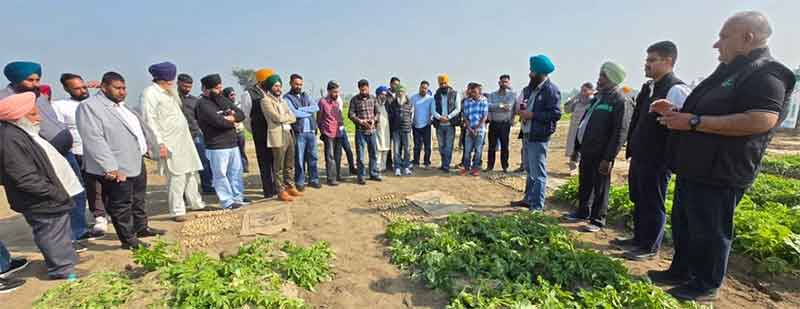
The 3rd Innovative Seed Show, held by Harinder Farms in Punjab in February 2026, brought together potato growers, agronomists, and industry stakeholders around a single theme: early-generation seed potato production . Harindra Biotech showcased its full varietal portfolio at 75 days after planting, with strip tests and yield estimation exercises demonstrating varietal uniformity and productivity under real field conditions. The company also launched Harindra Grow, a structured seed multiplication and market linkage program .
But this event did not occur in isolation. Across Punjab, a parallel transformation is underway. Just days before the Seed Show, the Punjab Agricultural University (PAU) reported that its newly released varieties PP-101 and PP-102 are achieving yields of 444.8 q/ha and 461.5 q/ha respectively—among the highest recorded for potato in the region. On-farm demonstrations across 15 villages in Kapurthala district, the state’s core seed belt, have shown strong farmer satisfaction with tuber uniformity and yield performance . Meanwhile, the Department of Horticulture is actively promoting tissue culture and aeroponics for virus-free seed production, with a 50% subsidy available for net house units under the National Horticulture Mission . The goal is to replace table potato cultivation with certified seed potato production, responding to inter-state demand from West Bengal, Maharashtra, and Karnataka .
Simultaneously, the technological frontier is advancing rapidly. HyFarm, the agri-business arm of HyFun Foods, has partnered with precision agriculture firm Fyllo to deploy IoT-based soil, crop, and climate intelligence across India’s potato processing supply chain. Growers now receive real-time irrigation scheduling, disease prediction models, and hyperlocal weather advisories via integrated digital platforms . This shift from advisory to intelligence was formalized in the Union Budget 2026, which announced Bharat Vistar—a national, multilingual AI-enabled advisory ecosystem. As articulated by HyFarm CEO S. Soundararadjane, the policy moves Indian agriculture “beyond fragmented digitisation and toward institutionalised decision intelligence” .
Crop diversification, another pillar of the Seed Show, also finds empirical reinforcement. Punjab’s paddy monoculture, cultivated on 31 lakh hectares, faces groundwater depletion and climate vulnerability. Following the 2025 floods that damaged over 2 lakh acres of paddy, experts from PAU and the state agriculture department have urged farmers to adopt kharif maize, which requires only 3–4 irrigations compared to paddy’s 18–19, and short-duration pulses like moong that mature in 60–65 days . However, maize adoption remains constrained by mandi prices as low as ₹900–1,400/qtl against an MSP of ₹2,240/qtl, with inadequate drying infrastructure identified as the primary bottleneck .
The International Potato Center (CIP) is also actively supporting this transition. Its ongoing project aims to shorten potato variety release timelines from 10 years to 6 years in India and Bangladesh, while developing short-season, heat-tolerant, and pest-resistant clones compatible with cereal-based cropping systems. The target is to improve potato-derived income for at least 20,000 households by 15% through strengthened seed value chains .
The 3rd Innovative Seed Show was not merely a demonstration event—it was a convergence point. The data from PAU confirms that high-yielding varieties are ready for deployment. Government subsidies and policy architecture (National Horticulture Mission, Bharat Vistar) provide the enabling environment. Private-sector initiatives (Harindra Grow, HyFarm-Fyllo) are building the execution layer. What remains is the integration of these moving parts at the farm level. For progressive growers and agricultural professionals, the path forward is no longer about choosing between seed quality, technology, or diversification—it is about recognizing that all three are now inextricably linked.