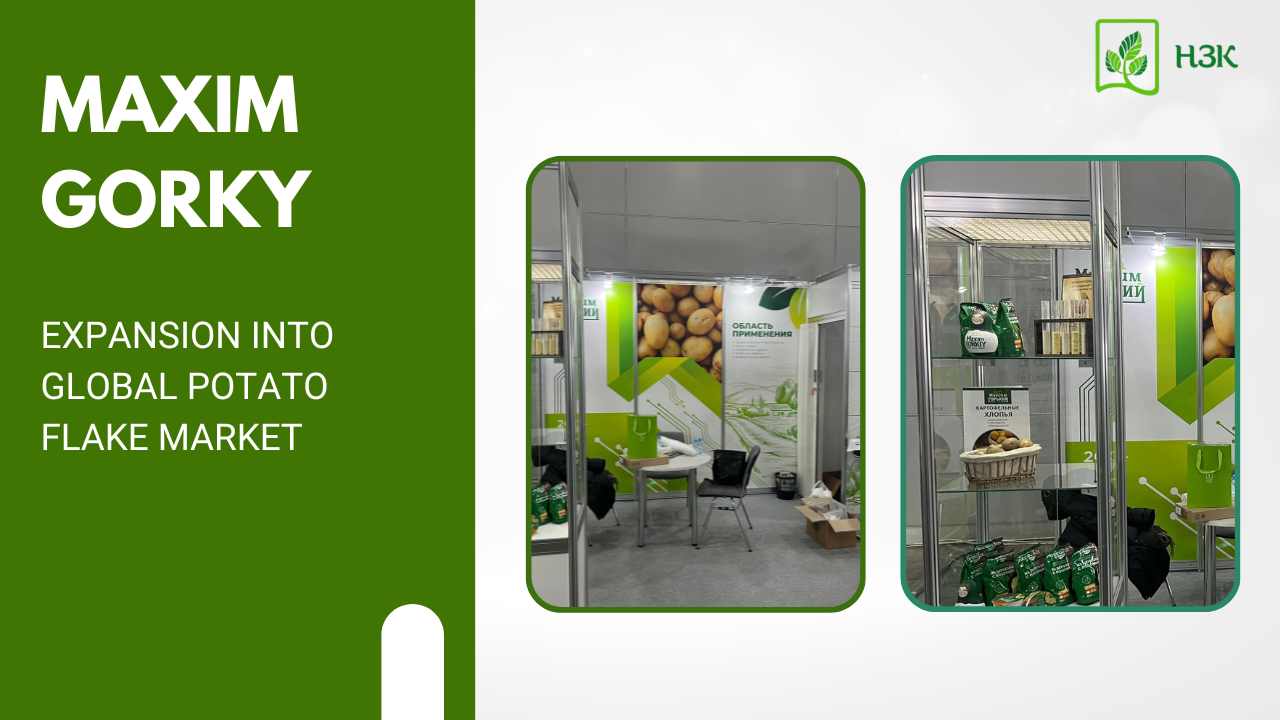
The global landscape of agricultural processing is often a story of untapped potential meeting industrial scale. One of the most significant intersections in recent years occurred exactly one year ago at the Agravia (Potato Horti AgriTech) exhibition in Moscow, held from January 21–23, 2025. It was here that the Russian industrial powerhouse, Maxim Gorky Plus, sat down with Devendra K Jha, a prominent figure from Indian Potato and a member of the International Potato Tour led by Viktor Kovalev, to blueprint a strategy for one of the most promising trade corridors in the snack food industry: the export of potato flakes from the Russian heartland to the bustling markets of the Indian subcontinent.
Maxim Gorky Plus: An Industrial Titan in the Tundra
To understand the export strategy, one must first understand the engine behind it. Maxim Gorky Plus is not merely a participant in the Russian agricultural sector; it is its undisputed leader in the dehydration space. As the largest potato flake producer in Russia, the company operates with a precision that reflects the massive scale of Russian potato cultivation.
With a production capacity exceeding 2,000 tons per month across three state-of-the-art production lines, the company has built a reputation for volume and reliability. Their current footprint is already global, with established export routes to:
- Europe: Germany and Belarus.
- Central Asia: Uzbekistan and Tajikistan.
- The Americas & Southeast Asia: Brazil and Indonesia.
- Middle East: Turkey.
The Science of the Flake: Density and Specification
During the discussions between Jha and the Maxim Gorky Plus technical team, Anastasia Fedorava, the conversation moved beyond mere logistics and into the granular physics of potato dehydration. Potato flakes are not a “one-size-fits-all” commodity; their application is dictated by bulk density and dry matter content.
1. High-Density Flakes (The “Flour-Like” Variant)
Primarily used in the production of fabricated potato chips (the kind that come in a tube), these flakes require a specific texture to ensure the dough remains consistent during high-speed extrusion.
2. Standard-Density Flakes
These are the workhorses of the food industry. Their applications include:
- Instant Mashed Potatoes: Requiring quick rehydration.
- Meat Production: Acting as a binder in sausages and patties.
- Bakery & Confectionery: Improving shelf life and texture in breads.
Maxim Gorky Plus maintains a rigorous standard for these products, typically achieving a dry matter content of 20–23%. Interestingly, the company utilizes mixed potato varieties in their production rather than a single-variety stream. While this allows for more consistent volume, it introduces challenges in sugar management.
The Pricing and Sugar Dilemma
The base price discussed at the exhibition hovered around €1.05 per kg, though this fluctuates based on volume and density. A critical point of the export strategy involves low-sugar varieties. In Russia, the supply of low-sugar potatoes is limited and the raw materials are significantly more expensive. For high-end fry applications, this is a dealbreaker; however, for the flake market, this provides a strategic opening.
Why India? A Tale of 60 Million Tons
The dialogue with Devendra K Jha highlighted a fascinating paradox. India produces roughly 60 million tons of potatoes annually, benefitting from a twice-yearly harvest. Yet, the demand for high-quality processed flakes is outstripping local supply.
The Low-Sugar Advantage
One of the most insightful takeaways from the Agravia meeting was the realization that sugar content is less critical for flakes in the Indian market than it is for French fries. In India, flakes are primarily used for:
- Traditional Savory Snacks (Namkeen): Where the flake is a component of a larger spice-heavy mix.
- Semi-finished Products: Like alu tikki or samosa fillings, where a slight caramelization (from higher sugar) is often masked or even desired.
This makes Maxim Gorky Plus’s standard product a perfect fit for the Indian snack industry, bypassing the high-cost hurdles of low-sugar raw materials that plague the European fry market.
Diversification: From Human Consumption to Pet Food
A robust export strategy requires a plan for every grade of product. During the Moscow exhibition, Jha and Anastasia Fedorav explored the potential for lower-grade flakes—those characterized by “black spots” or slightly off-color profiles.
While these are unsuitable for premium retail mashed potatoes, they are goldmines for secondary markets:
- Pet Food: The growing Indian middle class is spending more on premium pet nutrition. Potato flakes serve as an excellent, hypoallergenic carbohydrate source in grain-free dog foods.
- Fish Feed: A more “blue-ocean” strategy discussed was the use of potato starch and flakes in aquaculture. While Jha noted that this market is still unfamiliar to many Indian potato traders, the potential for using low-grade Russian flakes as a binder in fish feed pellets is a significant opportunity for future-proofing the export volume.
The Path Forward: Logistics and Partnership
The meeting at Agravia 2025 wasn’t just a meet-and-greet; it was the start of a technical data exchange. Taking the details back to the International Potato Tour, Jha has positioned himself as a bridge between Russian industrial capacity and Indian entrepreneurial agility.
The strategy for 2026 and beyond is clear:
- Targeting the Snack Giants: Engaging with major Indian snack manufacturers who require high-density flakes for extrusion.
- Leveraging the “Mixed Variety” Benefit: Using the cost-effectiveness of Russian mixed-variety production to compete with high-priced European or American imports.
- Customization: Offering density-specific options to Indian “Haldiram-style” producers who require specific textures for traditional savories.
Key Takeaway: The success of the Maxim Gorky Plus expansion depends on translating Russian “bulk power” into “local precision” for the Indian palate.
Conclusion
As we look back at the Moscow exhibition of January 2025, it is clear that the groundwork laid by Devendra K Jha and Maxim Gorky Plus has redefined the potato trade. By focusing on the unique needs of the Indian snack market—where sugar sensitivity is lower and application variety is higher—this partnership has turned a cold-climate crop into a hot-market commodity.
The “Golden Spud” trade route is no longer a prospect; it is an active, thriving reality of the global food supply chain.