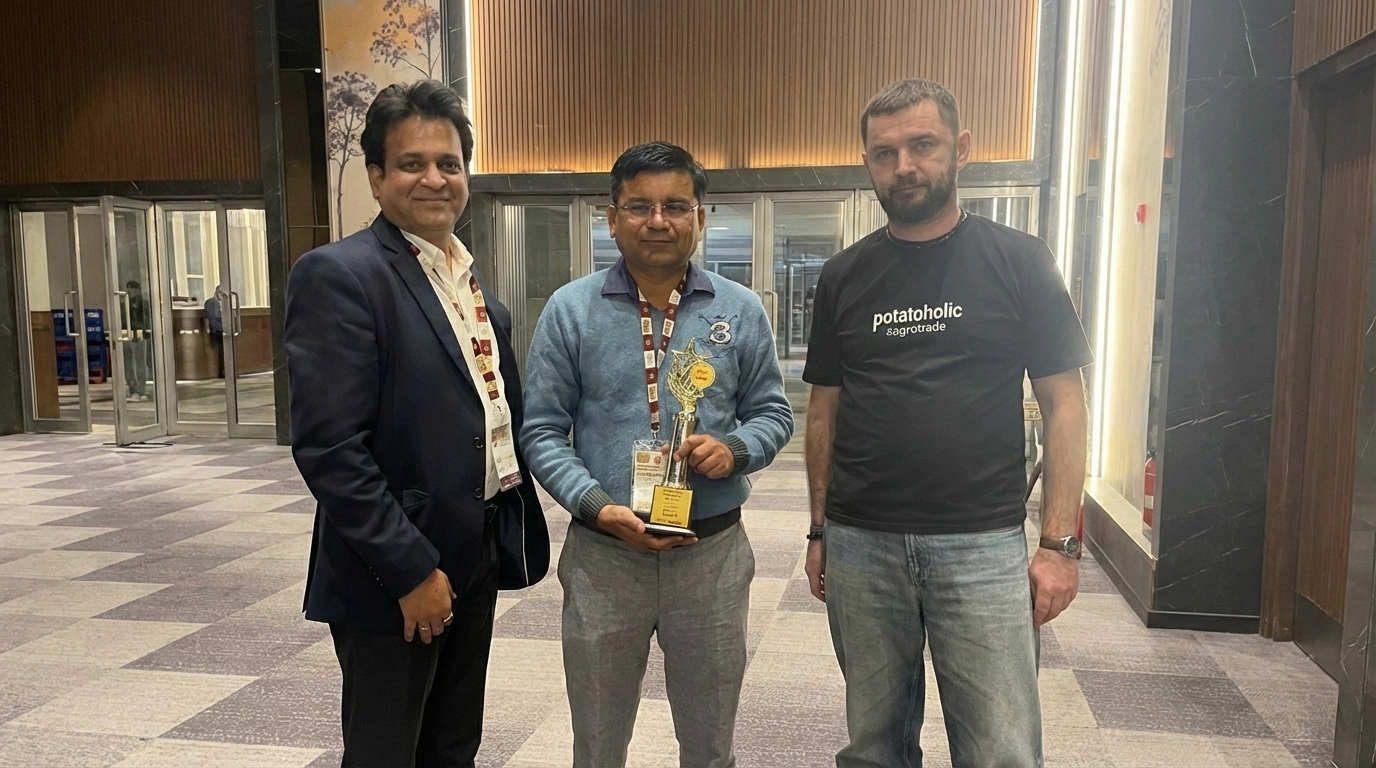
India’s potato sector is increasingly becoming a source not only of production volume, but also of practical, scalable innovation. One of the strongest examples comes from Gujarat, where Jitesh Patel, a progressive farmer widely known as the Potato King, helped turn a regional crisis into a roadmap for higher yields, better quality, and long-term sustainability.
This story is not just about hitting bigger numbers. It is about two major breakthroughs—first in water management, then in soil science—that reshaped farm economics and influenced wider adoption of modern practices across the state. Jitesh Patel_World Potato Summi…
https://open.spotify.com/episode/2jg7UhFf11OxIz0KFSm0WV?si=16v7VXMGRoGyXirNvbJdcw
From Crisis to Opportunity: Gujarat in the Early 2000s
In the early 2000s, potato farming in parts of Gujarat was under intense pressure. Limited rainfall, dependence on inefficient flood irrigation, and worsening soil conditions created a fragile system. A significant share of productive land was left fallow due to water scarcity, and yields were capped at around 30 tons per hectare—a ceiling that made farming feel like a high-stakes gamble.
Breakthrough #1: Choosing Advisory and Drip Irrigation Over Credit
At a critical moment in 2002–2003, the farming community faced a choice: access irrigation systems through credit, or invest in a solution backed by strong agronomic advisory and technical support. Jitesh Patel and his team made a deliberate business decision—to invest in knowledge and structured support, not simply financing.
The impact was immediate. Within one season, yields improved from 30 to 40 metric tons per hectare—a 33% increase. The results built confidence to convert more land to drip irrigation and proved that modern irrigation, when paired with agronomy, can change profitability fast. Jitesh Patel_World Potato Summi…
When One Farm Becomes a Signal: Policy-Level Attention
The breakthrough did not stay at farm level. The scale and clarity of results attracted government attention. In 2004, Patel shared real ROI calculations and a structured list of farmers’ key pain points during discussions that helped shape the next step in Gujarat’s approach to agricultural modernization.
By 2005, Gujarat established the Gujarat Green Revolution Company (GGRC)—an institutional platform designed to expand farmer support, improve access to funding mechanisms, and strengthen banking linkages for adoption of modern technologies. Jitesh Patel_World Potato Summi…
A Decade of Refinement: From 40 to 45 Tons per Hectare
Between 2004 and 2015, the system matured through continuous improvement. The model expanded with better agronomy, adoption of processing-oriented varieties through contract farming, and stronger operational discipline. Over time, yields climbed further toward 45 tons per hectare, confirming that performance gains can be sustained when technology is paired with process and planning. Jitesh Patel_World Potato Summi…
The New Crisis: When “More” Was No Longer “Better”
Around 2012, a different set of challenges began to grow: new diseases, declining quality, and reduced shelf life in storage. Even investment into cold storage did not prevent heavy losses in later years. The key lesson was clear: volume alone does not guarantee success if the biological foundation—especially soil health—is deteriorating. Jitesh Patel_World Potato Summi…
Breakthrough #2: Betting on Soil Science and Operational Efficiency
The second leap was deeper and more fundamental. After testing many products and approaches without lasting results, Patel’s team shifted focus toward soil science, rebuilding soil functionality instead of chasing temporary fixes.
This shift was supported by operational upgrades as well, including a strong emphasis on mechanization and efficiency. The outcomes became the new benchmark for the farm:
- 15–20% reduction in fertilizer use
- yields exceeding 50 tons per hectare
- improved soil quality and water retention
- higher marketability driven by quality: more uniform size and shape, reduced harvest damage, and longer storage life Jitesh Patel_World Potato Summi…
In other words, the biggest gains moved from “how much” to “how good”—and that improved both profitability and resilience.
The 60–80 Ton Horizon: Unlocking Genetic Potential
Based on years of observation and measurement, Patel points to a new target: 60–80 tons per hectare as the genetic potential of the potato plant. The guiding principle behind this ambition is that the next level is not achieved through one input, but through an integrated system—healthy soil, balanced nutrition, smart irrigation, and disciplined measurement (including quality indicators such as Brix/TSS). Jitesh Patel_World Potato Summi…
A Mission Beyond Yield: Dignity for the Farmer
This journey is also framed as a social mission. Patel’s message is that modern agriculture should restore the farmer’s status as a skilled professional—respected for knowledge, planning, and innovation, not seen as someone trapped by uncertainty and risk.
Why This Story Matters to the Global Potato Industry
Jitesh Patel’s experience is a practical case study for any region facing similar challenges—water constraints, yield plateaus, storage losses, and soil decline. It shows that transformation often happens in two stages:
- Technology + advisory support (drip irrigation, agronomy, ROI discipline)
- Biological foundation + efficiency (soil science, quality, reduced dependency, mechanization)
For growers, processors, and policymakers, Gujarat’s potato revolution offers a clear takeaway: sustainable growth is built on systems—starting with water, and ultimately returning to soil.