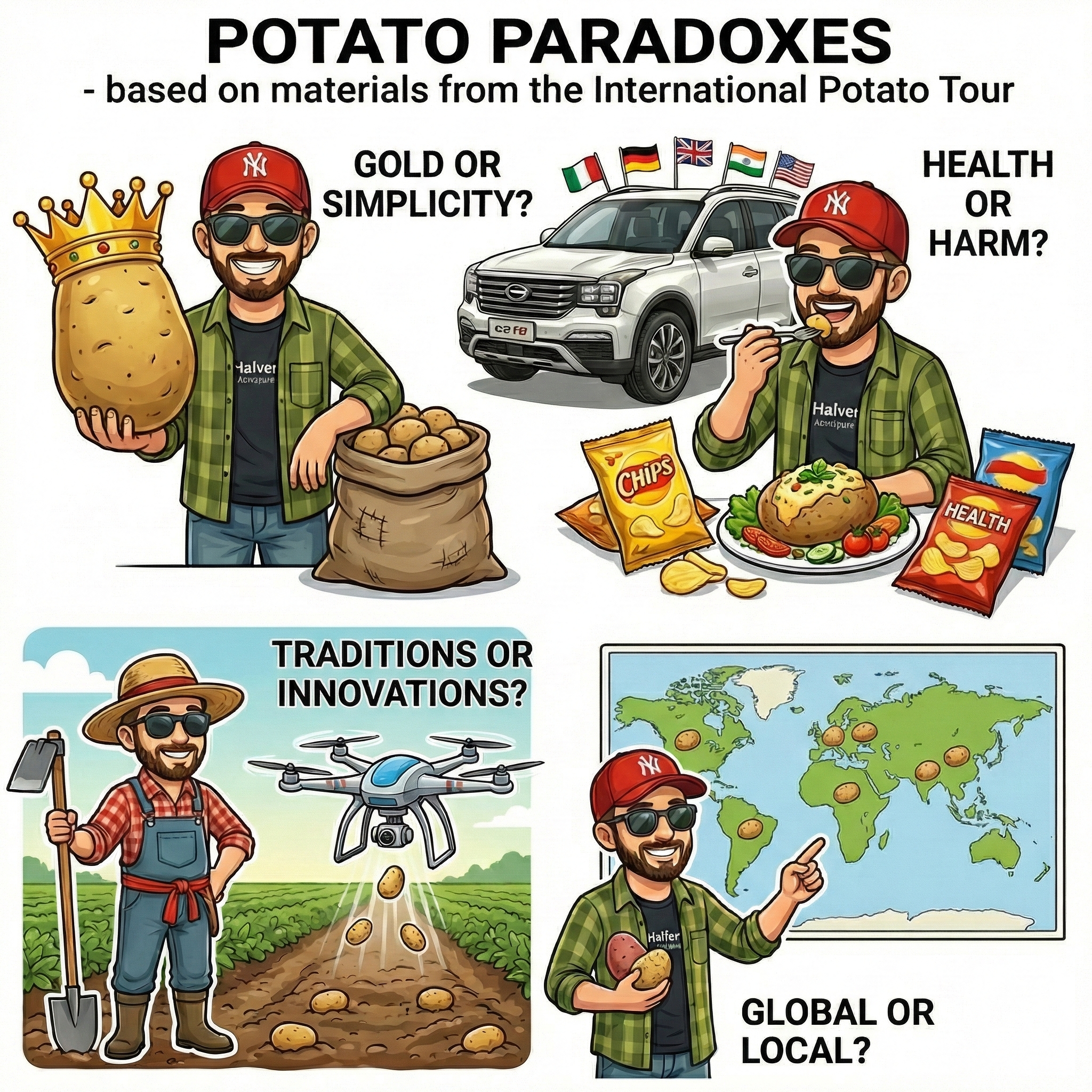
Potatoes remain one of the most universal and strategically important crops in the global agri-food system. Grown on every continent, they play a key role in food security while also serving as raw material for high-tech processing industries. Yet today, few crops illustrate the internal contradictions of agricultural development as clearly as potatoes.
This article is based on observations, interviews, and analysis collected during the International Potato Tour, organized by the international industry platform Potatoes.News.
Paradox 1. Production growth does not equal income growth
Global potato output continues to increase, supported by improved varieties, irrigation systems, mechanization, and precision farming tools. However, in many regions farmers are facing declining margins. Rising costs for seed, crop protection, energy, and logistics often outpace price growth. Potatoes are becoming more technological—but not necessarily more profitable.
Paradox 2. Advanced technology vs. outdated management
Across the tour, we see state-of-the-art storage facilities, automated processing lines, and digital field monitoring systems. At the same time, many management decisions are still based on intuition rather than data and long-term planning. As a result, the full potential of modern technology is frequently underused.
Paradox 3. Processing boom and unstable raw material supply
Demand for French fries, flakes, granules, and other potato products is rising worldwide. Investment in processing capacity is accelerating, yet processors increasingly struggle with inconsistent raw material quality and volumes. Contract farming is developing slowly, and alignment between growers and processors remains a challenge.
Paradox 4. Global markets and local vulnerability
Potatoes are now firmly embedded in global trade—covering seed, fresh consumption, and processed products. While this opens new market opportunities, it also increases exposure to global price volatility, logistics disruptions, and trade restrictions. Globalization expands access but often reduces resilience at the local level.
Paradox 5. A “simple” product with high complexity
For consumers, potatoes remain a basic, affordable food. For industry professionals, they represent a highly complex system involving breeding, phytosanitary risks, storage management, processing technology, energy use, and finance. The simpler the product appears on the shelf, the more complex the journey behind it.
Paradox 6. The generational shift
A new generation of producers—often referred to as “Potato Growers 2.0”—is entering the industry. They bring a stronger focus on data, branding, market orientation, and international experience. At the same time, they often operate within structures built on older models. This generational gap is less a conflict than a powerful driver of transformation.
Conclusion
Today’s potato industry reflects the broader dynamics of global agriculture. Growth and stagnation, innovation and conservatism, local realities and global forces coexist side by side. Understanding these paradoxes is essential for identifying new development models, improving resilience, and building effective cooperation.
Listen to the full podcast episode on Spotify:
https://open.spotify.com/episode/1NH9SdmBeJ8l8AdEu9ruAX?si=YMsHnPyaQpe-gacOPomYHQ
The International Potato Tour demonstrates that the future of the industry does not lie in a single solution, but in dialogue—between generations, countries, growers, processors, and markets. This dialogue is becoming the most valuable resource for sustainable growth.