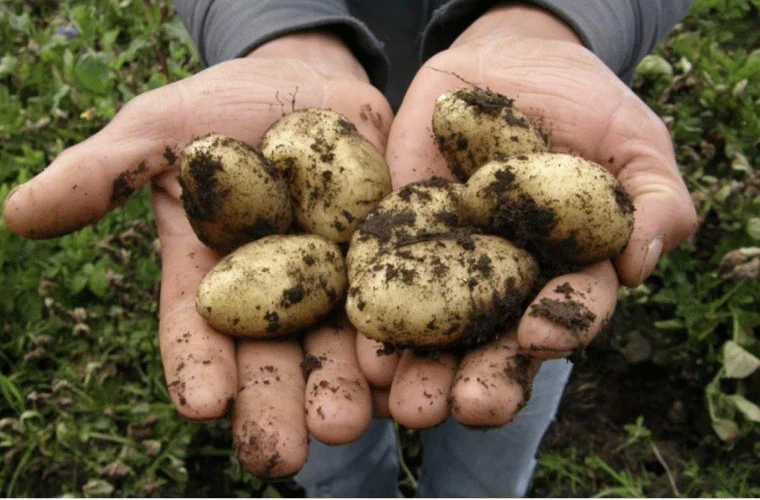
A seemingly simple product—a bag of washed ‘Gala’ potatoes—has achieved a significant first in Eurasian agriculture. Grown by the Belarusian company Agrocenter Sula, the “Babina Leta” brand has become the first crop product, and the first from Belarus, to receive the Russian “Leaf of Life” (Listok Zhizni) Type I ecolabel. This certification, verified by the independent “Ecological Union,” is not a simple “green” claim. It is awarded based on compliance with the rigorous national standard STO-56171713-008-2021, which encompasses 27 mandatory criteria assessing the entire product lifecycle from seed to packaging. This development highlights a growing consumer and institutional demand for verified, rather than self-declared, environmental claims in the food sector, a trend supported by the International Organization for Standardization’s (ISO) emphasis on life cycle assessment (LCA) as the foundation for credible ecolabelling (ISO 14024).
The technical requirements of the standard present a stark departure from conventional intensive farming. Key prohibitions include the use of synthetic pesticides and growth regulators, while the application of mineral fertilizers is strictly limited. Agronomic practices must pivot to biological and mechanical plant protection, such as biopreparations and trapping systems. Furthermore, the certification mandates strict spatial zoning: fields must be isolated from major roads, industrial sites, and other agricultural complexes to mitigate contamination. Regular monitoring of soil and finished product for hazardous substances, alongside certified waste and wastewater management protocols, completes a holistic framework for environmental stewardship. Critically, the standard also governs marketing claims, ensuring all on-pack environmental statements are verified, preventing “greenwashing.” This aligns with global movements, such as the EU’s ongoing efforts to combat unfair commercial practices with vague environmental claims.
The certification of Agrocenter Sula’s potatoes represents more than a market niche; it is a pilot project for the future of sustainable crop production in the region. It demonstrates that achieving internationally recognized eco-certification is technically feasible within post-Soviet agricultural systems but requires a fundamental re-engineering of agronomic practices, supply chain logistics, and verification protocols. The primary challenge for scalability will be economic: can the premium price commanded by such a meticulously certified product cover the significant costs of transition, ongoing compliance, and auditing, while remaining competitive? For farmers and agronomists, this case study offers a concrete blueprint. It shows that future competitiveness may increasingly depend on the ability to integrate verifiable environmental metrics—from input restriction and biodiversity protection to supply chain transparency—into core production models, moving sustainability from a marketing afterthought to a foundational operational principle.