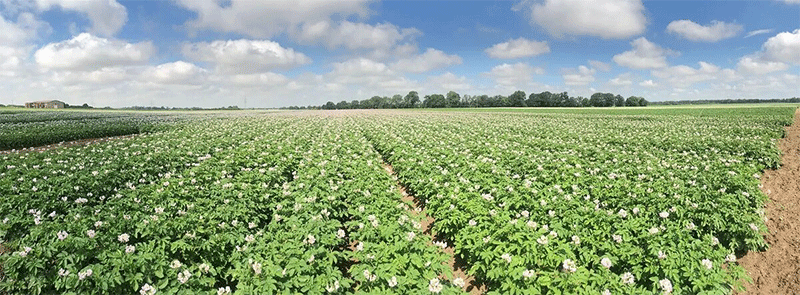
The landscape of Sand Mountain in DeKalb County, Alabama, tells a familiar story in American agriculture: the shift from diverse, small-scale specialty crops to consolidated commodity farming. Where potato fields once thrived, other crops now dominate. Farmer Spencer Hall, who learned the trade from his father, recalls the vibrant community that surrounded potato farming, where growers shared knowledge and supported a common goal. The growing cycle was brisk—seed potatoes ordered in late February, planted by early April, and harvested by July. However, this very efficiency became a liability. The intense, short harvest window made securing reliable, seasonal labor notoriously difficult, a factor that ultimately drove Hall and many of his neighbors to abandon potato cultivation for less labor-intensive crops like cotton.
The challenges faced by Sand Mountain’s potato farmers are not unique. Across the U.S., the production of fresh-market potatoes has declined in many traditional growing areas due to similar pressures. According to the USDA, the national average yield for potatoes has steadily increased due to technological advances, but this masks a significant consolidation of production. While states like Idaho and Washington dominate, many eastern and southern regions have seen a contraction. A primary driver is labor availability and cost. The American Farm Bureau Federation consistently cites labor as a top concern, with the H-2A temporary agricultural visa program becoming increasingly expensive and bureaucratic, making short-duration crops financially risky. Furthermore, competition from large-scale potato operations in the West, which benefit from economies of scale and advanced irrigation, has made it harder for smaller regions like Sand Mountain to compete in the wholesale market.
The transition away from potatoes on Sand Mountain was a rational economic decision made by farmers responding to real-world constraints. The story underscores that the survival of regional specialty crops depends not only on agronomic suitability but also on overcoming structural hurdles. For areas wishing to revitalize such heritage crops, the path forward likely involves a multi-faceted approach: developing new, high-value market niches (e.g., direct-to-consumer or specialty varieties), investing in labor-saving mechanization for harvest, and fostering local food systems that value regional identity and superior flavor over sheer volume. The passion farmers like Spencer Hall still hold for potatoes is a powerful asset; coupling that passion with innovative business and labor strategies could be the key to writing a new chapter for this lost crop.