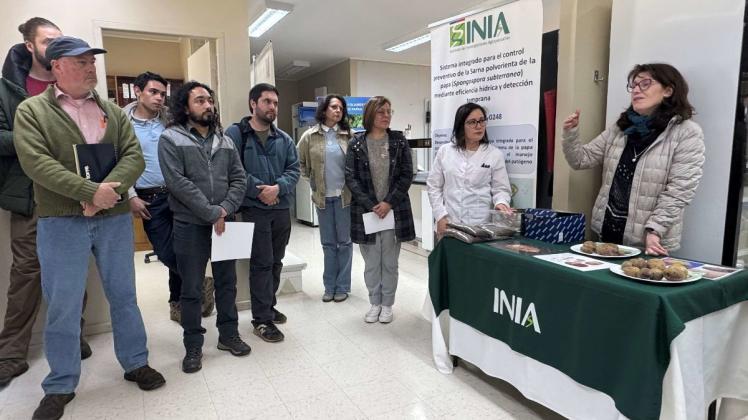
A sector-wide workshop fully dedicated to potato “powdery scab” (Spongospora subterranea)—a disease increasingly affecting yield and tuber quality in Chile’s southern regions—was held in Remehue (Chile). The event brought together researchers, phytopathologists, consultants, and growers for rapid knowledge sharing and practical risk-management training for both field and storage.
The workshop was organized by Chile’s Agricultural Research Institute (INIA) with support from the Agricultural Innovation Fund (FIA), Pontifical Catholic University of Chile (PUC), and the Agricultural and Livestock Service (SAG). The plenary session took place in the Puyehue hall, followed by hands-on work in INIA Remehue’s laboratories, where participants learned soil and tuber sampling and processing methods for accurate pathogen diagnostics.
The program featured four key talks:
- Stephanie Riquelme (PUC-Chile) presented current molecular diagnostics for Spongospora subterranea and protocols for early detection.
- Mónica Gutiérrez (SAG) reviewed pathogen prevalence in the country’s southern zone and approaches to optimizing soil surveillance.
- Ivette Acuña (INIA Remehue) focused on integrated control strategies: sanitation of machinery and containers, crop rotations with nematode-resistant species, water and drainage management, and proper selection and treatment of seed potatoes.
- Camila Sandoval (INIA Remehue) explained the “soil → roots → stolons → tuber” disease pathway and highlighted the most effective intervention points.
INIA Remehue regional director Manuel Muñoz emphasized that continuous technical exchange platforms are essential to strengthen Chile’s potato sector against soil-borne pathogens and to enhance producers’ competitiveness. Participants noted the workshop’s practical value: updated diagnostic protocols, farm checklists, and closer coordination among science, regulatory oversight, and industry.
Prepared based on ARGENPAPA’s publication: https://argenpapa.com.ar/noticia/16646-