The Indian potato sector, vital for both domestic consumption and the growing processing industry, is at a crossroads. Chronic labor scarcity, particularly during critical planting and harvesting windows, threatens both yield and quality. For Agristo, a major processor, this presented a direct threat to its supply chain. In response, the company has launched a transformative mechanization initiative in Western Uttar Pradesh, demonstrating that the solution lies not just in powerful machinery, but in a fundamental rethinking of agronomic practices. The project directly addresses a stark reality highlighted by the National Bank for Agriculture and Rural Development (NABARD): rising rural wages and a shrinking agricultural workforce are making labor-intensive crops like potatoes economically unsustainable for large-scale operations.
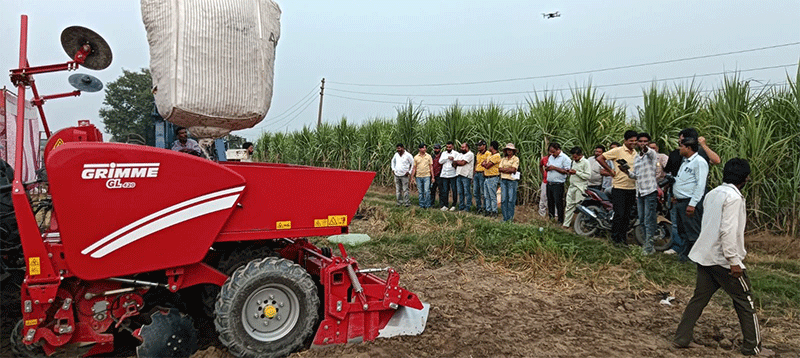
The core innovation of Agristo’s “Guided Farming” program is its radical simplification of tillage. While farmers traditionally performed 10-20 field passes to prepare fine seedbeds, Agristo’s model proves that only three are necessary: stubble cutting, subsoiling, and a combined pass with a front-mounted Deep-hiller and rear-mounted four-row planter. This integrated approach, using imported 260 HP New Holland tractors and precision planters from Germany and the Netherlands, slashes planting time from 5-6 hours per hectare to just 1.5-2 hours—a 300% efficiency gain. This speed is critical, as the optimal planting window in India’s Rabi season is a narrow four weeks in October. Delays directly impact yield potential, a risk exacerbated by climate change-induced weather variability. Furthermore, the mandatory 75 cm row spacing ensures uniformity, which is paramount for the automated AVR 2R bulk harvesters to function effectively, minimizing soil clod contamination—a major quality and efficiency hurdle in mechanized harvesting.
Agristo’s project is more than an equipment upgrade; it is a blueprint for the modernization of Indian potato farming. By proving that a “less is more” approach to tillage—coupled with high-horsepower, precision equipment—can simultaneously overcome labor constraints, adhere to critical timelines, and improve tuber quality, the initiative offers a replicable model. The success in Hapur and Amroha districts demonstrates that the future of competitive potato production in India lies in strategic mechanization integrated with disciplined agronomy. This not only secures the supply chain for processors but, crucially, enhances profitability and resilience for farmers, paving the way for a more sustainable and productive sector.