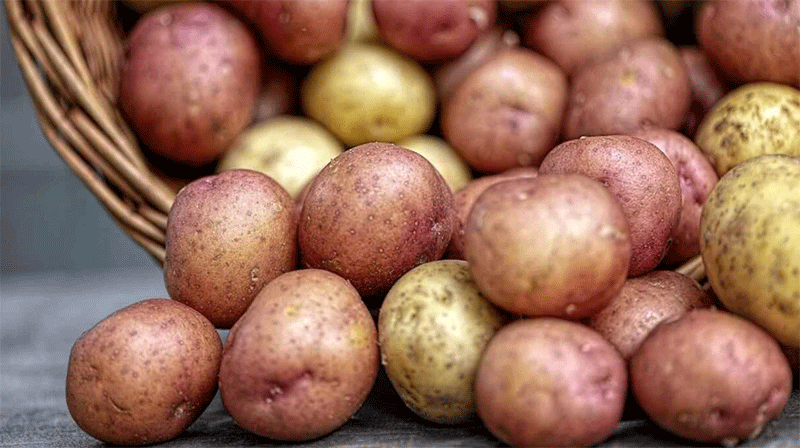
The potato’s dominance in Central European fields and diets can feel like a historical constant, but its path to prominence was complex and slow. A joint culinary research project by the Polish Institute Düsseldorf and Warsaw’s Wilanów Museum, titled “From Queen Marysieńka’s Garland to Potato Salad,” is meticulously mapping this journey. The project highlights that after its arrival from the Andes in the 16th century, the potato (Solanum tuberosum) was initially met with skepticism and was grown primarily as a botanical novelty in royal gardens. Its transition to a field crop and dietary staple was a centuries-long process, heavily promoted during the Enlightenment as a solution to famine and food insecurity. This historical pivot underscores a critical lesson for agricultural development: the introduction of a new crop requires not just agronomic suitability but also sustained educational and institutional promotion to overcome cultural barriers.
The project’s research into 19th and early 20th-century cookbooks, a key focus of the upcoming symposium, reveals the culinary innovation that cemented the potato’s place. These texts document its versatile application, from simple, sustaining dishes for the working class to sophisticated creations for aristocratic tables. This mirrors a broader European trend. According to data from the Food and Agriculture Organization (FAO), the potato’s cultivation in Europe expanded exponentially in the 19th century, becoming a primary calorie source for a growing population and playing a role in the agricultural revolutions of the era. The project also investigates the “pre-potato era” and “forgotten biodiversity,” reminding us that the adoption of this single, high-yielding crop came at the cost of other, perhaps more diverse, local food systems.
Modern Implications: Lessons from a Success Story
For today’s farmers, agronomists, and scientists, this historical deep dive is more than academic. It illustrates the complete lifecycle of a successful introduced crop:
- Introduction and Skepticism: The initial phase where a novel crop is assessed for its agronomic potential and safety.
- Institutional Promotion: A critical period, often driven by governments or influential figures (like the Habsburg court or Enlightenment thinkers), to encourage cultivation and consumption as a matter of public good.
- Culinary Integration: The grassroots and cookbook-driven phase where the crop is fully adopted into the national cuisine, creating an unbreakable demand loop that drives continuous agricultural production.
Furthermore, the mention of the Mennonite community’s role in Central Poland points to the importance of specific cultural or religious groups as early adopters and innovators in agricultural techniques, a pattern seen globally. The project’s findings reinforce that the success of any crop is a triad of agronomic potential, effective policy/promotion, and cultural acceptance.
The research by the Polish Institute and Wilanów Museum does more than celebrate a beloved vegetable; it provides a historical case study in agricultural transformation. The potato’s 500-year journey to the heart of Central European cuisine demonstrates that lasting agricultural change is a marathon, not a sprint, built on the pillars of science, policy, and culture. As the sector seeks to introduce new climate-resilient crops or revive forgotten varieties, the story of the potato offers a powerful blueprint: to truly succeed, a crop must ultimately be woven into the very fabric of what a community considers food.