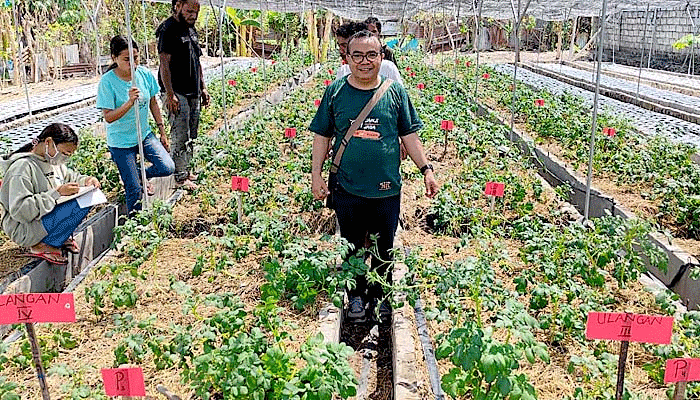
Conventional agronomic wisdom has long confined commercial potato (Solanum tuberosum L.) production to high-altitude regions (800-1,800 meters above sea level) where cool temperatures between 15°C and 18°C promote optimal tuberization. However, groundbreaking research led by Dr. Laurensius Lehar from Politani Kupang is challenging this paradigm. His team is conducting a field trial in Kupang, East Nusa Tenggara (NTT), Indonesia, cultivating the ‘Lembang’ G2 variety at a mere 70 meters above sea level, a locale characterized by a hot, dry tropical climate.
This research, hosted at the P4S Abdi Laboratus farmer field school, represents a significant shift in potato production strategy. The selection of the ‘Lembang’ G2 (Generation 2) seed is strategic. Certified, high-generation seed has inherently lower viral loads and greater physiological vigor, which is critical for withstanding abiotic stresses like higher soil temperatures and water scarcity. The research employs a suite of adaptive technologies, including:
- Liquid organic fertilizers based on local microorganisms to enhance soil health and nutrient availability.
- Water-efficient irrigation systems to optimize limited water resources in the arid lowlands.
- Pre-planting seed treatments to bolster the seed’s resilience before it even enters the stressful environment.
The potential impact of success is substantial. The FAO has consistently highlighted that diversification and climate-resilient cropping systems are essential for global food security. If potatoes can be reliably grown in lowland tropics, it opens vast new areas for production, reducing pressure on highland ecosystems and shortening supply chains. For a country like Indonesia, which has historically faced challenges in domestic potato production, this could significantly reduce import dependency. The World Potato Congress notes that innovations in heat-tolerant varieties and adaptive agronomy are key to meeting future food demand in a warming climate.
Early observations from the trial are promising. Dr. Lehar reports strong vegetative growth, high emergence rates, and positive plant response to the applied agronomic treatments. While final yield data is pending, this initial vigor suggests the plants are successfully acclimating. This aligns with global research efforts focused on developing heat-tolerant potato varieties. International research institutions, such as the International Potato Center (CIP), have been breeding for tolerance to abiotic stresses, and this on-the-ground trial in Indonesia provides valuable real-world validation of such efforts.
The Kupang lowland potato trial is more than a local experiment; it is a critical test case for the global potato industry in an era of climate change. By demonstrating that—with the right combination of high-quality seed, precise agronomy, and water management—potatoes can potentially thrive outside their traditional confines, this research paves the way for a significant expansion of potato cultivation. Success could revolutionize agricultural practices in tropical nations, creating new economic opportunities for lowland farmers and bolstering national food sovereignty. It underscores the vital role of adaptive research and localized solutions in building resilient and inclusive agricultural systems for the future.