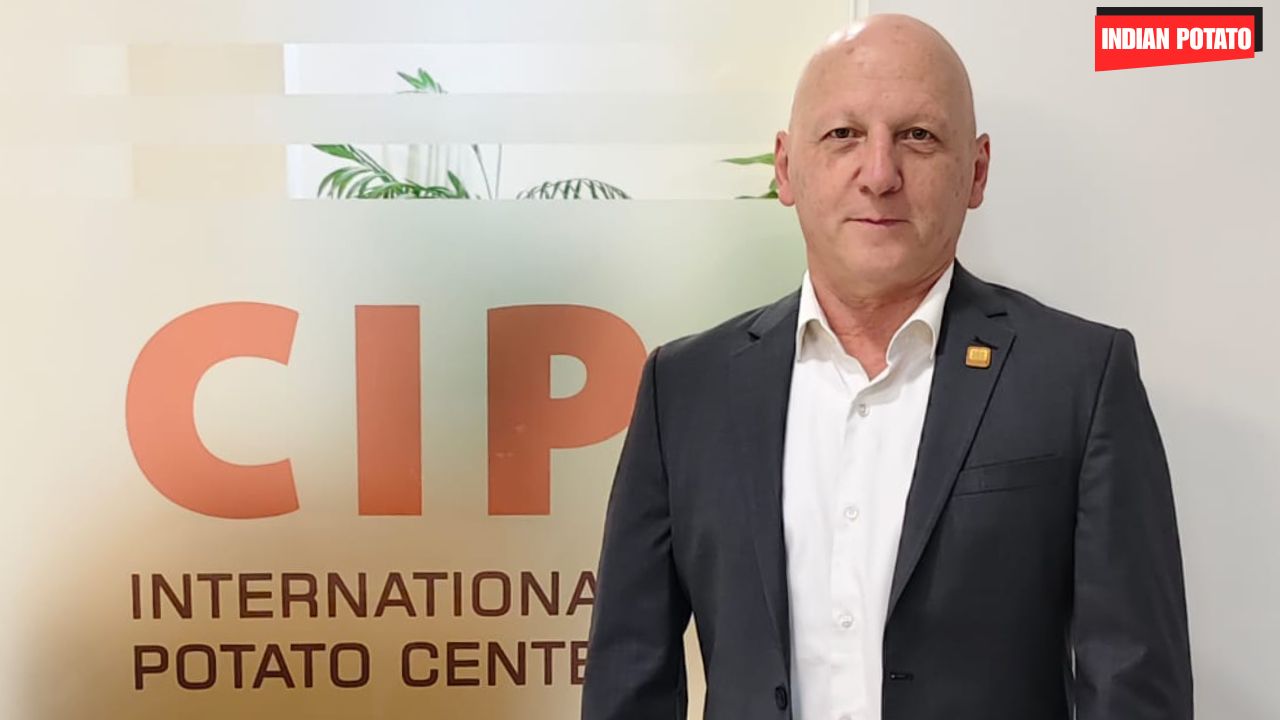
From an exclusive interview of Mr Simon Heck taken by Devendra K from IndianPotato.com
As the Director General of the International Potato Centre (CIP), Simon Heck is currently on a tour to India where he is sharing his insightful views on the potato industry. His perspective, shaped by frequent visits to India over the last ten years and a deep understanding of global agricultural trends, highlights CIP’s commitment to fostering a sustainable and innovative potato sector in the country.
A 50-Year Partnership and a New Beginning
CIP, the largest international organization dedicated to potato research, was founded in Peru in 1971. Only four years later, in 1975, CIP began its operations in India, entering into a research collaboration agreement with ICAR. This year marks the 50th anniversary of CIP’s presence in India, a milestone that Heck views as a testimony to the importance of both the potato in India and India’s role in the global potato economy. Early on, India was recognized as a future growth area for potatoes. While there have been successes in developing new varieties, Heck believes that much more progress is needed to realize the sector’s full potential.
This renewed focus on India is a direct response to a significant global shift in potato consumption and production. According to Heck, 58% of the world’s potatoes are now grown and consumed in Asia. This is a dramatic change from 1975, when consumption was primarily concentrated in Europe and North America. In those traditional hubs, per capita consumption is now declining, but the opposite is happening in Asia, including India, where consumption is increasing. Recognizing the future prospects of the potato industry, the Government of India invited CIP to establish a new research center.
Heck recently signed a 10-year partnership agreement with the Government of India through the Ministry of Agriculture and Farmers Welfare. This agreement will serve as a foundation for expanded collaboration between CIP, the Indian government, and a wide range of stakeholders, including research institutions like ICAR’s Central Potato Research Institute, agricultural universities, farmer associations, and private sector investors. The new research center will be strategically located outside Agra, Uttar Pradesh, a major potato production zone, and will be connected to research facilities throughout the country.

Priorities for the New Research Centre: Enhancing Productivity and Seed Systems
Heck emphasized that the primary priorities for the new centre revolve around enhancing potato productivity and improving the seed system. While India is the world’s second-largest potato producer, its growth has been driven mainly by expanding the area under cultivation, not by an increase in productivity per land or water input. With land and water becoming less available, Heck stressed that increasing productivity through science and innovation is crucial for long-term sustainability.
CIP aims to improve productivity by developing better varieties that are adapted to changing conditions and market demands. The organization also seeks to enhance the seed system to ensure that farmers have access to high-quality, affordable seed potatoes. The new centre will address the immediate need for high-quality seed potatoes by introducing new technologies and providing advanced training for technical staff from private companies and research institutes. This also involves policy development and oversight to increase investor confidence in a well-regulated sector. Initial field activities are scheduled to begin in October 2025.
Climate Resilience, Genetic Resources, and Regional Adaptations
Heck confirmed that CIP considers adaptation to climate change a primary breeding objective. The organization has developed drought-tolerant varieties that have faster growth cycles, a strategy to mitigate some climate change-related risks. These varieties can also be planted within an extended window, allowing farmers to adapt to a later onset of rains.
CIP, which holds the world’s largest collection of potato genetic resources, aims to intensify the exchange of germplasm with Indian institutions. This will provide Indian scientists with access to traits that have shown greater resilience to climate change, thereby accelerating their local breeding efforts and reducing the time it takes to develop new varieties. Heck noted that the breeding cycle for a new potato variety, which used to take eight to nine years, has already been reduced by half. The goal is to further accelerate this process as climate change picks up pace.
Heck also addressed the unique challenges faced by farmers in eastern and northeastern India. He explained that these mountainous regions share similarities with the potato’s origin in the Andes and require varieties adapted to altitude and specific ecological features. CIP plans to step up its work in these areas by linking farmers with their counterparts in other highland regions globally to share knowledge on soil management and to address issues like potato wart using diagnostic tools.

Beyond Productivity: Nutrition and Post-Harvest Management
Heck highlighted CIP’s work on enhancing the nutritional value of potatoes, particularly through biofortification. Using conventional breeding, CIP has successfully enriched potatoes with iron. In Peru, CIP has released two high-iron potato varieties that have been medically proven to significantly reduce iron deficiency in women and children. Germplasm of these varieties has been shared with India for local adaptation. CIP has also had success with sweet potatoes, introducing vitamin A-enriched orange-flesh sweet potato varieties in several Indian states.
Regarding post-harvest management, Heck acknowledged that potatoes are a perishable crop, but he sees this as a significant business opportunity. He stressed the need for adaptable technologies and broader market management. He emphasized that varieties with better storability and consistent production techniques are essential to reducing losses and waste, even before harvest.
A Long-Term Outlook for India’s Agricultural Future
Looking ahead 10 years, Heck shared an optimistic vision for India. He predicted an increase in sweet potato production, driven by new production systems like contract farming and a growing processing industry. He believes that sweet potatoes will become an increasingly important industrial ingredient due to their affordability, climate resilience, and low water and input requirements.
For potatoes, Heck foresees a greater diversity of varieties being developed for different production areas and new uses in food processing. He also believes that the science and management of potatoes will become more effective and efficient, much like high-value vegetables such as tomatoes. Heck suggested that India may explore the responsible use of biotechnology to develop varieties that are more resilient to diseases and require fewer agrochemicals, a strategy that has been successful elsewhere in the world.
Heck concluded by stating that as India has established itself as a leading potato producer, it will also establish itself as a leading innovator and a global hub for potato and sweet potato research. He sees CIP’s role as helping to accelerate this shift, positioning India’s great scientists and institutions at the forefront of agricultural innovation.
Source: Interview of Mr Simon Heck as taken by Devendra K of Indian Potato