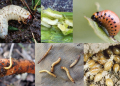
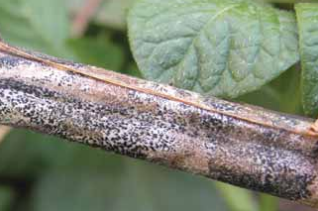
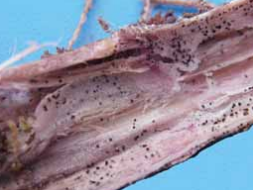
Pathogen. The black dot fungus persists as tiny sclerotia on the surface of tubers or in plant debris in the soil.
Disease development. The black dot fungus needs a wound to infect potato plants. If the fungus enters underground stems, it moves upward. If infections start in injured leaves or in stems, the disease progresses downward into the stems and into the roots.
The disease is associated with sandy soils, low nitrogen, high temperatures and poor soil drainage.
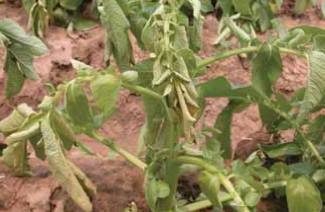
Symptoms. The top leaves in the canopy turn yellow and wilt in mid- to late summer. The symptoms progress down the stem to the middle and lower leaves. Wilt caused by black dot may be confused with Verticillium wilt. Black dot reduces yield by killing stems before the tubers size.

as dark-brown lesions that can be confused with late
blight. Lesions often develop at the base of the stems.


turn black.



areas of the tubers.


attached to the tubers.