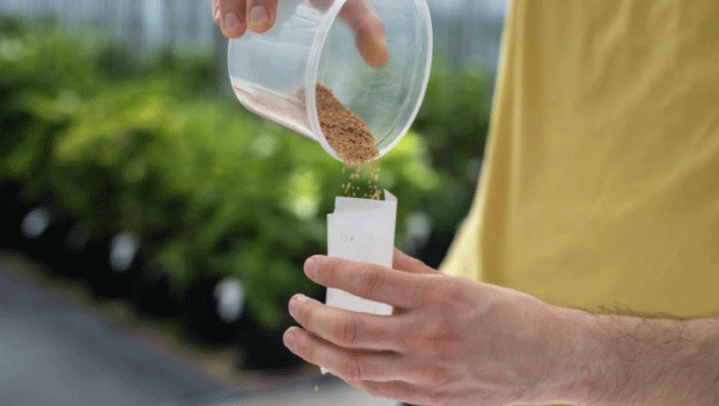
Hybrid potato breeding is poised to revolutionize the global potato value chain, moving propagation from the field to the lab. This article explores the groundbreaking genetic discovery enabling this shift and analyzes its immediate impact on food security in regions like Africa, while also considering the longer-term implications for established potato industries in Europe and North America. For professionals, understanding this technology is key to anticipating the future of varietal development, disease management, and seed systems.
The journey of hybrid potatoes began with a pivotal genetic discovery. For decades, self-pollination in potatoes was considered genetically impossible, blocking the path to efficient hybrid breeding. This changed in 1999 when Japanese scientist Hosaka published his work on a gene in a wild potato species that enabled self-pollination. Dutch breeding company HZPC successfully introgressed this gene into existing potato varieties, launching an intensive R&D program in 2011. This technique allows for the development of new varieties up to twice as fast as conventional breeding, a critical advantage in the race against evolving pathogens. While successful in crops like corn and tomatoes for decades, this marks a transformative moment for the potato, the world’s third-most important food crop.
Currently, the most significant impact of this technology is being felt in regions with underdeveloped seed systems. In Kenya, for example, only 10% of its 800,000 small-scale potato farmers have access to certified, disease-free seed tubers. This exacerbates food insecurity, especially with year-round pressure from diseases like Phytophthora infestans (late blight), where farmers often lack access to or cannot afford effective fungicides. HZPC’s hybrid varieties are being tested in Kenya without chemical protections, with one hybrid, D23HY2515, matching the yield of the largest local variety while maintaining its output under high blight pressure due to dual Phytophthora resistance. This directly addresses a core challenge; according to the International Potato Center, seed is the single most critical input for smallholder potato farmers, and losses to late blight can exceed 90% in untreated, susceptible varieties. However, HZPC clarifies that seed tubers, not True Potato Seed (TPS), will remain the most reliable planting method for the foreseeable future, as plants from botanical seed require a longer growing season to form marketable tubers.
Hybrid potato breeding represents a paradigm shift with a dual-track future. Its immediate and most profound value lies in enhancing food security in developing nations by providing access to resilient, high-quality genetics through a more logistically simple seed system. For the advanced agricultural sectors of Europe and North America, the adoption timeline is longer due to the intensive process of developing pure parental lines and the existing efficiency of high-grade seed tuber systems. However, the unparalleled speed of varietal development and the potential for stacking disease resistances make its eventual role in these markets inevitable. The industry must now prepare for a future where the agility of hybrid breeding complements the reliability of traditional seed tuber production.

