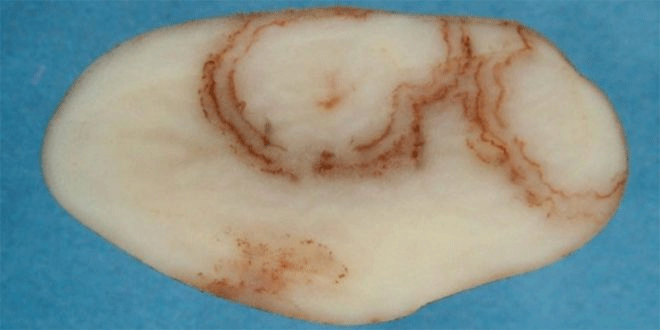
In a significant policy announcement, Ausveg, the national body for Australian potato growers, has declared a strategic shift in the national response to Potato mop-top virus. Moving away from an eradication goal deemed “not technically feasible” by biosecurity authorities, the focus is now on long-term, integrated management. This decision, formalized at a recent industry forum in Victoria, follows the confirmation of PMTV in Tasmania and the subsequent imposition of movement restrictions to the mainland states of Victoria, New South Wales, and South Australia. With Biosecurity Tasmania winding down its emergency response, the responsibility is now transitioning to industry stakeholders under a new framework designed to be woven into standard production systems.
This move towards a “consistent, science-based national approach” is not just administrative; it’s a necessity driven by the tenacity of the pathogen. PMTV, vectored by the powdery scab pathogen Spongospora subterranea, presents a formidable challenge. The virus can persist in soil for years, and its vector is notoriously difficult to control. According to a 2023 review in the journal Plant Disease, managing soil-borne viruses like PMTV requires a holistic strategy, as there are no curative treatments. Ausveg’s plan, championed by CEO Michael Coote, hinges on “uniform testing, tracing, and trade protocols” to enable safe movement of seed and ware potatoes, thereby protecting the industry’s estimated $750 million annual value. A key step will be a national meeting on November 18th to align federal and state agencies on these critical procedures.
Australia’s strategic pivot on PMTV is a lesson in pragmatic biosecurity for the global agricultural community. It acknowledges the scientific reality that some pathogens cannot be simply eliminated and must instead be managed through sophisticated, cooperative systems. For growers, this means adopting rigorous on-farm biosecurity, certified seed programs, and tolerance for new traceability protocols. For agronomists and scientists, it underscores the need for ongoing research into resistant varieties and soil health management. Ultimately, this shift from a crisis response to a sustained management plan offers the best path forward to safeguard trade, ensure business continuity, and secure the long-term viability of the Australian potato industry in the presence of an endemic disease.

