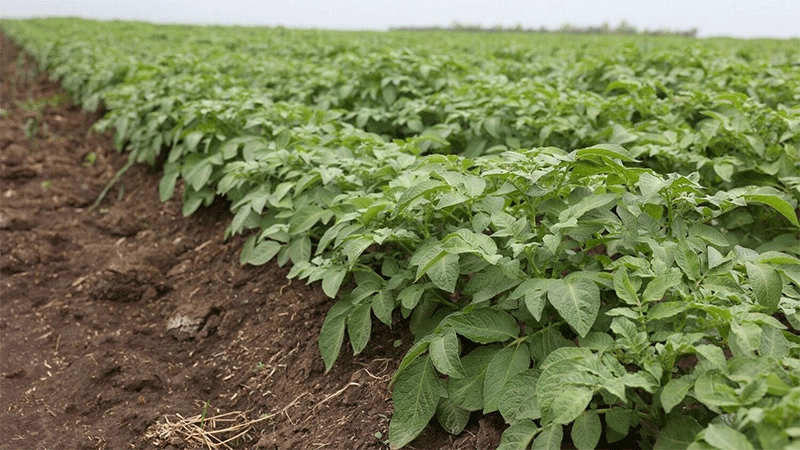
On the surface, the 2025 season looks like a resounding success for Russian agriculture. The Russian Potato Union forecasts a harvest of nearly 7.5 to 8 million tons, a significant increase from the previous year’s 7.3 million tons. However, for the farmers in the ground, this “record” harvest tells a story of financial peril and systemic failure. The situation in Rostov Oblast is a microcosm of a nationwide issue: a destructive cycle of boom and bust that jeopardizes the stability of the entire sector.
The Price Rollercoaster and Its Consequences
The core of the problem is extreme price volatility. Following a 2024 deficit of 1.3 million tons that saw retail prices soar by up to 92% and import volumes quadruple, the market has now swung in the opposite direction. As of late September 2025, wholesale prices have collapsed to an average of 12 RUB/kg, with reports of sales as low as 11-12 RUB/kg at the farm gate. For many farmers, this is far below the stated production cost of approximately 20 RUB/kg, forcing them to operate at a significant loss.
This price collapse has a direct human and operational cost. As the Potato Union itself notes, a “number of producers left the market” during the 2024/25 season due to low prices. A farmer from Kostroma Oblast, Alexander Lazutin, lamented that record yields in 2023 led to a market crash, leaving potato growers barely surviving. He highlighted a critical pain point: a 32% increase in labor costs over two years, coupled with what many describe as insufficient and inaccessible state support.
Beyond Overproduction: The Role of Quality and Imports
While overproduction is a common scapegoat, farmers in Rostov point to more nuanced factors. Nikolay Yuzefov, a local farm head, argues that the low prices are not solely due to high volumes but to poor quality. Persistent rains led to widespread scab infection, rendering a significant portion of the harvest unsuitable for storage. This diseased potato is being dumped on the market, dragging down prices for everyone.
Compounding this issue is the timing of imports. To address the spring 2025 deficit, Russia imported a record 850,000 tons of potatoes, primarily from Egypt. However, farmers allege that this imported product flooded supermarket chains precisely when domestic early harvests from regions like Rostov and Krasnodar were ready for market. This “capped” the price for local producers, preventing them from recouping their investment and creating a dependency on foreign supply that undermines domestic food sovereignty.
A Call for Better Forecasting and Infrastructure
The grievances extend to market forecasting and infrastructure. Farmers criticize the official yield data collection methods as overly simplistic and disconnected from on-the-ground realities like post-harvest losses and disease. They call for more granular, evidence-based planning that involves direct consultation with farms.
Furthermore, the lack of investment in modern storage, seed certification, and supply chain coordination is evident. Yuzefov notes that while his farm rigorously tests seeds for nematodes and viruses, many smaller farmers cannot afford to, leading to poor yields and further propagating disease. The predictable seasonal spikes in fuel prices add another layer of unpredictable cost, squeezing profitability even further.
The Russian potato market is trapped in a volatile cycle that serves neither the producer nor the consumer. The current model, characterized by reactive import policies, inadequate price support, and a lack of investment in quality infrastructure and forecasting, is unsustainable. Record harvest figures are meaningless if they bankrupt the farmers who grow them. Achieving true stability requires a strategic shift towards building a more resilient system—one that prioritizes long-term planning, robust disease management, fair market access for domestic producers, and investments that lower the real cost of production. Without these systemic changes, the specter of shortage and exorbitant consumer prices will continue to loom every few seasons.

