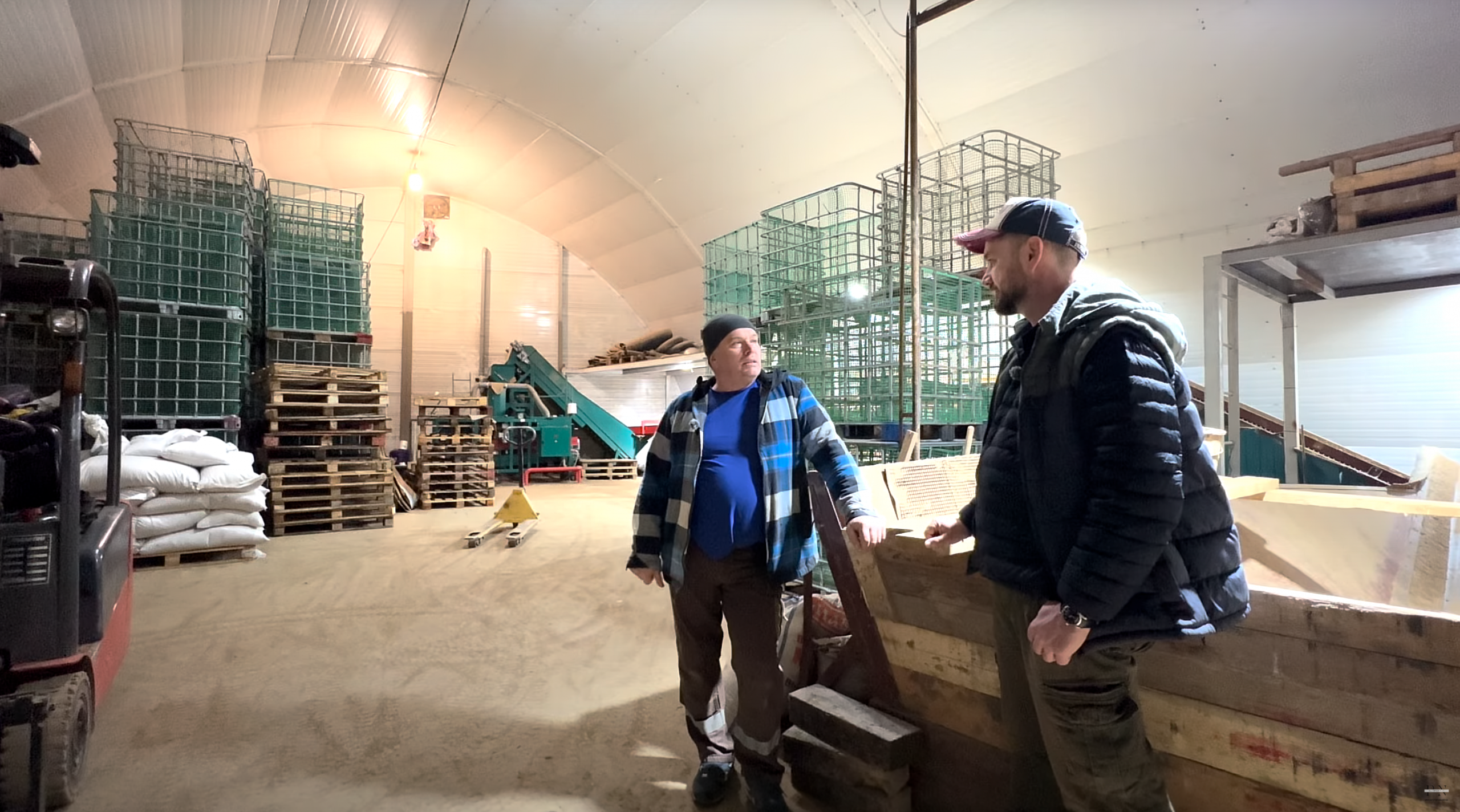
interview recorded during the “Potato Tour of Russia” (Moscow Oblast, Mozhaysk District).

This stop isn’t a giant with thousands of hectares—it’s a family farm where potatoes have been a way of life for 33 years. From a “tractor driver by calling” and a potato-growing father to an independent, debt-free operation—the journey has been built on discipline, ingenuity, and precise technical choices.
Scale & sales
- Area: ~15 ha of potatoes and 5 ha of carrots.
- Channels: local public sector (schools, kindergartens) and Moscow; the farm acts as a buffer supplier for several buyers and can hold product as long as needed.
- Infrastructure: on-farm cold storage and containerized storage.
“We agreed that we’d hold potatoes as long as partners need. I built the cold rooms for that.”
Economics: the “fat years” vs. today
The best years were 2007–2009: prices and margins let you sleep at night. Today is different: a high farm-gate price doesn’t guarantee profit without a sober calculation of full cost, including the “invisible” items—logistics, warm site cabins, meals, laundering workwear, and multiple re-handlings of bags.
“Farmers must count their own time and life as money. I lift each bag 4–5 times—that’s labor and cost.”
Land—the hard limit
In the Moscow region “every square belongs to someone”: complicated ownership, very high land prices, and few transparent ways to expand. The district ag office, the farmer says, doesn’t function as a service for producers. Bottom line: growth is possible, but access to land is the bottleneck.
Agronomy & “iron”
- High ridges (targeting the 1.40 m bed system): better moisture buffering in drought, lower risk of waterlogging/flooding, easier harvest.
- Ridge formation with a rotary tiller (spring), fertilizer incorporated into the ridge body with thorough mixing.
- Irrigation: three irrigation machines (two in regular use + one mainline unit). Drought has been systemic for 10–12 years—irrigation is essential.
- Machinery: experience with different harvesters; key units are heavily customized to local conditions.
- Phytosanitary practice: new varieties always planted on new fields (field return in 5–10 years) to suppress disease carryover.
“In last year’s drought, higher ridges would have saved even more: there was still enough moisture under the tuber.”
Container “innovation” from a scrap yard
The idea for wire-mesh potato containers came… while passing a metal-scrap yard. The mesh bins used for cans suggested the form and ventilation logic. The first generation of containers has been in use for 20+ years.
Seed & varieties
- Portfolio: incoming Mia; strong preference for Baltic Rose (wanted to buy more this year—short supply).
- Arizona is a yield rocket, but poor keeper.
- The farm tops up seed in small volumes each year, planning 1–2 years ahead.
Team & organization
Core staff is 3 people, with seasonal help on intake/sorting. The household runs two independent businesses (vegetable farming with the son and contract machinery services with the father) that backstop each other—allowing the farm to operate without loans.
For newcomers: what to start with—and what to avoid
The story “multiplied it on a calculator → bought a fleet → stalled” is common. Practical advice:
- start with 0.3 ha–3 ha,
- count everything, including the “small stuff,”
- secure 2–3 years of working cash,
- be realistic about people and land (a birch thicket means acidity, roots, and years of prep).
“You can and should farm—if you know what you’re doing. Jumping in blind is pointless.”
Fact sheet
- Years in potatoes: 33
- Area: 15 ha potatoes, 5 ha carrots
- Irrigation: 3 machines
- Storage: on-farm cold rooms, container system
- Finance: no bank loans
- Sales: Moscow and local public institutions
In their own words
“Potatoes are a way of life now. It used to be pure enthusiasm; today it’s work and arithmetic.”
“You must see every ‘penny’ of cost—otherwise that feeling of being short-changed won’t go away.”
“Give me land—I can double or triple volumes.”