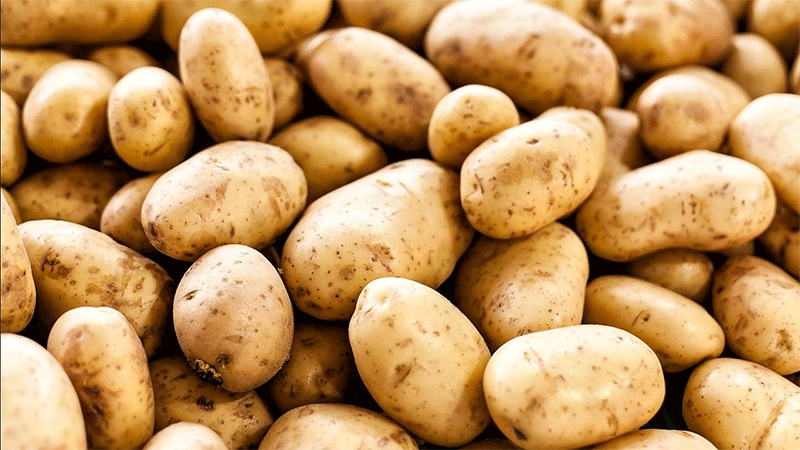
Belgium, a cornerstone of Europe’s potato industry, is experiencing a classic agricultural paradox. While farmers are harvesting one of the largest crops in the nation’s history—an estimated 4.96 million tons—the market response has been a catastrophic price collapse, with free-market potatoes fetching as little as €15 per 100kg. This situation, driven by a combination of strategic agronomic decisions and favorable growing conditions, highlights the persistent vulnerability of farmers to the boom-and-bust cycles that plague commodity production, even when operational efficiency is at its peak.
The Agronomy of a Bumper Crop
The projected harvest represents a 16% increase over 2024 and nears the all-time record of 5.08 million tons set in 2017. This remarkable output stems from two primary factors: a significant 7.3% expansion in planted area and a strong average yield of 46 tons per hectare, a 7.5% increase from the previous year. The dominance of the processing variety Fontane, which accounts for 58% of the total acreage, provided a foundation of reliable yield potential.
A critical agronomic advantage was the extended growing season. The Fontane variety was planted 20 days earlier than usual and benefited from 145 growth days—23 more than in 2023 and 5 above the five-year average. This extended period for photosynthesis and tuber bulking was a major contributor to the high yields. According to data from the European Potato Trade Association, each additional growth day during key tuberization phases can increase final yield by 0.5-1.0%. Furthermore, as noted by World Potato Markets, later-maturing varieties generally performed better, having escaped the worst of the spring and early summer drought that challenged earlier crops.
The Market Reality: A Glut with No Outlet
Despite the agronomic success, the market reality is stark. Prices have collapsed to a point where the Belgian potato growers’ association, Belgapom, could not even set a reference price due to a lack of market transactions—a rare event signaling a non-functioning market. The core issue is a fundamental imbalance: processing lines in factories are standing idle, and frigocy stores are full. This surplus is expected to maintain downward pressure on prices for months, drawing direct and worrying parallels to the price crash that followed the 2017 record harvest. The current situation underscores a harsh truth for modern farmers: maximizing production does not guarantee profitability and can, in fact, trigger a financial disaster when it outpaces demand.
The Imperative for Market-Smart Production
The Belgian potato crisis of 2025 serves as a critical case study for the global agricultural community. It demonstrates that advanced agronomy and high yields are only one part of a sustainable farming operation. The other, more challenging part is aligning production with market capacity. For farmers and farm owners, this underscores the need for risk management strategies, including forward contracting and diversification, to insulate themselves from price volatility. For agronomists and scientists, it highlights the importance of developing varieties and practices that not only maximize yield but also enhance storage quality and meet specific, value-added market niches. Ultimately, the path to resilience lies not just in growing more, but in growing smarter, with a constant eye on the market dynamics that ultimately determine success.

