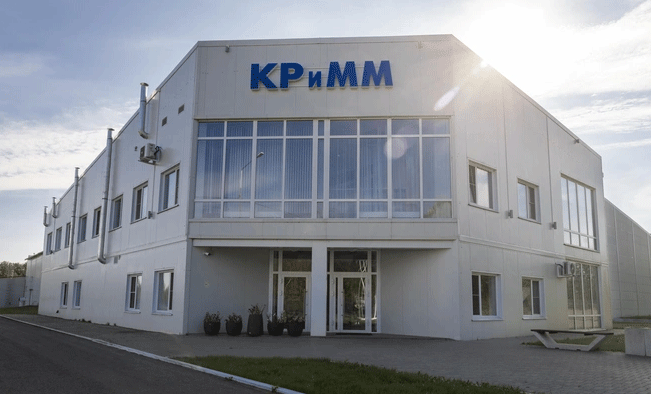
A visit to the “KRiMM” agrofirm in Tyumen reveals a multi-billion dollar operation bridging primary production with high-value processing, capturing consumer demand for convenience and showcasing the immense profitability of vertical integration in modern agriculture. This model demonstrates how adding value on-farm can future-proof a business against commodity price fluctuations.
In an era where consumer convenience is king, one Russian agribusiness is capitalizing on the trend by transforming the humble potato into a premium, ready-to-eat product. The “KRiMM” agrofirm, founded over two decades ago as a small farm, has evolved into an agricultural powerhouse with assets valued at 6.3 billion rubles. Its recent foray into deep potato processing—launching a state-of-the-art factory in 2019—exemplifies a strategic shift from commodity production to value-added manufacturing, targeting consumers who prioritize time and convenience over traditional, unwashed tubers.
The processing journey at the KRiMM plant is a marvel of agricultural engineering. A standard potato undergoes a rigorous, automated pipeline: initial sorting, washing, a second precision sorting, cutting, packaging, autoclaving (pressure cooking for sterilization), and finally, shock cooling. Within hours, the raw field crop is converted into a sterile, ready-to-heat meal, drastically extending its shelf life and market value. The facility’s design, spanning 12,000 square meters across two buildings, incorporates a strict separation between “dirty” (washing and calibration) and “clean” zones to ensure ultimate product hygiene and quality control.
The business intelligence behind this move is as impressive as the technology. The idea was conceived in 2015 at the Agritechnica fair in Hannover, Germany, where the founders identified a growing global trend toward prepared foods. By 2024, this vision has paid substantial dividends. The company reported a revenue of 3.3 billion rubles with a net profit of approximately 651 million rubles, figures that underscore the high margins achievable in value-added processing compared to selling raw commodities.
This success aligns with powerful global trends. According to a 2024 report by Research and Markets, the global processed potato market is projected to grow at a CAGR of 4.5%, driven by urbanization and rising demand for convenience foods. Furthermore, a FAO analysis on value-added agriculture confirms that vertical integration and on-farm processing significantly enhance profitability and buffer farmers against the volatile price cycles inherent in raw commodity markets.
The story of KRiMM is a compelling case study for the future of agribusiness. It moves beyond the traditional model of simply growing and selling a raw product to one of capturing maximum value within the supply chain. For farmers and agricultural engineers, it demonstrates the critical importance of observing consumer trends and investing in technology to meet them. For farm owners and scientists, it highlights that long-term resilience and profitability may depend less on incremental yield increases and more on strategic diversification into processing. KRiMM’s model—combining large-scale primary production with sophisticated, consumer-driven manufacturing—offers a replicable blueprint for achieving financial stability and growth in the 21st-century agricultural economy.

