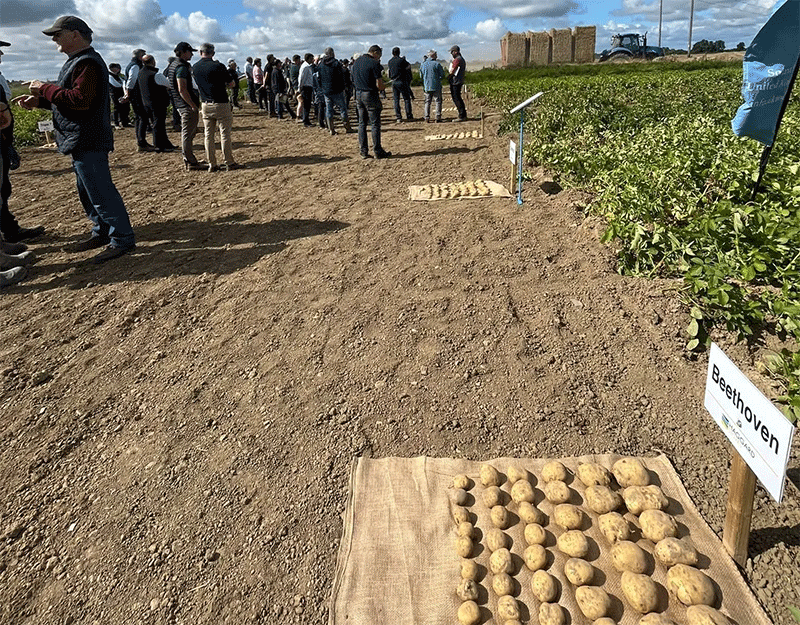
In an era of volatile input costs and increasing climate pressures, the quest for the perfect potato variety has never been more critical. Haggard Stores Ltd., a cornerstone of Ireland’s potato industry, is addressing this challenge head-on with its annual Potato Variety Day, showcasing the results of one of the country’s most comprehensive independent trial programs. Now in its third year, the initiative has expanded to evaluate over 50 varieties—32 for crisps and 20 for fresh fries—under rigorously controlled conditions. The trials are uniquely designed not just for maximum yield, but to identify genetics that can thrive with lower inputs, store better, and ultimately reduce the carbon footprint of one of Ireland’s most important crops.
A Data-Driven Approach to Sustainability and Quality
The methodology behind these trials reflects a sophisticated, forward-thinking approach to cultivar selection. A key differentiator is the deliberate use of low-nitrogen fertilization. This strategy directly addresses both economic and environmental concerns; synthetic nitrogen fertilizer is a major cost for farmers and a significant source of agricultural greenhouse gas emissions. By testing varieties under a “low nitrogen system,” the trials identify genotypes that are inherently more nutrient-efficient. This is a critical trait, as research indicates that nitrogen use efficiency in crops can vary by up to 40% between different cultivars.
Post-harvest analysis is equally rigorous. Each variety is stored at 8°C and subjected to a battery of tests for bruising, greening, sugars, and dry matter content. This focus on storage characteristics is vital for reducing waste and maintaining quality. The Food and Agriculture Organization (FAO) estimates that post-harvest losses for roots and tubers can exceed 30% in some regions. Identifying varieties with superior storage traits, such as stable sugar levels and resistance to bruising, can directly combat these losses, improving profitability for growers and processors alike. The collaboration with Tayto Snacks (Intersnack) ensures that the cooking quality metrics are directly relevant to industrial end-users.
Addressing Pressing Biotic Threats
The event’s agenda underscores its practical relevance, featuring expert discussions on two of the most damaging potato diseases: late blight and Potato Virus Y (PVY). Late blight, caused by Phytophthora infestans, remains a global threat, costing the potato industry over €10 billion annually in control measures and yield losses. With new, more aggressive strains continuously emerging, as Teagasc expert Shay Phelan will discuss, the need for genetic resistance is paramount. Similarly, PVY can cause yield reductions of 20-80% in susceptible varieties, making effective control strategies a top priority for growers.
The Value of Independent, Locally-Validated Data
The work of Haggard Stores demonstrates a powerful model for agricultural innovation. By operating independently of breeding and processing companies, they provide unbiased, locally validated data that is desperately needed by commercial growers. This shift from simply chasing yield to evaluating a holistic set of traits—including input efficiency, storage longevity, and disease resistance—represents the future of crop cultivation.
For farmers, these trials offer a risk-free opportunity to see how new varieties perform under Irish conditions before making costly planting decisions. For agronomists and scientists, they generate a rich dataset on genotype-by-environment interaction. And for the entire industry, this systematic approach to “future-proofing” the potato is an essential investment in building a more resilient, sustainable, and profitable supply chain.

