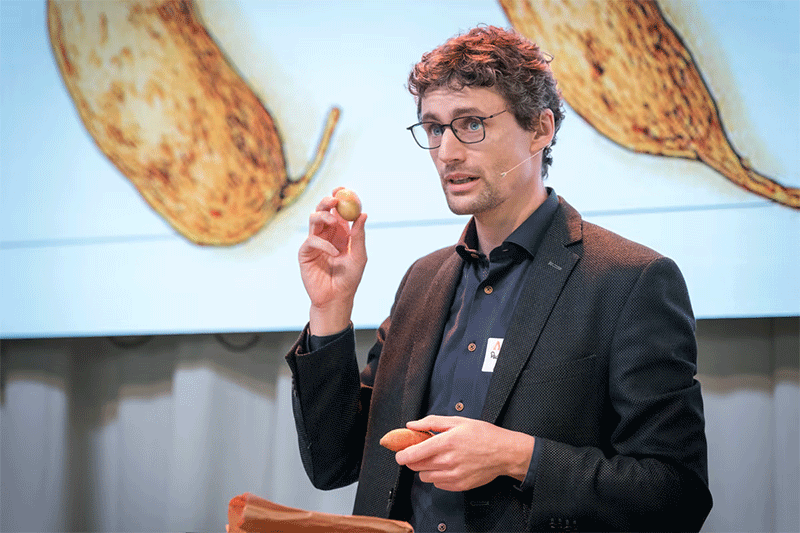
For millennia, agricultural progress has been defined by the slow, incremental domestication of wild plants. Now, a Dutch startup named Aardaia is poised to accelerate this process dramatically. The company has introduced the “aardaker,” a rediscovered tuber with a unique combination of traits that could address fundamental challenges in modern agriculture. This nitrogen-fixing, protein-rich root represents not just a new crop, but the first product of a revolutionary platform that uses genomics and predictive breeding to domesticate wild plants with unprecedented speed and precision. For farmers and scientists, this signals a potential paradigm shift from modifying existing crops to creating entirely new ones tailored to specific global needs.
The Aardaker: A Biological Powerhouse
The aardaker, historically known as the “African tuber oat” or “earth acorn,” possesses a rare and valuable set of biological characteristics. Its claimed ability to fix nitrogen could reduce synthetic fertilizer requirements, a significant advantage given that fertilizer production accounts for approximately 1.4% of global CO2 emissions. Furthermore, its reported capacity to produce five times more protein per hectare than standard crops addresses a critical gap in the global food system. While potatoes can yield over 100 tons per hectare but are low in protein, and soybeans are protein-rich but yield far less in terms of biomass, the aardaker aims to combine the best of both. Its higher dry matter content (reportedly double that of potatoes) also suggests better storability and transport efficiency, reducing post-harvest losses, which can exceed 30% for root crops in developing nations.
The “On-Demand Domestication” Platform: Speed and Precision
The true innovation lies not just in the aardaker itself, but in Aardaia’s methodology. The company employs a suite of modern technologies—genome sequencing, high-throughput phenotyping, and genomic prediction—to compress the domestication timeline from millennia to years. By moving much of the selection process “from the field to the computer,” they can identify and propagate desirable traits with far greater speed and lower cost than traditional breeding. This “on-demand” approach allows them to systematically address priorities identified by experts, such as drought tolerance, salinity resistance, and enhanced nutritional compounds. This is a stark contrast to the random, slow process of historical domestication and even to modern GMO development, which often faces significant regulatory and public acceptance hurdles.
Market Validation and Regulatory Pathway
A key to the aardaker’s potential success is its status as a forgotten crop, not a novel food. With historical evidence of its consumption in Europe prior to 1997, it bypasses the stringent regulatory pathways that can delay new GMOs for a decade or more. This provides a significant commercial advantage. Furthermore, its adoption by a two-Michelin-star restaurant, De Nieuwe Winkel, provides crucial early-market validation. The chef’s description of its flavor—a cross between potato, sweet chestnut, and cassava—points to a versatile profile suitable for high-value culinary markets, creating an initial economic incentive for growers before the crop is scaled for broader agricultural use.
A New Tool for Agricultural Resilience
The work of Aardaia represents a fundamental shift in our approach to crop development. It demonstrates that the vast repository of Earth’s 30,000 edible plant species holds untapped solutions to our most pressing agricultural challenges. For farmers, this could eventually mean access to crops that are inherently more resilient, nutritious, and less input-dependent. For agronomists and agricultural engineers, it opens a new frontier in designing cropping systems around plants with entirely new biological capabilities, like self-fertilization.
While the aardaker must still prove itself at commercial scale, the underlying platform of accelerated domestication is a powerful new tool. In an era of climate change and resource scarcity, the ability to deliberately and rapidly create crops that are tailored to specific environmental and nutritional needs may be one of the most important innovations in the future of sustainable agriculture.

