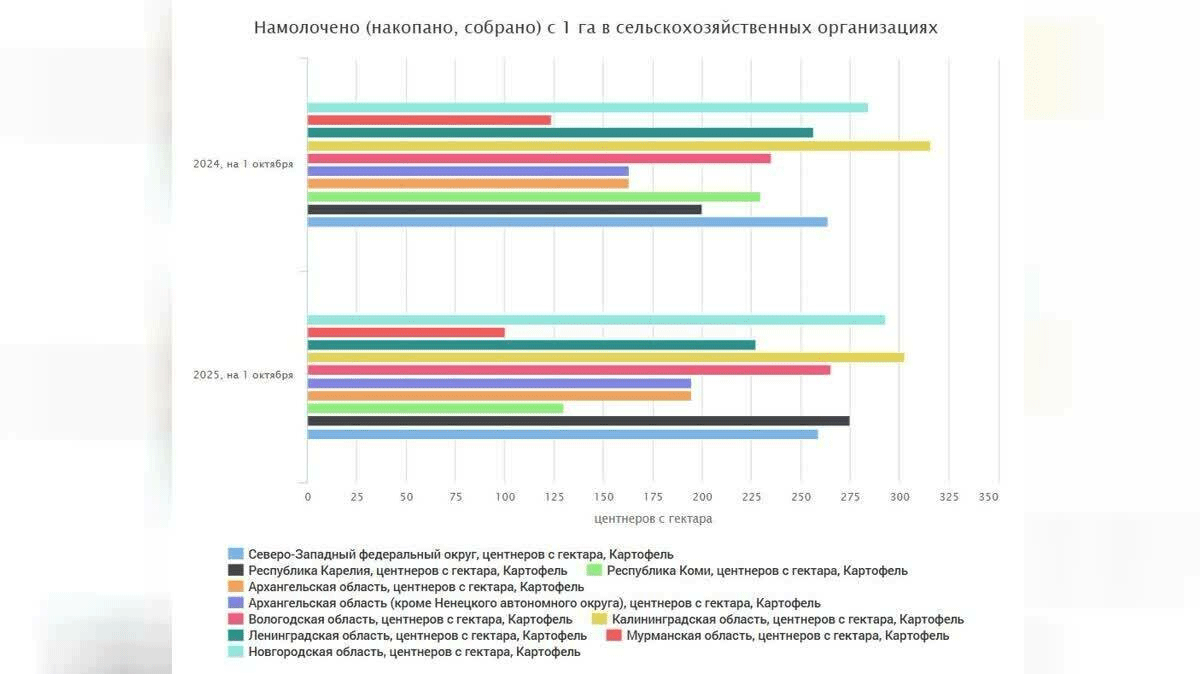
The recent data from the Unified Interdepartmental Statistical Information System (EMISS) presents a compelling narrative for the potato sector in Northwestern Russia. The standout headline is that the Kaliningrad region achieved the highest yield in the district, harvesting an average of 302.7 centners per hectare. This performance secured its leadership position despite a noticeable drop from its 2023 yield of 315.8 centners per hectare. This decline, however, must be viewed within a broader context of a challenging season across the district. Neighboring regions like Leningrad Oblast and the Komi Republic saw more severe drops, with yields falling to 237.1 centners/ha and a dramatic 129 centners/ha, respectively. This contrast highlights that while Kaliningrad experienced a downturn, its agricultural systems demonstrated significant relative resilience.
This regional analysis becomes even more insightful when viewed at the national level. While leading the Northwest, Kaliningrad’s yield of 302.7 centners/ha would place it sixth among federal districts, being outperformed by the Central (346.5 ц/га), Volga (334.9 ц/га), Southern (329.8 ц/га), Ural (301.7 ц/га – a very close margin), and North Caucasian (282.3 ц/га) districts. The fact that the Northwestern Federal District as a whole saw a decline to 259.1 centners/ha, while other districts like the Urals maintained strong performance, points to the hyper-localized nature of agricultural stressors in 2024. These could include irregular precipitation patterns, localized pest pressures, or soil moisture deficits that disproportionately affected the Northwest. According to global agronomic research, such variability is increasingly linked to climate volatility, pushing farmers to rely more heavily on adaptive strategies, including improved irrigation, precision agriculture, and resilient cultivars, to stabilize yields.
Kaliningrad’s top regional ranking is a significant achievement, but the true lesson for farmers, agronomists, and farm owners lies beneath the surface. The 2024 season underscores that success is no longer just about achieving absolute yield highs in a good year, but about building systems that minimize losses during bad ones. The stark differences between Kaliningrad and its neighbors, and between the Northwestern district and the rest of Russia, reveal that localized resilience is the new benchmark for profitability. The focus must shift from mere production to risk mitigation through advanced agronomy, smart water management, and the adoption of potato varieties capable of withstanding environmental stress. In an era of unpredictable seasons, the ability to consistently produce a respectable yield, even when conditions are suboptimal, is the hallmark of a truly modern and sustainable farming operation.

