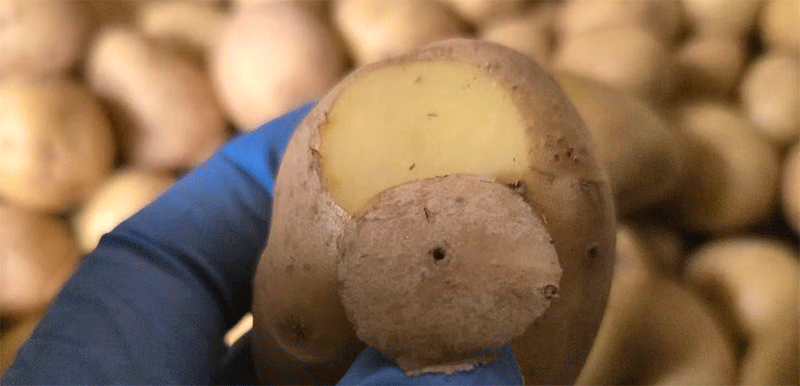
Jan Ryser, a 32-year-old farmer from Golaten in the Swiss canton of Bern, is facing a modern agricultural nightmare. Despite a successful harvest, he is unable to sell 32 tonnes of his potatoes through conventional channels. The reason is not food safety or taste, but aesthetics. His produce has been rejected by large-scale buyers due to minor blemishes, primarily pinprick holes from wireworms. Ryser states that 88% of his batch is flawless, yet the buyers enforced a strict tolerance threshold, rejecting entire loads if more than 7% show even superficial defects. “A wireworm hole just 3 millimeters deep is enough to classify the potato as faulty,” Ryser explains, “even though it is peelable and completely edible.”
This situation is exacerbated by a saturated market. In years of shortage, buyers may show flexibility, but when supply is high, standards become rigid. This creates a devastating financial imbalance. Ryser invested approximately 9,000 CHF (over $9,800 USD) in production costs for these 32 tonnes. While he could have earned around 15,000 CHF from a regular sale, his only official option now is to sell the lot to a biogas plant for a mere 4,500 CHF, turning potential food into energy at a significant loss. This reflects a broader issue; a 2023 UN FAO report estimated that 13% of the world’s food is lost between harvest and retail, often due to similar stringent cosmetic standards and market inefficiencies.
Direct Sales: A Partial Solution to a Systemic Problem
In an effort to avoid total waste, Ryser has turned to direct-to-consumer sales, offering 10 kg bags for 10 CHF from his farm and through the Facebook group “Rettet die Ernte vor dem Müll” (“Save the Harvest from the Trash”). The initiative has been met with moral support, but the scale of the solution is mismatched with the problem. After a week, he had sold only 950 kg—a small fraction of the 32-tonne mountain. This highlights the logistical limitations farmers face in bypassing the established supply chain, which offers convenience and volume that direct sales often cannot match.
Ryser’s experience points to a critical power imbalance. “Farmers have the greatest responsibility but the least power,” he laments. He criticizes agricultural associations for not adequately supporting primary producers and warns that the combination of tightening quality specifications and diminishing tools for pest control is disheartening a generation of young farmers. This sentiment is echoed in agricultural communities worldwide, where producers feel increasingly squeezed by the demands of powerful retailers.
The case of Jan Ryser is not an isolated incident but a symptom of a broken link in the agricultural value chain. It underscores an urgent need to re-evaluate cosmetic standards for produce, which contribute significantly to food loss and farmer financial distress. For the agricultural community—from farmers and engineers to scientists and owners—this story is a call to action. There is a pressing need to develop and advocate for more realistic quality grades, invest in technologies that can manage pests without cosmetic damage, and build stronger, more equitable direct-market infrastructures. Without such changes, the sustainability of farming operations, particularly for high-risk crops like potatoes, will remain in jeopardy.

