The European potato industry is undergoing a significant contraction. As Ben Bredek of 3PointPotatoes starkly observes, the entire chain is resetting, with implications for every stakeholder from seed suppliers to lessors. This reset, while challenging, presents a critical opportunity to address systemic inefficiencies, with yield and cost-price management at its core.
The central problem is clear: European competitiveness is eroding. Bredek identifies a net yield target of 50,000 kg/ha as the benchmark for viability. However, current figures from the North-Western European Potato Growers Foundation (NEPG) reveal a stark reality. The 2023 gross yield in Northern Europe averaged just 42,000 kg/ha. This 8,000 kg/ha deficit directly translates to unsustainable cost prices, squeezing profitability across the chain.
The Genetic Lever: Beyond Monoculture to Varietal Rotation
A key solution lies beneath the soil surface. Bredek highlights a critical agronomic insight: soil fatigue from varietal monoculture. Planting the same variety too frequently—even on a four-year rotation—depresses yields. The solution requires a strategic shift to a multi-variety system, with a recommended return interval of one in eight years for a single cultivar.
This approach is supported by emerging research. A 2023 study from Wageningen University & Research emphasized that diversifying genetic portfolios with robust varieties can mitigate soil-borne pathogen build-up and improve overall soil health, leading to more stable and resilient yields in the face of climate variability. This is not merely about swapping seeds; it’s about building a more robust biological system.
Confronting the Dual Challenge of Climate and Regulation
The pursuit of higher yields is set against a backdrop of two formidable, parallel pressures: climate change and tightening environmental regulations. Bredek correctly notes the dual impact of unpredictable growing seasons and the inevitable reduction in permissible nitrogen use. The European Union’s Green Deal targets a 20% reduction in fertilizer use by 2030, making nutrient efficiency paramount.
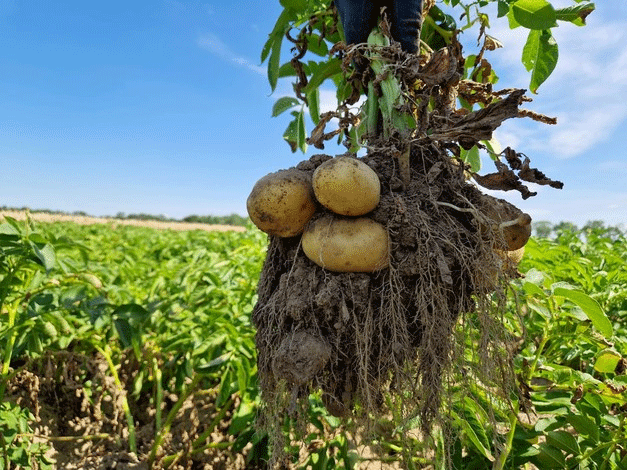
This is where new cultivation methods, focused on root development rather than excessive foliage, become a strategic advantage. These methods, while requiring “intensive cultivation guidance” as Bredek notes, align with the principles of precision agriculture. By channelling resources into the tuberization process, growers can potentially achieve better nutrient and water use efficiency, a necessity in a future of constrained inputs.
A Future Built on Efficiency and Professionalism
Despite the immediate challenges, the long-term outlook for the potato is fundamentally strong. Bredek provides a powerful macro-perspective: the potato produces the highest number of kilocalories per hectare of any major crop. Furthermore, its water-use efficiency is exceptional, using water 3.5 times more efficiently than rice—a critical advantage in an era of increasing water scarcity. According to the FAO, potatoes produce more food per unit of water than any other major crop, solidifying their role in global food security.
The current market reset is a painful but necessary correction. It forces the industry to confront its productivity gap head-on. The path forward is not simply to grow more area, but to grow smarter on existing land. This requires a holistic commitment: adopting robust varieties in sophisticated rotation systems, embracing root-centric cultivation techniques for input efficiency, and leveraging intensive agronomic guidance. The future of potato farming belongs not to the largest growers, but to the most professional and adaptable ones who can systematically bridge the yield gap to secure a profitable and sustainable place in the global food chain.

