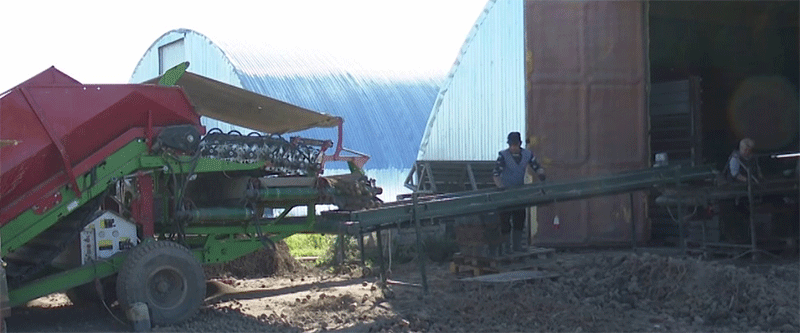
While many regions grapple with volatility, the Melelenkovsky district in Russia’s Vladimir region is consolidating its position as a potato production leader. Driven by a new generation of farmers, strategic state support, and significant private investment, the district is showcasing a model of modern, scaled agriculture. With over 1,800 hectares dedicated to the crop and yields averaging a robust 328 centners per hectare (32.8 t/ha), this region provides a compelling case study in commercial potato farming efficiency.
The success is built on several key pillars. First is the aggressive expansion and reclamation of agricultural land. Farmers like Alexander Volkov, a second-generation farm head, are bringing long-fallow land back into production. His operation alone now cultivates 200 hectares of potatoes on land that had been unused for two decades. This reflects a broader trend of land consolidation and intensification in Russian agriculture, aimed at boosting self-sufficiency.
The Financing and Technology Engine
A critical enabler of this growth is access to capital. The regional Minister of Agriculture, Oleg Pugaev, highlights the role of state-subsidized loans for peasant farms (KFKh), with floating interest rates currently around 7%. This preferential financing is pivotal for continuous technification. Farmers are relentlessly updating their machinery parks to avoid costly downtime during critical harvest periods, recognizing that investment in reliable equipment like new tractors is a necessary cost of doing business.
This focus on post-harvest infrastructure is equally vital. Volkov’s farm is constructing its seventh storage facility, a clear indicator that the business model relies on managing market supply. By using computer-controlled environments to maintain optimal temperature and humidity, they can extend their selling window and mitigate the impact of harvest-time price slumps, aiming for a higher return than the current 20 RUB/kg wholesale price.
The Human Factor and Regional Dominance
The model is not solely about machines and money. It depends on a skilled workforce, from mechanics and operators to the sorting brigades that process “dozens of tons per shift” to ensure a clean, high-quality final product. This professional approach, combined with concentrated production, has made Melelenkovsky the dominant force in the region, accounting for over 50% of the oblast’s potato area. The current 80% harvest completion rate signals a highly organized and efficient seasonal operation.
This yield of 32.8 t/ha, while strong, sits within a global context. For comparison, the average potato yield in the European Union is approximately 40 t/ha (Eurostat, 2023). This indicates that while Melelenkovsky is a domestic leader, there remains potential for further genetic and agronomic optimization to close the gap with other major producing regions.
The rise of Melelenkovsky district as a potato hub illustrates a successful, state-supported commercial farming model. The formula combines scale, facilitated by land consolidation; capital investment, supported by subsidized credit; and a sharp focus on the entire value chain, from high-yielding field practices to sophisticated post-harvest management. For agricultural professionals globally, it demonstrates that profitability in staple crop production increasingly depends on moving beyond subsistence-level thinking and embracing a fully integrated, industrial approach where investment in technology and infrastructure is non-negotiable for competitiveness.

