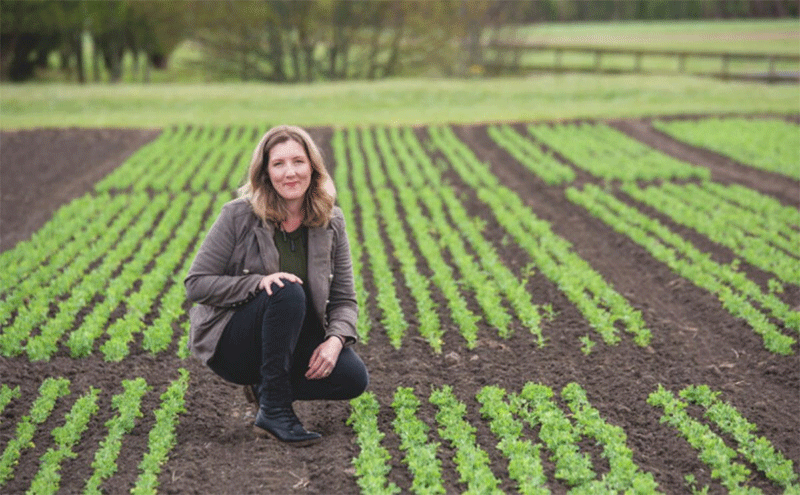
In a global French fry market projected to grow from USD 18 billion to USD 24 billion by 2030, the quest for the ideal processing potato has intensified. For decades, the industry standard has been the Russet Burbank, prized for its qualities but notoriously input-heavy. Now, New Zealand’s Plant & Food Research has introduced ‘Crop 78’, a variety that is the culmination of nearly 25 years of targeted breeding. The development was driven by a clear need for a more sustainable alternative. As Barry Cowen, Business Development Manager, notes, the project began in 2004 as a direct response to the unsustainable practice of increasing yields solely through higher nitrogen application. This aligns with growing regulatory and consumer pressure; the European Union’s “Farm to Fork” strategy, for instance, explicitly aims to reduce nutrient losses by 50% by 2030, making low-input cultivars like Crop 78 strategically vital.
The agronomic data for Crop 78 is compelling. Field trials have demonstrated a 36% higher yield compared to standard varieties, achieved with only half the typical nitrogen fertilizer. This has a dual impact: it significantly lowers the environmental footprint by reducing nitrous oxide emissions and nitrate leaching, and it directly cuts one of the largest variable costs for growers. Beyond its nutrient efficiency, Crop 78 boasts a high tuber set rate for seed multipliers, an oval shape that maximizes fry recovery, and higher dry matter content for superior fry quality and oil absorption. Furthermore, its extended dormancy—allowing it to remain in the ground longer and store for extended periods without sprouting—reduces harvest pressure and post-harvest losses, a critical factor in a recent FAO report citing that up to 25% of all potatoes grown are lost post-harvest in some regions.
Crop 78 represents a paradigm shift in potato breeding, moving beyond a narrow focus on end-product quality to encompass the entire agricultural value chain. It successfully addresses the tripartite challenge of modern agriculture: increasing productivity, enhancing profitability, and reducing environmental impact. For growers, it offers a clear path to lower input costs and higher, more stable yields. For processors, it delivers the consistent quality and storage longevity required in a competitive global market. Its commercial success in New Zealand, already capturing 11% of the domestic French fry supply, is a powerful proof-of-concept. As the global industry seeks more resilient and sustainable supply chains, Crop 78 and the science behind it set a new benchmark for what a modern processing potato can and should be.

