Based on the study conducted by researchers from Lomonosov Moscow State University, led by Dr. Natalia O. Kalinina (kalinina@belozersky.msu.ru)
Original research: Samarskaya V.O. et al., “The Temporal and Geographical Dynamics of Potato Virus Y Diversity in Russia,”
International Journal of Molecular Sciences, 2023, 24(19), 14833 – Read full text
A Brief History of PVY: From the Andes to Russian Fields
Potato virus Y (PVY) is one of the most destructive viral pathogens affecting Solanum tuberosum (potato). First identified in the early 20th century, PVY likely originated in the Andes along with domesticated potatoes. Over time, it has become a global threat, causing substantial losses in yield and quality.
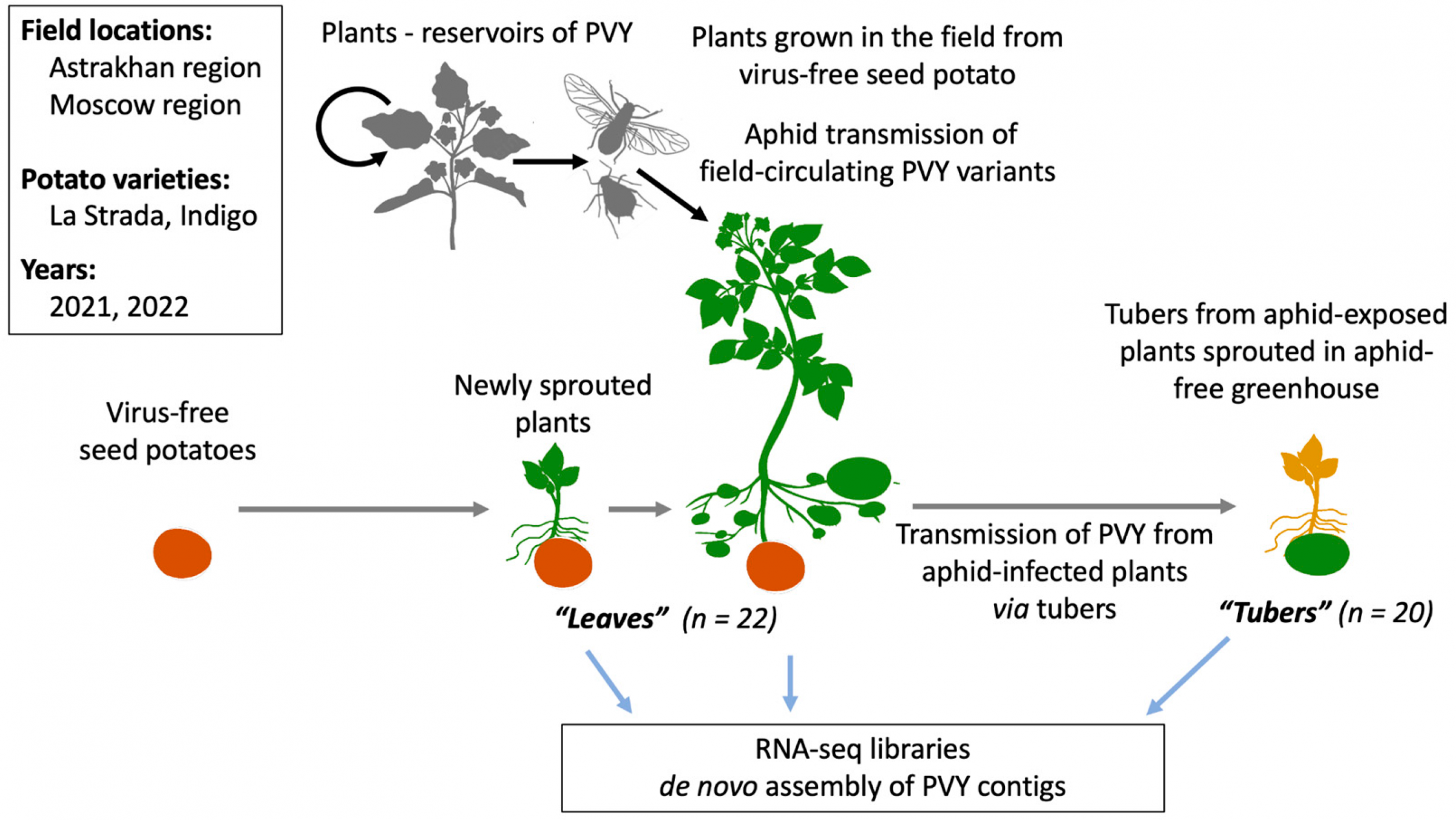
PVY spreads through two main pathways. The first is via aphids — tiny insects like Myzus persicae — which transmit the virus from plant to plant during feeding. The second is through infected seed tubers: if a tuber carries PVY, any plant that grows from it will be infected from the start. In addition, wild Solanum species and solanaceous weeds often act as natural virus reservoirs, allowing PVY to persist from season to season.
How Scientists in Russia Studied the Virus
To investigate PVY diversity in different climates, a research team from the Shemyakin–Ovchinnikov Institute of Bioorganic Chemistry and the Belozersky Institute of Physico-Chemical Biology at Lomonosov Moscow State University (MSU), led by Dr. Natalia O. Kalinina (kalinina@belozersky.msu.ru), conducted a multi-year field study in Moscow Oblast and Astrakhan Oblast. These regions differ significantly in climate: the Moscow region has cold winters and shorter growing seasons, while Astrakhan is warmer with longer seasons and milder winters.
Researchers planted virus-free seed potatoes of two commercial varieties, Indigo and La Strada, in open fields without insecticides. Natural infection by aphids was allowed to occur. Leaf samples from mature plants and sprouts from harvested tubers were collected and analyzed using high-throughput RNA sequencing (RNA-seq). This modern technique allowed researchers to reconstruct nearly 100 complete PVY genomes directly from the samples and determine which types of PVY were present in each region and sample.
Key Discoveries
1. Southern Russia Has Greater PVY Diversity
The Astrakhan region showed significantly more diverse PVY populations than the Moscow region. In total, eight recombinant PVY variants were identified: NTNa, NTNb, N:O, N-Wi, SYR-I, SYR-II, SYR-III, and 261-4.
2. No Pure PVY-O or PVY-N Types Found
All PVY genomes detected in the samples were recombinants — mosaics of the classical PVY-O and PVY-N types. No full-length genomes of the original parental strains were found. This reflects a global trend where recombinant strains are displacing classical ones due to increased fitness or adaptability.
3. Tuber Transmission Changes Virus Composition
Sprouts from infected tubers often carried different PVY variants than the leaves of the parent plants, indicating that vertical transmission via tubers can act as a genetic filter or bottleneck. This suggests that virus populations can shift between generations — an important consideration for seed potato producers.
4. Climate and Landscape Matter
Astrakhan’s warm climate and surrounding biodiversity (wild plants, fewer pesticides) likely contribute to the higher diversity of PVY in this region. In contrast, the colder and more urban Moscow region — where pest control is more frequent — showed a narrower range of PVY variants.
5. Viral Load and Diversity Not Always Linked
Although Indigo plants accumulated more PVY than La Strada, both cultivars harbored a similar number of different virus types. This means susceptibility affects how much virus a plant accumulates, but not necessarily how many different types it hosts.
Why This Matters for Farmers and Breeders
Test seed potatoes before planting: Since PVY is easily passed through tubers, clean seed is essential. Use diagnostic tools to check for PVY presence.
Breed for resistance to current strains: Focus on developing or selecting cultivars resistant to recombinant strains like NTNa, NTNb, and N-Wi — these are now more widespread than the classical types.
Control aphids and weeds: Aphids are fast vectors of PVY, and surrounding wild solanaceous plants can host the virus. Both need to be managed to reduce infection pressure.
Monitor virus evolution: As this study shows, the virus population is dynamic and can change between generations. Long-term monitoring helps in timely responses.
Final Word
This research — conducted by one of Russia’s leading plant virology teams at Lomonosov Moscow State University — highlights how climate, geography, and crop practices shape the viral landscape in agriculture. By revealing the hidden complexity of PVY populations and how they evolve, the study provides a roadmap for better virus control, healthier seed production, and more sustainable potato farming.
Full scientific article:
Samarskaya V.O. et al., The Temporal and Geographical Dynamics of Potato Virus Y Diversity in Russia. International Journal of Molecular Sciences, 2023, 24(19), 14833.
Read online: https://www.mdpi.com/1422-0067/24/19/14833
Prepared for Potatoes.News — sharing the science behind the world’s favorite crop.