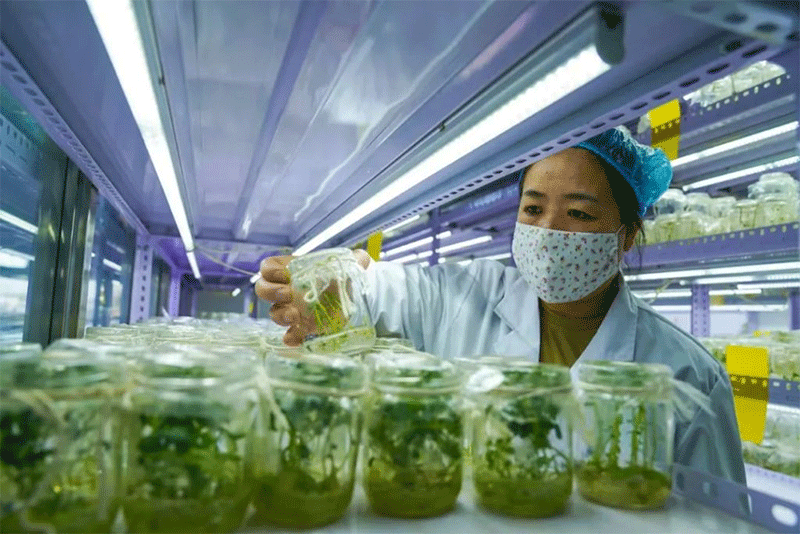
In the fertile black soils of Yakeshi City, a quiet technological revolution is transforming China’s potato industry. By combining pristine natural conditions with cutting-edge laboratory science, this northern region has become a powerhouse for virus-free seed potato production, ensuring food security and setting a new standard for agricultural innovation.
Nestled at 47°-50° North latitude in Inner Mongolia, Yakeshi City possesses ideal natural conditions for potato cultivation: abundant sunshine, fertile organic-rich soils, and significant diurnal temperature variation that promotes high dry matter accumulation. But its true advantage lies in its mastery of the “original chip”—the virus-free seed tuber. With substantial government investment and leading-edge techniques like apical meristem dissection and aeroponics, Yakeshi has built a comprehensive seed industry that serves national markets and boosts local economies, demonstrating how technology can maximize agricultural potential.
Building an Industrial Hub on Nature and Science
Yakeshi’s 2.38 million acres of farmland, predominantly rich chemozem and meadow soils, provide a natural foundation. However, strategic government support catalyzed its rise. In 2019, Yakeshi was named one of China’s top ten potato seed breeding reward counties by the Ministry of Agriculture, receiving 60 million RMB in development funds. This investment fueled the construction of the Inner Mongolia Yakeshi Potato Agricultural Technology Park, a 4 billion RMB, 3000-acre complex designed as an integrated platform for breeding, storage, logistics, and R&D. To date, 2 billion RMB has been invested, creating 11 storage warehouses (110,000-ton capacity), 33 greenhouses, and a 16,000-square-meter tissue culture R&D center.
The Science of Clean Seed: From Microscopic Tips to Marketable Tubers
The production process is a marvel of agricultural precision. It begins with the meticulous dissection of a 0.2-0.5 mm apical meristem—a region typically free of viruses—under a high-power microscope. This “original chip” is then cultured in a sterile medium. Virus testing is the critical gatekeeper; only plants meeting strict national standards for being pathogen-free proceed to the next stage. This scientific rigor ensures the health and quality that defines Yakeshi’s output.
This focus on elite seed is a response to a critical global challenge. Potato viruses can cause yield losses of 30-50%, and climate change is exacerbating the spread of pests and diseases. A 2023 report by the International Potato Center (CIP) emphasized that investments in clean seed systems, like Yakeshi’s, are among the most effective ways to climate-proof potato production and safeguard food security for smallholders and commercial growers alike.
Two Technological Paths, One Goal: Scale and Quality
The park hosts two leading companies that exemplify different technological approaches to seed multiplication:
- Xingjia Potato Industry uses a substrate-based method with vermiculite. This traditional method produces easy-to-store, high-quality mini-tubers but at a higher cost. Their annual capacity is immense: 50 million virus-free plantlets and 100 million mini-tubers.
- Senfeng Potato Industry employs advanced aeroponics, where roots are misted with nutrients. This soilless system boasts the highest multiplication rate in China, with a single plant yielding around 60 mini-tubers. It offers higher yields and lower costs, though the tubers can be more perishable. Senfeng produces 10 million plantlets and 50 million mini-tubers annually.
Both companies are also innovation powerhouses, having developed multiple proprietary varieties certified by the Ministry of Agriculture, such as “Liu Ping No. 1” and “Senfeng No. 1,” and earning national high-tech enterprise status.
A Complete产业链 (Industrial Chain) and Economic Impact
Yakeshi has moved far beyond just planting. It has built a fully integrated industry:
- Production: Annual potato planting area is stable at over 250,000 mu (~16,667 hectares), including 50,000 mu dedicated to seed production.
- Storage: 175 storage cellars with a capacity exceeding 600,000 tonnes.
- Processing: 7 small-scale starch processing plants handling 100,000 tonnes of potatoes annually, and a dedicated feed factory that processes 150,000 tonnes of potato pulp waste.
The economic impact is profound. The industry provides employment for over 6,500 people and generates an average annual output value of 1.1 billion RMB. A smart greenhouse built with rural revitalization funds, for example, yields 300,000 RMB in annual collective dividends for the local community. The “Yakeshi Potato” has earned geographical indication certification, and its seed potatoes, known for low degeneration, high yield, and superior quality, are increasingly sought after across China.
Yakeshi’s model offers a powerful blueprint for modernizing agricultural regions globally. It successfully demonstrates how to leverage natural comparative advantages and amplify them through significant investment in research, technology, and infrastructure. By focusing on the high-value “seed chip” segment and building a complete industrial chain, Yakeshi has not only secured its own economic future but has also strengthened the resilience of China’s broader potato industry. For agronomists and policymakers, Yakeshi underscores that the future of food security depends on sophisticated seed systems that are both biologically advanced and economically integrated, turning raw production into lasting prosperity.

