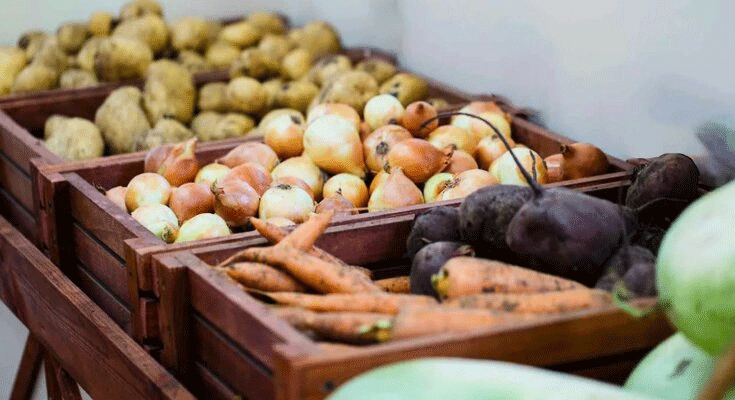
In preparation for the winter of 2025, the Republic of Belarus has significantly expanded its strategic food reserves, a move highlighting a state-centric approach to market management. The Ministry of Antimonopoly Regulation and Trade (MART) reported a 30% year-on-year increase in vegetables allocated to state stabilization funds. The stockpiled volumes are substantial, headed by over 61,000 tonnes of potatoes, followed by significant quantities of cabbage (26,000+ tonnes), onions (17,000+ tonnes), carrots (15,000+ tonnes), and beets (9,000+ tonnes). The core mechanism of this policy is direct price control: Decree No. 58 establishes fixed maximum retail prices for this state-procured produce. The prices are strikingly low, with potatoes set at 1.07 BYN/kg, carrots at 1.35 BYN/kg, and onions at 1.68 BYN/kg (approximately $0.33, $0.42, and $0.53 USD/kg respectively, based on current exchange rates). These prices are intentionally detached from free-market dynamics during the winter period.
This policy creates a dual-market structure with profound implications. For consumers, it guarantees access to affordable staple vegetables, effectively insulating them from seasonal scarcity-driven price spikes and inflationary pressures. For producers, however, the picture is more complex. The state procurement for these funds provides a guaranteed, large-volume buyer, which can offer stability and reduce marketing risk. Yet, the administered prices are typically set below average free-market winter prices, potentially compressing farmgate margins. This system requires efficient state logistics and storage to manage over 128,000 tonnes of vegetables without significant spoilage. Comparable mechanisms exist in other countries with strong food sovereignty policies; for instance, China maintains strategic pork reserves, and India has buffer stocks for staple grains, though direct price fixing for fresh vegetables on this scale is less common. The success of such a model hinges on accurate forecasting of national production, demand, and the financial capacity of the state to subsidize the difference between procurement costs and fixed retail prices, a cost not explicitly detailed in the announcement.
Belarus’s expansion of its vegetable stabilization fund represents a robust, top-down strategy for ensuring food security and price stability. It effectively protects consumers from market volatility and provides a structured demand channel for agricultural output. However, its long-term sustainability depends on the state’s fiscal health and its ability to balance the interests of consumers and producers. For agricultural professionals, it serves as a case study in command-and-control market intervention, contrasting sharply with the market-driven models prevalent elsewhere. The key takeaway is that such policies can achieve specific social stability goals but may also dampen market signals for production efficiency and innovation, ultimately placing the financial and operational burden of price stability squarely on the state budget and its procurement agencies.

