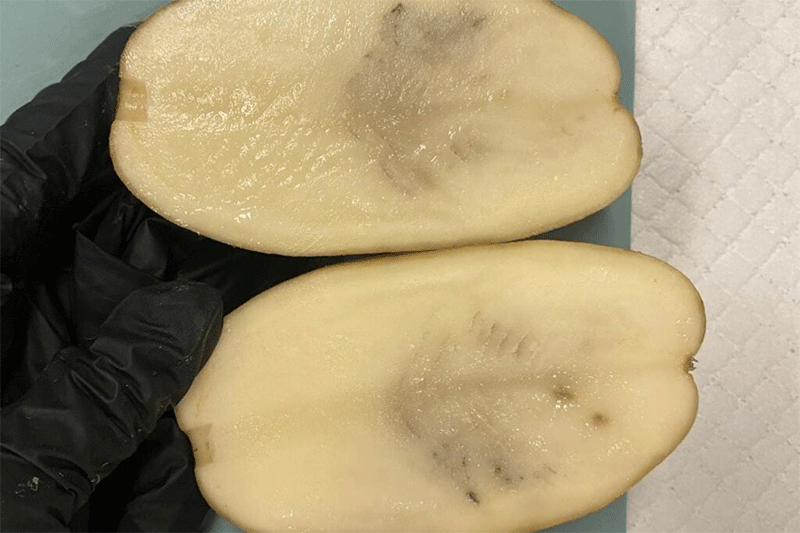
The incurable Potato mop-top virus (PMTV) has expanded its reach to southern Tasmania, prompting officials to abandon eradication efforts. This pivotal decision forces the industry, which supplies 70% of Australia’s seed potatoes, to adopt a long-term management strategy for the soil-borne pathogen.
Biosecurity Tasmania has confirmed the first detection of Potato mop-top virus (PMTV) in the state’s south, bringing the total number of infected sites to nine. This spread has triggered a ban on seed potato exports from the island, a significant blow given Tasmania’s role as the supplier of approximately 70% of Australia’s certified seed potatoes. The response has shifted dramatically from containment to acceptance; authorities have officially ruled out eradication, stating PMTV “cannot be eradicated” due to its complex relationship with the soil-borne vector, Spongospora subterranea (powdery scab), which can harbour the virus for years.
This decision aligns with global experiences. A 2023 review in the journal Viruses confirmed that PMTV is one of the most challenging soil-borne viruses to manage due to its persistence in soil via the durable resting spores of its vector. The review notes that once established, eradication is considered economically and practically infeasible, with management instead focusing on limiting spread and mitigating impact. This is compounded by the virus’s ability to present asymptomatically, allowing it to move undetected through the supply chain. Traceback activities suggest PMTV may have been present in Tasmania for at least two years before its initial detection in July, highlighting this exact diagnostic challenge.
The new strategy prioritizes biosecurity to prevent further dissemination. All affected properties are under movement restrictions for potato material, machinery, and soil. The industry is advised to adopt a strict “‘come clean, go clean’ approach” to decontaminate equipment—a practice supported by global phytosanitary protocols. Furthermore, the industry will plant only seed lines where the virus was not detected in recent extensive testing, though officials caution that a “not detected” result may not guarantee absence, only that levels are below the test’s threshold.
The Tasmanian PMTV outbreak has transitioned from a short-term biosecurity emergency to a permanent agronomic challenge. The abandonment of eradication is a sobering acknowledgment of the power of persistent soil-borne pathogens in a globalized agricultural landscape. For growers and agronomists, the focus must now urgently shift to rigorous on-farm biosecurity, the adoption of resistant varieties where available, and sophisticated management of powdery scab. This incident serves as a critical case study for other potato-producing regions, underscoring the non-negotiable need for robust pre-border and on-farm biosecurity measures to protect vital seed systems from irreversible incursions.

