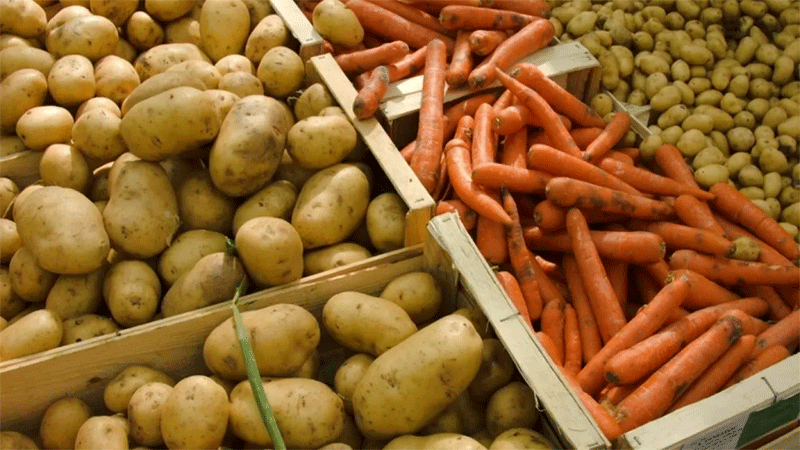
In the Pavlodar region of Kazakhstan, agricultural authorities are implementing a deliberate strategy of massive production to control the market. According to an official release, the area under potato cultivation has been expanded by 6,000 hectares this year, reaching a total of 31,200 hectares. Carrot fields also saw significant investment, covering 5,300 hectares.
The projected output from this expansion is staggering. The region forecasts a harvest of 937,000 tons of potatoes and 184,500 tons of carrots. These figures are put into perspective when compared to the region’s annual consumption needs, which are estimated at just 75,000 tons of potatoes and 17,000 tons of carrots. This means the projected harvest is over 12 times the local demand for potatoes and nearly 11 times for carrots, creating a substantial strategic reserve.
This ambitious production drive is heavily supported by state subsidies. A total of 29.9 billion Kazakhstani Tenge (KZT) has been allocated for agribusiness development, with 6.6 billion KZT directed specifically to vegetable and potato producers, in addition to benefits like reduced-cost fuel.
To manage this surplus and fulfill its social mandate, the regional government has signed a memorandum establishing a mechanism for market intervention. As part of this, 10,000 tons of potatoes and 3,000 tons of carrots will be placed into storage, constituting a 30-day strategic reserve for the region. Furthermore, fixed retail prices have been set for social grocery stores and agricultural fairs: 125 KZT per kg for potatoes and 115 KZT per kg for carrots (approximately $0.25 and $0.23 USD, respectively).
The Pavlodar model represents a highly interventionist approach to agricultural market management. While it successfully aims to ensure food security and stabilize prices for consumers in the short term, it presents a complex set of challenges and considerations. The success of this model hinges on the efficient and cost-effective management of the enormous surplus, including storage, potential for processing, and finding export markets to avoid long-term price depression that could eventually hurt the very farmers it seeks to support. For agricultural professionals, it is a stark example of how production volume, when decoupled from immediate market demand, becomes a powerful but double-edged tool for policy makers.

