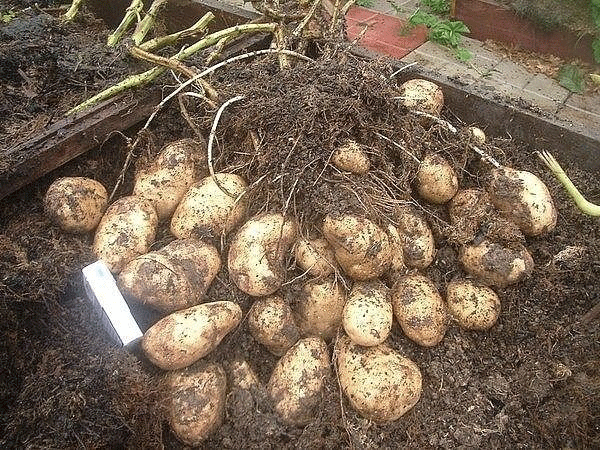
A forgotten organic potato cultivation technique from the USSR promises astonishing yields of 100 or more tubers per plant through a deep understanding of plant morphology. This article investigates the science behind the Balabanov method, its core principles, and its potential relevance for modern sustainable agriculture.
Amidst the prevailing focus on high-input, technology-driven agriculture, a historical organic method is resurfacing. The Balabanov method, developed by Soviet agronomist Pyotr Balabanov, claims to achieve yields of 100-120 large, select tubers per potato plant. This is not achieved through genetic modification or chemical intensification, but through a profound manipulation of the plant’s natural growth structure, specifically by maximizing the development of stolons—the underground stems that produce tubers.
The core principle of Balabanov’s technique is the artificial elongation of the plant’s etiolated (white) underground stem. Since tubers form on stolons that grow only from the darkened portion of the stem, the goal is to dramatically increase this area. This is achieved through 2-3 instances of pre-emergence hilling, where soil is mounded over the planting row at 5-7 day intervals before the sprouts break the surface. This forces the stem to grow upward toward light, creating a lengthy underground section (up to 20-25 cm) laden with buds, each capable of producing a stolon and a cluster of tubers.
The method rests on four foundational pillars:
- Organic Focus: Balabanov vehemently opposed mineral fertilizers and deep plowing, relying instead on green manure (e.g., phacelia) to build soil organic matter and structure.
- Soil Requirements: The ideal soil is loose, well-aerated, and slightly acidic (pH 5.5-5.8), optimized for tuber expansion and health.
- Premium Seed Stock: He insisted on using large seed tubers (100g+), rigorously sprouted (vernalized), and treated with micronutrients (copper, boron, manganese) and ash.
- Strategic Spacing and Timing: Wide spacing (30-40 cm in-row, 1.2 m between rows) ensures ample resources for each massive plant. The regimen includes precise post-emergence hilling and three critical irrigations at key growth stages.
The biological rationale is sound. Modern agronomy confirms that stolon initiation and tuberization are photoperiod-sensitive processes inhibited by light. A 2022 study in the American Journal of Potato Research reiterated that soil management practices that ensure adequate soil moisture, aeration, and hilling directly influence stolon number and tuber set. Furthermore, the global push for sustainable intensification, highlighted in a 2023 FAO report, emphasizes agro-ecological practices that reduce dependency on external inputs, precisely aligning with Balabanov’s organic, systems-based approach.
The Balabanov method is far more than a historical curiosity; it is a sophisticated, biology-first farming system that challenges modern input-dependent models. While its labor-intensive nature may not suit large-scale mechanized farms, it presents a compelling model for organic producers, market gardeners, and regions seeking to enhance food sovereignty with limited chemical resources. Its resurgence underscores a critical lesson: sometimes, the most revolutionary advancements in agriculture come not from inventing something new, but from rediscovering a deeper understanding of the natural world. For agronomists and farmers, testing this method on a trial basis could provide valuable insights into achieving high yields through ecological principles, potentially offering a blueprint for more resilient production systems in an era of climate change and rising input costs.

