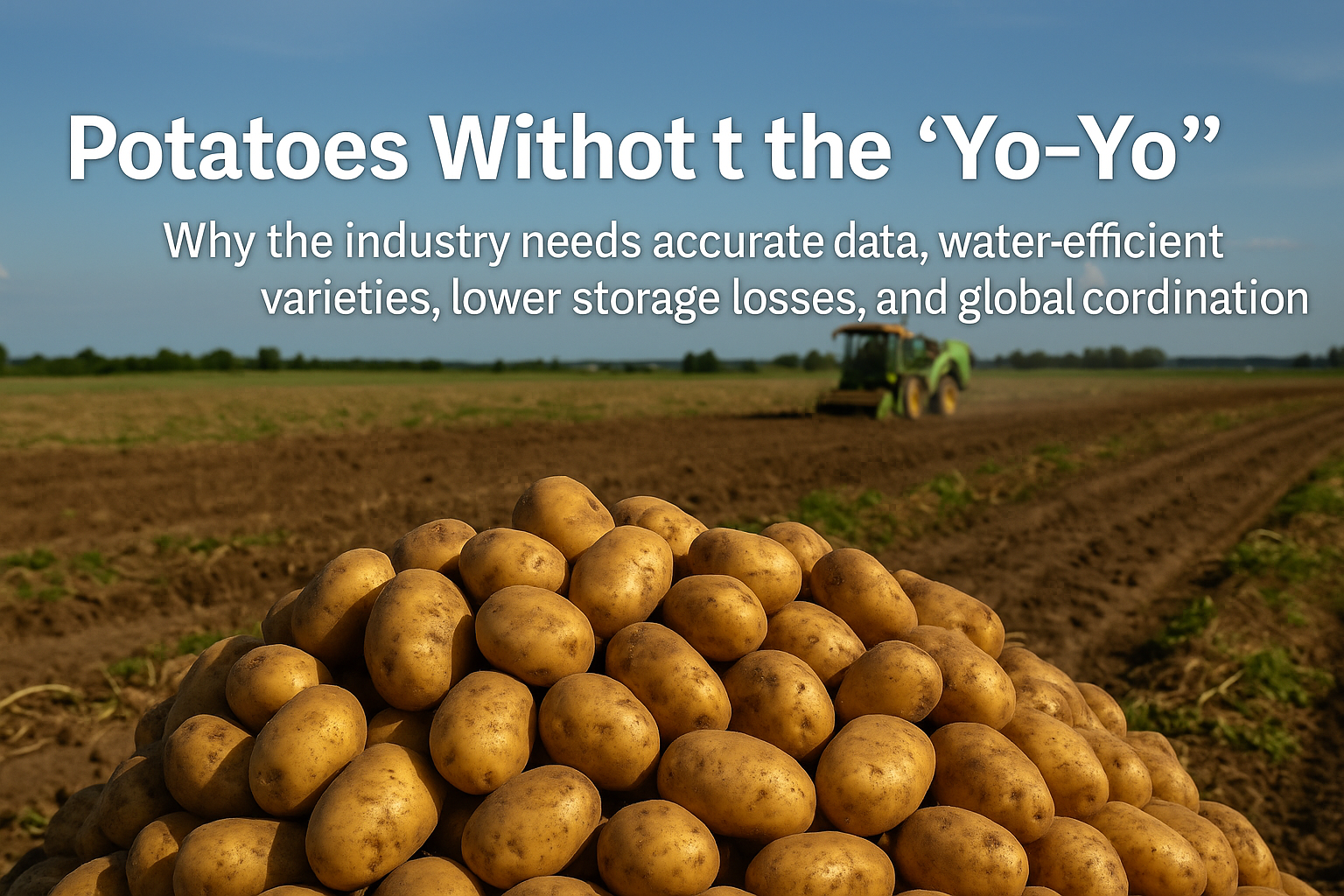
This article is prepared for publication as a framing piece for discussions that will continue at the Potato Summit in Delhi (December 11–13). The core idea is simple: as long as we manage the potato sector “by feel” and with statistics that don’t match across countries, the market will keep behaving like a yo-yo — oversupply → price dumping → acreage cuts → shortages → price spikes.
1) Global scale: potatoes are huge, but trade is only a small slice
Global potato production is around 383 million tons per year. Yet international trade in potatoes and processed potato products, converted into raw-potato equivalent, is about 50 million tons, roughly ~13% of global volume.
This matters because it means the potato market is fundamentally local, and any disruption in logistics can instantly turn into dramatic price swings.
2) Logistics has become the main “multiplier” of price and risk
When transport becomes more expensive, lead times increase, and routes face restrictions, the market stops “flowing” from surplus regions to deficit regions. Then we get two extremes at once:
- in one place — oversupply and collapsing prices (farmers sell below cost),
- in another — shortages and price shocks (processors can’t secure raw material).
That’s why a “global industry” often behaves like a set of disconnected local markets.
3) The most dangerous zone is statistics: if the baseline is wrong, “minus 20%” means different universes
The key message: without accurate data, there are no accurate decisions — for farmers, processors, or governments.
Russia as a clear example of “two realities”
In some international reviews and historical estimates, Russia is reported at around ~30 million tons of production. The critical issue is what exactly is being counted: total production across all categories versus the volume that actually moves through the organized commercial market are not the same thing.
- Some estimates put Russia’s total crop around 17.8 million tons in 2024, with a large share coming from household plots, which often do not fully enter formal market channels.
- At the same time, public discussion of shortages has referenced around ~7.3 million tons (as a proxy for the market-visible commercial segment) and consumption needs around ~8 million tons.
- Other reports highlight how large the household share can be (for example, ~11.2 million tons from households in 2023 out of roughly ~19.2 million tons total).
Now for the “meaning math.”
If a planner uses 30 million tons as the baseline, then “minus 20%” equals a 6 million ton market shortfall — a macro shock.
If we use a 7–8 million ton commercial baseline, “minus 20%” becomes just 1.4–1.6 million tons — still serious, but a completely different scale. In that case, partial coverage via imports from nearby regions may be discussed, but it immediately runs into logistics constraints (cost / time / quality in transit).
A comparison helps to feel the scale: India produces roughly 60 million tons of potatoes per year. So a 6 million ton gap (if one believes the 30 million baseline) equals about 10% of India’s annual output. A gap of that size cannot be filled quickly or cheaply — and it will inevitably affect prices and market stability.
4) Europe and China show the same story in different frames: surplus → price pressure → farmer pain → market reset
Europe: strong crops and downward price pressure
Industry briefings for the EU have cited crop estimates around ~48.9 million tons for 2024 (with alternative scenarios higher). In 2025, market reports repeatedly discussed oversupply and sharp price declines in North-Western Europe, linked to expanded acreage and weaker free-market demand.
China: scale plus processing growth can reshape competition
China is the world’s largest producer (around ~93.5 million tons in 2023). Alongside that, processing capacity has been expanding, and China’s footprint is increasing in segments like frozen fries and other products. As exports from China and other origins intensify competition in international markets, margins can compress elsewhere.
The point isn’t “who is to blame.” The point is: when production and processing grow faster than consumption and logistics can absorb, surplus turns into price wars.
5) Strategy “inside the product”: varieties, water, dry matter, and losses
If we want fewer yo-yo cycles and more stability, we must manage not only hectares, but also raw material quality and resource efficiency.
5.1. Processing varieties: dry matter is economics
For fries, processors often prefer potatoes with ~20–25% dry matter because it improves yield, texture, oil uptake, and frying consistency. Research on chips and processing also highlights the importance of dry matter and related quality parameters.
In simple terms: less excess water in the tuber → lower processing costs → higher finished-product yield → better resilience under price pressure.
5.2. Water: potatoes are often far more water-efficient than rice
Global water footprint benchmarks frequently show rice requiring much more water per ton than many other foods. For potatoes and other root/tuber crops, average figures can be significantly lower — while still varying strongly by region, climate, and production system (rainfed vs irrigated, yields, etc.).
The conclusion is practical: water-efficient potato varieties and technologies are not just sustainability — they are competitiveness.
5.3. Storage losses: the “silent margin killer”
Post-harvest references show striking ranges: in improved storage, losses can be around ~15%, while traditional storage under long holding periods can reach up to ~50%. Review papers also cite ranges such as 15–50% in some developing-country contexts.
So while the industry debates “millions of tons” in forecasts, profits are often lost quietly through quality and weight losses in storage.
6) Potatoes as a food-security tool: calories, affordability, adaptability
Potatoes are widely recognized as a key non-cereal food crop with an important role in food security and farmer incomes.
But “potatoes vs hunger” should be approached as a system, not a slogan:
- varieties with strong nutritional value,
- resilience and water efficiency,
- low-loss storage,
- processing and product innovation (so surplus becomes value, not dumping).
7) Consumption culture is as powerful as yield
Demand is the stabilizer. If we want less dumping and fewer bankruptcies during high-yield years, consumption must keep pace:
- stronger processing,
- new dishes and formats,
- partial replacement of traditional ingredients with potato-based solutions (noodles, starch-based foods, “grain alternatives,” etc.),
- potato marketing as a reliable, affordable food — not just a volatile raw commodity.
8) What to align on in Delhi: practical theses for an industry “agreement”
At the Potato Summit in Delhi (December 11–13), the discussion should focus on actionable alignment:
- A shared data glossary: total vs commercial volume vs household share vs processing share vs losses.
- Early warning of oversupply: shared monitoring of acreage, weather risk, stocks, and export flows.
- Variety and quality standards: dry matter, sugars, uniformity, storage/processing suitability.
- Loss reduction and storage: technology, infrastructure, training, and modernization economics.
- Water and resilience: investments and technology where water is the binding constraint.
- Consumption growth: new products, new recipes, new markets — so surplus becomes value, not price collapse.
Sources and links (for publication)
1) FAO: International Day of Potato 2025 (383 million tons in 2023)
https://www.fao.org/plant-production-protection/news-and-events/news/news-detail/fao-announces-the-theme-for-international-day-of-potato-2025/en
2) FAO (production statistics, 2023, 383 million tons)
https://openknowledge.fao.org/bitstreams/df90e6cf-4178-4361-97d4-5154a9213877/download
3) Potatoes South Africa: global trade 29.96 million t; ~50 million t raw equivalent; ~13%
Global potato trade sets records but faces uncertainty