For farmers, agronomists, agricultural engineers, and scientists working in agriculture, technological innovation is revolutionizing potato production systems. From disease-free seedling cultivation to automated smart greenhouses and deep-processing products like “bursting french fries,” the integration of science and technology is creating unprecedented opportunities for yield improvement, efficiency gains, and value addition across the agricultural sector.
The potato industry is experiencing a technological transformation that is redefining traditional farming practices. Advanced breeding techniques, smart greenhouse systems, and diversified processing technologies are enabling producers to achieve higher yields with reduced resources while significantly improving end-product quality and market competitiveness.
Breakthroughs in Seedling Technology and Disease Prevention
A fundamental advancement driving this transformation is the widespread adoption of virus-free seedling technology. In China’s Yakeshi City, Xingjia Potato Industry operates glass smart greenhouses covering 5.2 mu (approximately 0.35 hectares) each. These facilities are equipped with 83 seedbeds and cultivate approximately 700,000 seedling plants per greenhouse. Through scientific nutrient solutions and automated protection systems—including fully automatic spray vehicles—these facilities produce roughly 1.8 million seeds per season and up to 5 million seeds annually. Remarkably, each smart greenhouse requires only one worker for management, demonstrating extraordinary efficiency gains[citation:0].
Similar progress is evident in Zhuanglang County, Gansu Province, where aeroponics (mist cultivation) has been implemented. In these facilities, a single greenhouse can produce nearly 3 million mini-tubers (original seeds), with the entire breeding center producing 40 million mini-tubers annually. This method allows potato roots to suspend in the air, absorbing nutrient-rich mist, which dramatically increases yield compared to traditional techniques—sometimes producing 60 tubers per plant[citation:0].
The “Bursting French Fries” Innovation: Case Study from LuLong County
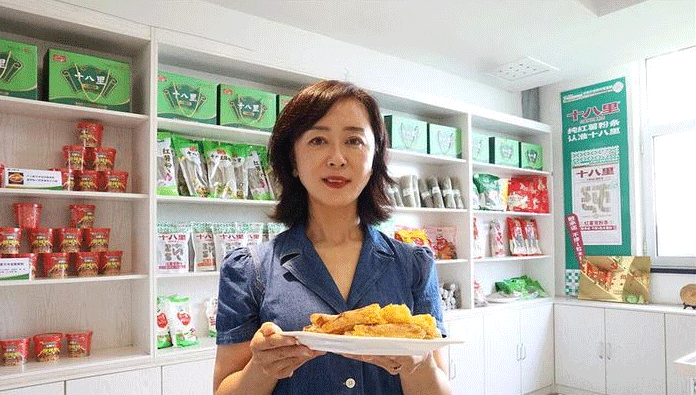
In Hebei Zhongshu Agricultural Technology Co., Ltd., a revolutionary new product exemplifies how value addition is transforming the potato industry. The company has developed “bursting french fries”—a novel snack made from a specially bred sweet potato variety called ‘Jiyuan 1’, which won the first prize in the fresh-eating group of the National High-Quality Sweet Potato Variety Competition in 2023.
These fries leverage the natural properties of this innovative variety without adding any other components. When cooked, the fries develop a crispy exterior that gives way to a soft, creamy interior that bursts with sweetness—hence the name “bursting french fries.”
This product innovation is backed by rigorous scientific testing through the Xuzhou Institute of Agricultural Sciences and represents how targeted breeding can create specialized products for premium markets.
Automation and IoT: The Backbone of Modern Potato Farming
Automation and Internet of Things (IoT) technologies are becoming critical components in potato cultivation. In Zhuanglang County, smart systems enable farmers to manage daily tasks such as fertilization, irrigation, temperature, and humidity control remotely via computer or smartphone. These technologies are not only convenient but also significantly reduce resource use: compared to traditional methods, they achieve water savings of over 70%, reduce fertilizer use by more than 50%, and increase water and fertilizer utilization rates by 20-30%[citation:0].
Beidahuang Potato Industry Group in Heilongjiang has taken automation even further. They employ a “sky-land-integration” management platform that combines satellite remote sensing, drone patrols, and ground sensors to monitor field conditions. This system provides real-time data on soil moisture, seedling growth, and pest risks, allowing AI algorithms to generate precise planting recommendations. Since implementation, their farms have reduced chemical fertilizer use by 15%, cut pesticide applications by 20%, and improved water use efficiency by 30%, all while increasing average potato yield to 3.2 tons per mu[citation:0].
Economic Impact and Employment Opportunities
The technological revolution in potato farming is generating substantial economic benefits and creating new employment opportunities:
- In Yakeshi City, the potato industry has established a complete industrial chain encompassing breeding, planting, processing, sales, and potato residue recycling. This sector provides employment for over 6,000 local farmers and has stimulated growth in transportation, storage, and packaging industries. The city maintains a steady annual potato planting area of more than 250,000 mu, with the industry generating an average annual output value of 1.1 billion yuan[citation:0].
- In Gansu’s Zhuanglang County, potato farming now covers 365,000 mu, producing 540,000 tons of fresh tubers annually with a total output value of 580 million yuan. This contributes over 1,000 yuan in per capita income for local farmers[citation:0].
- Gansu Agricultural Reclamation YSheng Tiaoshan Branch reports impressive yields from their 12,000 mu potato planting base, with a single-season output of 35,000 tons and an annual output value exceeding 50 million yuan. The company also allocates 5 million yuan annually in wages for local laborers involved in planting and harvesting[citation:0].
National Policies and Regional Development Strategies
The Chinese government is actively supporting technological advancements in agriculture. Inner Mongolia has outlined plans to restore potato planting area to 8 million mu by 2025. The strategy emphasizes[citation:0]:
- Developing a high-standard virus-free seed potato breeding base covering 2 million mu.
- Increasing the popularization rate of virus-free seed potatoes to 92%.
- Raising the initial and deep processing conversion rate to around 60%.
- Aiming for a total industry chain output value exceeding 23 billion yuan.
The region also plans to enhance its digital infrastructure through projects like the Inner Mongolia Potato Late Blight Digital Monitoring and Early Warning System. With 103 IoT automatic monitoring stations already deployed across 41 banner counties, the system aims to provide 14-20 days of advance warning for late blight outbreaks, reduce pesticide applications by at least three sprays per season, and cut chemical usage by 100 grams per mu[citation:0].
The Future of Potato Farming is Technology-Driven
The integration of technology into potato farming—from smart greenhouses and automated systems to IoT-based field management and innovative products like “bursting french fries”—is proving to be a game-changer for farmers, agronomists, and agricultural engineers. These innovations deliver tangible benefits: significantly higher yields, more efficient resource use, reduced environmental impact, improved economic returns, and exciting new products for consumers.
The case of Hebei Zhongshu Agricultural Technology Co., Ltd. demonstrates how strategic partnerships with research institutions can lead to the development of premium products that command higher market prices. As research continues and technology becomes even more accessible, the global potato industry is well-positioned to meet growing food demands in a sustainable and profitable manner.
The future of potato farming lies in continued investment in research and development, strengthening the connection between scientific institutions and farming practices, and embracing digital technologies that optimize production from field to fork.

