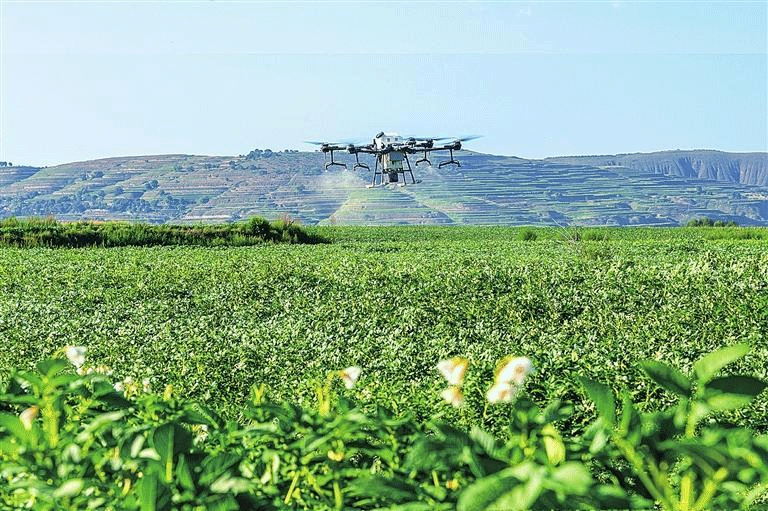
Nestled in the Loess Plateau, the city of Dingxi has orchestrated one of modern agriculture’s most remarkable transformations. Once known as a land of subsistence farming, Dingxi has leveraged the humble potato to build a multi-billion dollar industry, becoming a case study in successful agricultural value-chain development. With a full-industry chain value of 254 billion yuan ($35 billion USD equivalent, though often reported as a $3.9 billion core industry value in international agri-economics reports) and contributing 23% to local farmers’ per capita disposable income, Dingxi’s model offers critical insights for agronomists, processors, and policymakers globally.
This meteoric rise is no accident. It is the result of a deliberate, decades-long strategy encapsulated in the “whole-chain development” approach: systematic breeding, standardized planting, deep processing, and branded marketing. The upcoming 2025 China Dingxi Potato Congress, themed “Gathering Chains, Empowering Innovation,” underscores this commitment, aiming to further strengthen every link from seed to shelf.
The Foundation: Mastering the “Chip” of the Industry
Dingxi’s first strategic move was conquering the industry’s core: seed technology. Recognizing that superior genetics dictate market leadership, the region established itself as China’s largest脱毒种薯 (virus-free seed potato) breeding base.
- Genetic Repository: Scientists have collected and preserved over 1,500 potato germplasm resources, providing a vast genetic library for breeding.
- Domestic Cultivars: They have successfully bred 13 proprietary “Ding Shu” potato varieties, which have been cultivated across over 500 million mu (approximately 8.2 million acres).
- Industrial Scale: Dingxi now hosts 38 specialized seed potato companies with an annual production capacity of 1.8 billion mini-tubers (原原种) and 2.2 million tons of virus-free seed potatoes. This scale not only supplies China’s major potato regions but also fuels a growing export market to countries like Saudi Arabia, Turkey, and Egypt.
This focus on “the chip” of the industry ensures high-yielding, disease-resistant crops that form the foundation of a reliable and high-quality product stream—a lesson in the critical importance of public and private investment in agricultural R&D.
The Value Multiplier: Deep Processing and Brand Building
The second pillar of Dingxi’s strategy is capturing value far beyond the raw commodity. By moving into deep processing, they have created diverse revenue streams and built resilient market demand.
- Processing Powerhouse: A network of 28 leading processing enterprises with a total processing capacity of 960,000 tons transforms raw potatoes into high-value goods.
- The Value Chain: The product spectrum has evolved from basic starch to a sophisticated array including modified starch, potato flakes, Dingxi Wide Noodles, staple foods, and snack products. This diversified output fuels a processing industry valued at 4 billion yuan.
- The Star Product: The “Dingxi Wide Noodle” is a masterclass in brand building. From a local delicacy, it has been catapulted to national fame. The city supports 128 processing entities producing over 120 packaged product varieties, generating 4 billion yuan in annual output value. Its success is institutionalized through a provincial food safety standard (2022) and a National Geographical Indication Certification Trademark (2023).
Market Integration and “Dingxi Speed”
The final piece of the puzzle is seamless market integration, characterized by astonishing efficiency. The story of Gansu Yiwei Qiancheng Agricultural Technology Co. exemplifies this “Dingxi Speed.” A joint venture established in 2023, it went from obtaining production permits to exporting its products in mere months. Now operating 6 production lines producing potato balls, crisps, and frozen products for national restaurant chains, it targets $6.9 million (50 million yuan) in sales and aims to expand to 11 lines. This agility in connecting raw material supply with consumer market trends is a key driver of growth.
Dingxi’s journey from “famine relief potato” to “revitalization potato” provides a powerful blueprint for agricultural regions worldwide. Its success is built on three non-negotiable pillars: 1) controlling the genetic source through massive investment in seed technology and breeding; 2) capturing maximum value through diversified, branded processing rather than selling raw commodities; and 3) fostering an ecosystem of agile public-private partnerships that can respond at “Dingxi Speed” to market opportunities.
For global agricultural professionals, the implications are clear. The future of profitable potato production lies not in chasing yield alone, but in building integrated, resilient value chains that are consumer-focused, technology-driven, and brand-oriented. Dingxi demonstrates that with strategic vision and systemic investment, a regional specialty can indeed become a global powerhouse.

