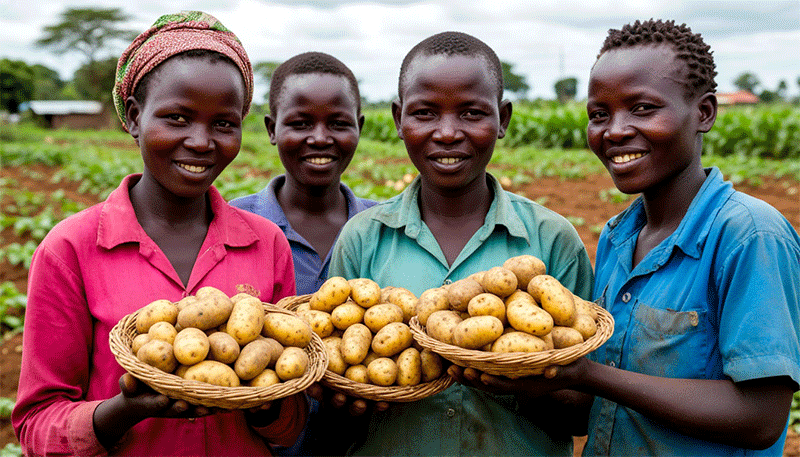
For decades, a primary constraint on potato yields across Sub-Saharan Africa has been the severe shortage of high-quality, certified seed. Ugandan smallholders have faced this challenge directly, relying on a public sector system that, despite its efforts, could not meet demand. The recent licensing of Farm Inputs Care Centre Ltd. (FICA Seeds) as Uganda’s first private company authorized to commercially produce tissue culture plantlets and early-generation seed potatoes represents a transformative step toward a more resilient and market-oriented seed sector.
This development, facilitated by the Building Resilience and Inclusive Growth of Highland farming systems for rural Transformation (BRIGHT) project, moves beyond the traditional public-domain model. Until now, institutions like the National Agricultural Research Organization (NARO) shouldered the burden. However, data consistently shows that public systems alone struggle to close the seed supply gap. The International Potato Center (CIP) estimates that access to quality seed remains the single biggest yield-limiting factor in Africa, with less than 5% of farmers in many regions using certified seed. This perpetuates a cycle of low productivity, as farmers save and recycle their own seed, leading to a accumulation of viral and bacterial diseases that can depress yields by 50% or more.
The FICA Seeds model aligns with a proven global trend: effective seed systems require robust private sector engagement. The company’s certification to manage early-generation seed for seven key varieties—including Victoria, NAROPOT 1, and Kinigi—is crucial. Early-generation seed (Pre-Basic and Basic) is the foundation of the seed multiplication pyramid. By injecting 60,000 tissue culture plantlets annually into this pyramid, the project triggers a significant multiplier effect:
- 60,000 tissue culture plantlets →
- ~15 metric tons of Pre-Basic seed →
- ~90 metric tons of Basic seed →
- ~540 metric tons of Certified seed for smallholders.
This pipeline directly addresses the volume problem. Furthermore, the provision of technical support to screenhouse operators is a critical sustainability component, ensuring that the quality built into the tissue culture stage is maintained through subsequent multiplication phases.
The broader implication is a strategic shift towards a market-oriented system. The BRIGHT project’s goal of moving households from subsistence farming is only achievable with reliable inputs that guarantee higher marketable surpluses. Quality seed is the catalyst for this transition. Studies show that adopting certified seed potato can increase yields by 30-50% compared to recycled local seed, directly boosting farmer income and contributing to regional food security.
The licensing of FICA Seeds is more than a single company milestone; it is a replicable model for national seed system transformation. By successfully aligning a private entity with national research (NARO) and regulators (MAAIF), Uganda has created a sustainable engine for producing the most critical input in potato cultivation. This public-private partnership effectively leverages the innovation and efficiency of the private sector while grounding itself in the scientific rigor and public mandate of government institutions. For policymakers, development partners, and agribusiness leaders across Africa, this initiative demonstrates a viable pathway to breaking the seed bottleneck, ultimately driving productivity, resilience, and economic growth for smallholder farmers.

