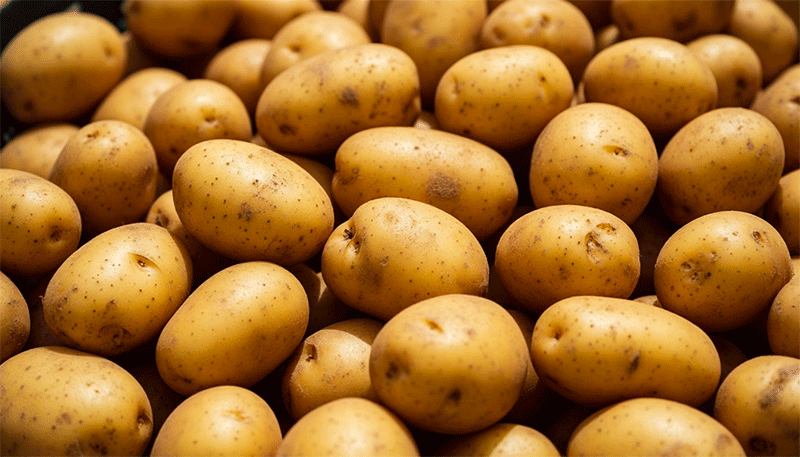
The global map of agricultural trade is being redrawn, and one of the most significant new corridors is between Russia and China. Data from Rosselkhoznadzor (Russia’s Federal Service for Veterinary and Phytosanitary Surveillance) reveals not merely incremental growth but exponential increases in the exchange of key commodities. By September 10th, Chinese potato imports into Russia had skyrocketed by 320%, while Russian corn exports to China tripled. This isn’t a simple case of import-export growth; it represents a deep, strategic alignment of two agricultural powerhouses, with profound implications for producers, markets, and global supply chains.
Analyzing the Data: A Tale of Complementary Needs
The trade figures reveal a clear pattern of complementary economic needs and strategic pivots in response to global geopolitics.
- China’s Export Surge to Russia:
- Potatoes: A 4.2x increase is staggering. This surge is likely driven by several factors: Russia’s need to stabilize domestic supply and price volatility, potential gaps in its own harvests due to logistical or climatic issues, and China’s vast and competitive potato production capacity in regions like Inner Mongolia.
- Onions and Cabbage: Increases of 2.3x and 1.7x, respectively, indicate a strong Russian demand for staple vegetables that China can supply reliably and at scale.
- Overall: The 45.8% overall growth in Chinese fruit and vegetable exports to Russia, certified as “quality and safe” by Russian authorities, signals a major shift in Russia’s sourcing strategy, potentially reducing its reliance on European suppliers.
- Russia’s Export Boom to China:
- Grains and Oilseeds: The export of over 4.7 million tons of grain to China in 2024, with 2.9 million tons already shipped by early 2025, underscores China’s strategy to diversify its grain sources away from traditional suppliers like the U.S. and Australia. The 3x increase in corn and significant rises in sunflower (29%) and buckwheat (27%) exports highlight Russia’s role as a key supplier of raw agricultural commodities.
- Animal Products: The massive increases in pork (1.7x), beef (15%), and animal by-products (2.5x) are particularly telling. Following outbreaks of African Swine Fever (ASF) and other diseases, China is rebuilding its herds and securing protein from multiple sources. Russia, with its vast land resources, is positioning itself as a major livestock exporter.
The Bigger Picture: Strategic Alignment and Market Integration
This trade boom is not accidental. It is the result of deliberate political and economic alignment. The high-level talks between Rosselkhoznadzor and the Chinese ambassador emphasize “market complementarity” and “integration processes.” This suggests a long-term strategy to intertwine the two agricultural economies, creating a more self-sufficient bloc less susceptible to Western market fluctuations and sanctions.
For global farmers and agribusinesses, this means:
- New Competition: Russian grain and Chinese vegetables will become more competitive in global markets, potentially suppressing prices.
- Shift in Supply Chains: Traditional trade routes are changing. Logistics companies and port operators will need to adapt to these new flows.
- Sanctions and Food Security: The trade relationship demonstrates how major nations can create alternative supply chains to circumvent geopolitical obstacles, making food a central tool of foreign policy.
The Rise of a Resilient, Alternative Food Corridor
The dramatic figures from Rosselkhoznadzor are a powerful indicator of a new, resilient agricultural trade axis. For farmers and agronomists in both countries, this opens new markets but also introduces new competitive pressures. For the global agricultural community, it signals a fragmentation of the global market into more regionalized blocs.
The key takeaway is that agricultural trade is no longer just about economics; it is increasingly about geopolitics and strategic security. The Russia-China corridor is a case study in how two nations are leveraging their agricultural sectors to build mutual resilience and assert their independence on the world stage. Understanding these shifts is crucial for anyone involved in the business of global food production.

