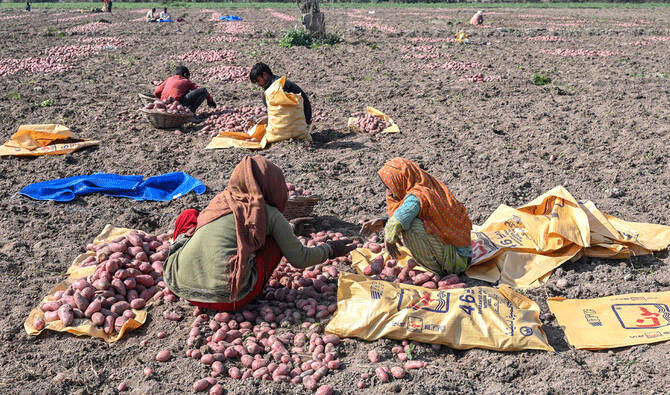
A profound agricultural crisis is unfolding in Pakistan, serving as a stark warning to producers and policymakers worldwide about the dangers of concentrated export dependencies and fragile geopolitical trade routes. Following border closures with Afghanistan in October due to security clashes, Pakistan’s potato market has been thrown into disarray. With exports via Afghanistan—a conduit to Central Asia and Russia—completely halted, domestic prices have collapsed by 60-77%. A 60kg bag that fetched Rs 2,600 ($9.3) now fails to cover even its Rs 600 ($2.1) storage cost, placing farmers on the brink of financial ruin as a new Rabi season harvest approaches.
The scale of the disruption is monumental. Pakistan is a potato powerhouse, harvesting 9.4 million metric tons from 386,000 hectares in the last fiscal year—a 12% increase from the prior season. Historically, the country has run a massive agricultural trade surplus with Afghanistan, exporting $778 million against imports of just $26 million in FY 2024-25. Afghanistan’s role as a land bridge was indispensable; as noted by the Pakistan Kissan Ittihad president, it facilitated access to markets in Tajikistan, Kazakhstan, Kyrgyzstan, and beyond. The current blockade has not only stranded thousands of shipments but has also contributed to a 15% year-on-year decline in Pakistan’s total vegetable exports, now at $368 million. This shock is rippling through the macroeconomy, widening the current account deficit to $733 million for Jul-Oct, compared to $206 million the previous year.
This crisis underscores a critical vulnerability: an agricultural sector booming in productivity but perilously tethered to a single, unstable logistics artery. The situation is exacerbated by the lack of immediate diversification. Reports suggest Afghanistan is already pivoting trade to Iranian and Central Asian routes, a structural shift that may outlast the current political tension. For Pakistan’s agriculture, which contributes 24% to GDP and employs 37% of the workforce, the implications are severe. The government’s target of 8.9 million tons for the 2025-26 Rabi season now meets a market with no outlet, threatening massive waste and crushing debt for producers.
Pakistan’s potato crisis is not an isolated event but a powerful case study in systemic agricultural risk. It highlights the non-negotiable need for export market diversification and robust contingency planning in agri-logistics. For farmers, agronomists, and engineers globally, the lesson is clear: maximizing yield is only half the battle. Securing multiple, resilient pathways to market is equally critical for economic sustainability. Investing in value-added processing, exploring alternative trade corridors, and developing domestic storage and processing infrastructure are essential strategies to buffer against geopolitical shocks. When a border closes, it’s not just trade that halts—it’s the livelihoods of millions that hang in the balance.

