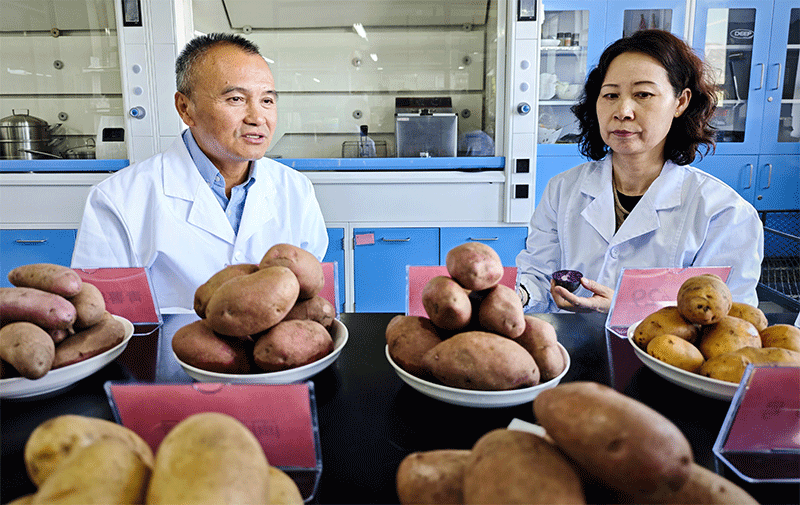
High-Altitude Innovation: How Qinghai’s “Commanding Talent” Program is Revolutionizing Potato Breeding
On the high plateaus of Qinghai, a pioneering scientific initiative is breaking new ground in potato breeding and seed production. By combining advanced genomic tools with a novel collaborative model, researchers are developing resilient new varieties and dramatically expanding the reach of a national favorite, securing food supply in challenging environments.
The “Plateau Potato Breeding Capacity Innovation System” project, led by “Commanding Talent Scientist” Jian Wang of the Qinghai Academy of Agricultural and Forestry Sciences, represents a strategic investment in agricultural resilience. Mid-term evaluations confirm significant progress: the project has substantially expanded genetic resources, achieved a major genomic breakthrough with the complete assembly of the flagship variety Qingshu No. 9, and established a robust, commercially-oriented seed production system that is already impacting hundreds of thousands of acres and generating substantial economic value.
Building a Genetic Fortress for the Future
The cornerstone of the project is the creation of a comprehensive and future-proof genetic library. The research team has added 242 new accessions, bringing the total potato germplasm repository to 1,237 distinct accessions. This diverse collection is a critical resource for breeding resilience against climate change and disease. More impressively, the team has completed a high-quality, complete genome assembly for Qingshu No. 9—a landmark achievement for a variety of such agricultural importance. This genomic map is a powerful tool, enabling the development of an efficient gene-editing system and the creation of a foundational database for 977 germplasm resources, which will accelerate the precision breeding of future varieties.
This work is timely. The 2023 Global Food Policy Report by the IFPRI highlights that climate change could reduce global potato yields by 18-32% by 2050 without the development of new, climate-resilient varieties. Qinghai’s effort to genotype and characterize a vast germplasm bank is a direct and necessary response to this looming threat.
A Novel Breeding System Yields Tangible Results
Moving from the lab to the field, the project has created an innovative breeding system tailored to高原 (plateau) conditions. The “clonal high-altitude backup, multi-altitude synchronous selection, targeted early-generation line expansion” system is designed to efficiently identify and propagate superior genetics. This has been operationalized through:
- The establishment of 4 dedicated breeding bases.
- The development of 4 new varieties (3 already registered), including early-maturing, colored, and processing types.
- The identification of 16 promising new breeding lines.
A Commercial Model for Scalable Impact
Perhaps the most impactful innovation is the organizational model. The “research unit + enterprise + cooperative” commercial consortium has successfully bridged the gap between science and production. This collaboration has:
- Established 21,330 acres of core seed multiplication areas.
- Created demonstration bases辐射 (radiating) across 101,951 acres.
- Generated a total output value of 433.922 million RMB.
This system has supercharged the propagation of Qingshu No. 9. Already a national star, its planting area grew to 7.17 million mu in 2023 (ranking first in China) and is projected to expand by another 300,000 mu to 7.47 million mu in 2024. This massive adoption is a testament to the variety’s performance and the efficacy of the new seed production model.
Conclusion:
The Qinghai project offers a masterclass in modern, mission-oriented agricultural research. It successfully demonstrates how to integrate fundamental science (genomics), applied breeding, and commercial-scale production within a single, cohesive framework. By treating the development of a resilient seed system as a strategic priority, the program is not only safeguarding a key food crop for China but also providing a replicable model for other regions facing agricultural marginality. For the global agricultural community, it underscores that overcoming the challenges of climate change and food security requires not just scientific discovery, but also innovative institutional models that can rapidly translate research into widespread farmer benefit.

