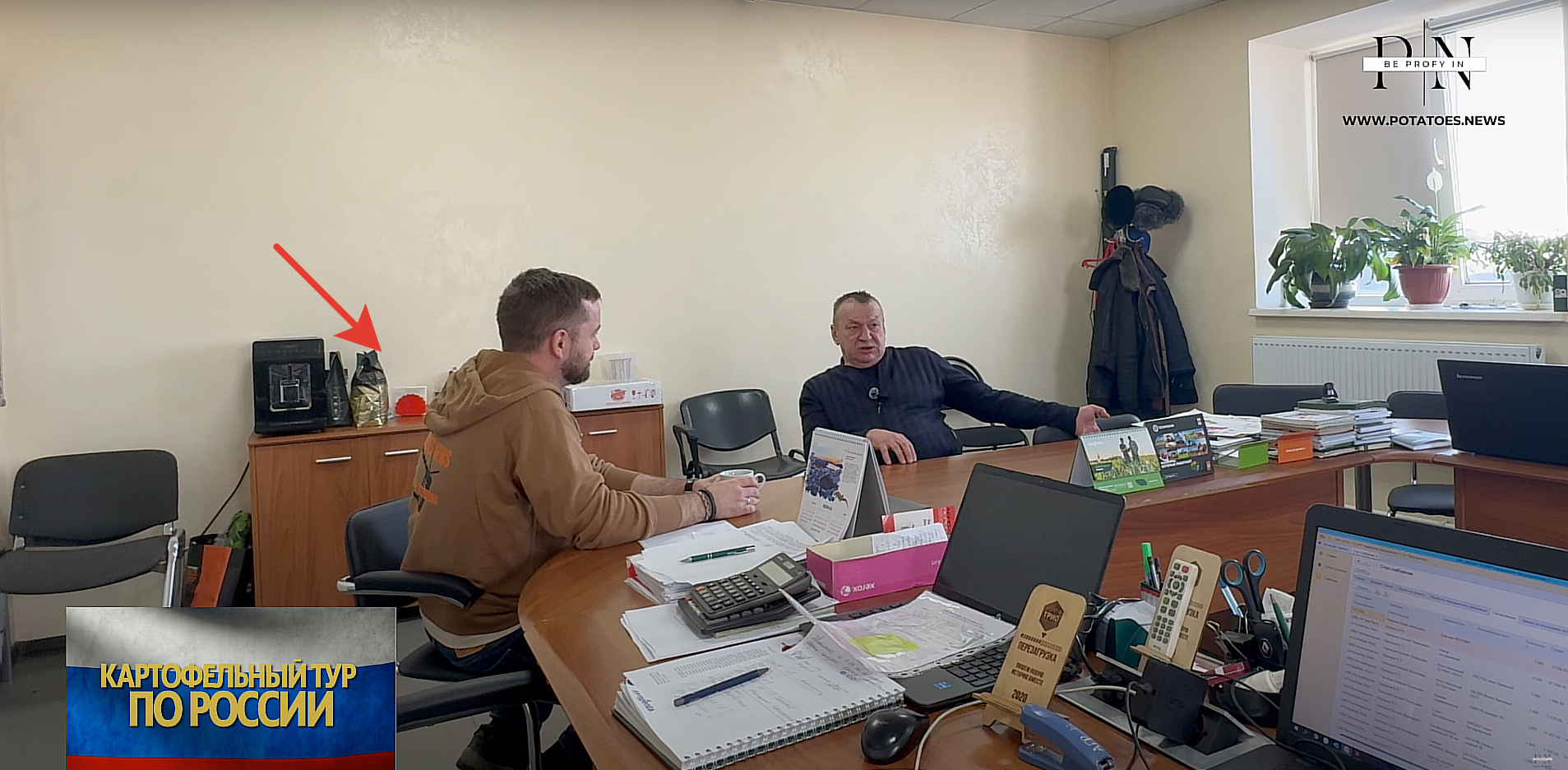
From the “Potato Tour across Russia.” A technology talk: skipping the rotary tiller on chernozems, forming ridges in autumn, using moisture probes, and speeding up harvest

The farm deliberately moved away from the “European” rotary-tiller + plow approach on chernozems and closer to an “American” logic (90-cm rows, no rotary tiller). Core idea: rotary tillers pulverize and glaze the surface, destroy chernozem structure, and create a compacted layer that blocks water movement—causing drought stress in summer and “pudding” conditions in wet autumns. The replacement is autumn ridge formation plus deep ripping with no soil inversion.
The core system (short version)
- Irrigated 4-field rotation: two cereals → potatoes → cereal → sugar beet → cereal → potatoes. Soy and corn are used sparingly (risks: rhizoctonia, stalk issues).
- Autumn (after cereal harvest):
- apply anhydrous ammonia,
- apply compound fertilizers (KCl + ammophos),
- one-pass combination tillage (discs + 20-cm shanks + press roller),
- Domodacker/chisel at 30–40 cm and form the ridge.
- Spring: no additional seedbed tillage; plant directly into the ready ridge (rear plate finishes the crown), then run the Domodacker again in the wheel tracks—~40 cm loosening to remove compaction.
- Why it works: the ridge’s capillary structure is preserved; after irrigation, water moves down and wicks back up at night—the ridge “breathes” instead of crusting.
Irrigation: larger shots, fewer starts
- Shift from 6–7 mm “frequent sips” to 15–20 mm every ~4 days, guided by AquaSpy probes (upper ~40 cm and lower horizon to ~1.2 m).
- On slopes, dimple/pocket wheels with the Domodacker create micro-terraces that slow runoff.
- Result: under heat and low humidity, water isn’t lost to the air; the profile truly wets.
Why not a rotary tiller — field-level effects
- No “layer cake” (dry base + freshly thrown, finely milled moist cap), which is almost impossible to wet through even with 4–5 irrigations.
- No glazed “concrete” surface: water passes a fine, crumbly structure instead of sheeting off.
- Autumn harvestable: in rainy years, moisture drains down instead of standing in ridges—machines re-enter the day after 40–50 mm of rain.
- Fuel & wear savings: dropping the tiller cuts energy use by up to ~80% in seedbed prep.
- Less re-compaction: wheel tracks are loosened immediately after planting.
Harvest & logistics
- Pattern: bed lifter (4 rows) + harvester (4 rows) → straight-through harvest (no field bunkers).
- Daily pace: ~18–20 ha by day + ~18–20 ha by night (up to ~40 ha/day). Typical harvest window 10–15 days (often from 5 September).
- Intake: up to ~3,000 t/day at the store; minimal crew compared with table-potato sorting.
- Working yield: ~45–50 t/ha with this system.
Seed potatoes “in-house”
- Goal: avoid import/logistics timing; bring in SE/Elite, produce R1 on farm.
- Seed area: ~100 ha (designed to support ~1,500 ha of ware).
- Virus control: separate rotation; one dedicated sprayer on seed, pass every 5 days; seasonal virus increase ~2%.
- Seed storage: two side-loading container stores with precise lot/fraction addressing.
Varieties & storage
- Long-running mainstay Innovator; testing Fontane (rounder, more plastic, lower storage temperature).
- Based on past processor contracts: accustomed to 9–10 °C; now hold ~7 °C reliably for low defects and late shipping (to June).
- For processors, shipments run “from wheels”: wash → buffer → one truck ≈ every 40 minutes.
Economics: contracts and predictability
- French-fry potatoes on processor contracts; sugar beet on contract; barley on contract with Baltika; corn mainly for the farm’s livestock; winter wheat quality is adjusted by blending.
- The business also runs a seed grain plant (incl. hybrid rye work). The philosophy is steady margin, not price gambling.
Takeaways for potato growers
- On chernozems, a rotary tiller often does more harm than good: soil structure beats a glossy ridge surface.
- Autumn ridging + spring planting with no re-tillage preserves capillarity and cuts evaporation.
- Fewer, larger irrigations—governed by probes—outperform frequent sips.
- Loosen wheel tracks right after planting to remove the main compaction source.
- Internal seed loop (SE/Elite → R1) gives control over timing, fractions, and virus pressure.
“Chernozem structure is sacred. One pass with a rotary tiller can kill it. We dropped the tiller—and half the moisture and harvest headaches vanished.”
“Form the ridge right once in autumn—don’t spend spring fighting clods and a ‘layer cake’ seedbed.”
Figures from the talk
- Irrigated rotation: cereals/potatoes/sugar beet
- Depths: combo tillage ~20 cm; chisel/Domodacker 30–40 cm
- Irrigation: 15–20 mm every ~4 days (AquaSpy to ~1.2 m)
- Yield: ~45–50 t/ha
- Harvest rate: up to ~40 ha/day; window 10–15 days
- Seed: virus increase ~2%; containerized storage
- Processor loading: ~1 truck every 40 min
Prepared within the “Potato Tour across Russia” for Potatoes News.