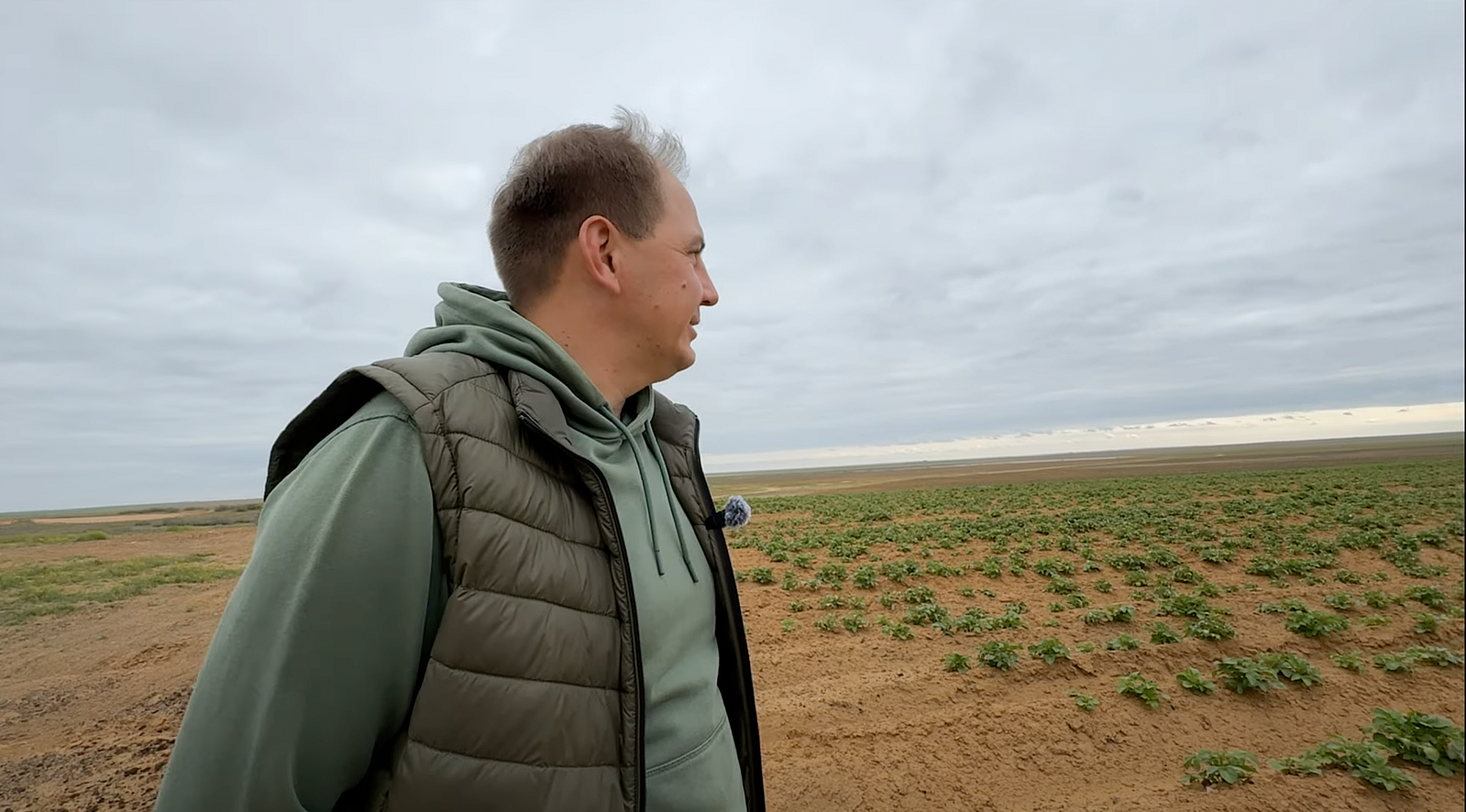
Early potatoes in Astrakhan Oblast: how Pavel Androsov’s farm keeps its market head start under +45 °C heat and return frosts. 24/7 irrigation, leveled pivot “circles,” wheat against erosion, and a people-first process culture.

A unique early-market foothold. In Limansky District—a multiethnic, multifaith hub in the far south of Astrakhan Oblast—we spent a day at the farm of Pavel Androsov. His family is now in its third generation of farming: from the famed “Limansky watermelons” grown by his grandfather to today’s early potato technology with harvests kicking off in June.
June.
“The most accurate definition of early-potato technology is simple: do everything it takes to grow early potatoes,” Pavel smiles.
Location & a seasonal head start
- The oblast’s southernmost district: the sea is just ~60 km away, giving a +2–3 °C edge in spring—an early start that matters.
- Early potatoes here are historically high-risk, high-reward: the market greets first movers with better prices.
Early-potato technology: from pre-heating to first bins
- Planting on schedule (this season even a couple of days earlier), with pre-warmed seed.
- Anti-stress support and canopy management; for the early segment they aim for fewer tubers per plant to speed up marketable sizing.
- Hand picking of the first lots—“earlier and pricier” justifies the labor.
- Dual channels: processing (primarily chips, which start earlier than fries) and the fresh/table segment.
Climate: heat, hot dry winds, and late frosts
- Summers run +40…+45 °C, nights +26…+28 °C; frequent sukhovei (desiccating winds).
- This year brought return frosts down to –6 °C locally (north of the oblast –8…–9 °C): damage in bands—from minor on ridges to 60–80% in low spots.
- The response: intensified nutrition, anti-stress care, and patience until regrowth—stress passes, but time is needed.
Irrigation & field leveling: the “circles of life”
- In heat waves, irrigation runs 24/7. Moisture sensors are used for monitoring, not as an autopilot: conditions swing too fast (heat/wind).
- Fields are laid out for center pivots—“circles” of ~70 ha (diameter ~950–960 m): heavy grading, 4–5 m of soil fill in saline depressions, plus pipelines and power.
- Water comes from the Volga via reclamation canals and lift stations; in 2025 a low flood is expected, and the region is pushing for a release scenario that protects both fisheries spawning and the farm season.
Production calendar
- The variety lineup stretches harvest from June through December. A second crop used to be common; now they often use long-cycle varieties depending on the year.
Market & competitors
- Azerbaijan traditionally hits the market even earlier (greenhouses, film, micro-plots 0.02–0.5 ha). In 2025 yields there are modest due to wet/cool weather, but higher prices support early shipments.
- Locally, some years table, other years processing pays better—this farm switches tactically with the market.
People: talent decides everything
- At peak hand-harvest: 100–200 pickers daily + the core team (~250 people total).
- Pay: from ₽60,000 for beginners up to ₽150,000 at peak; bonuses for multi-skill roles (operator-mechanic-welder), KPI and responsibility.
- Fleet includes modern tractors with GPS guidance and automatic gearboxes.
- To retain specialists, the farm is exploring employer-assisted mortgages and other “rooting” tools.
- Management philosophy: let people make mistakes so critical thinking kicks in and ownership grows.
Crop rotation: wheat to tame wind erosion
- After potatoes they sow winter wheat to stop wind erosion on light chestnut soils and to support the region’s livestock and poultry feed demand; quality regularly reaches 3rd class.
- Residual potato fertilizers carry into year two, damping wheat input costs.
- Logistics help: proximity to Port Olya and river shipping.
Family & succession
- Pavel is an agrarian in the 3rd generation. His grandfather just turned 90 and is still active. The children study—and grow up—around the farm.
- The surname Androsov likely has Greek roots (from Andros, “man”).
“We know how to work; now we’re learning to work right—build processes so production runs without you, and your family still has your time. Without systems, there’s no next-level growth.”
Key facts from the visit
- Where: Limansky District, Astrakhan Oblast — farm of Pavel Androsov.
- Focus: early potatoes (table & processing, emphasis on chips) + winter wheat.
- Climate factors: heat +40…+45 °C, return frosts to –6 °C, sukhovei.
- Irrigation: continuous in heat; ~70 ha pivot circles with deep grading and soil fill.
- Season: harvest June—December.
- Workforce: ~250 at peak; training, KPI, and “rooting” specialists.
- Market stance: agile balance between fresh and processing; watchful of Azerbaijani early crop.