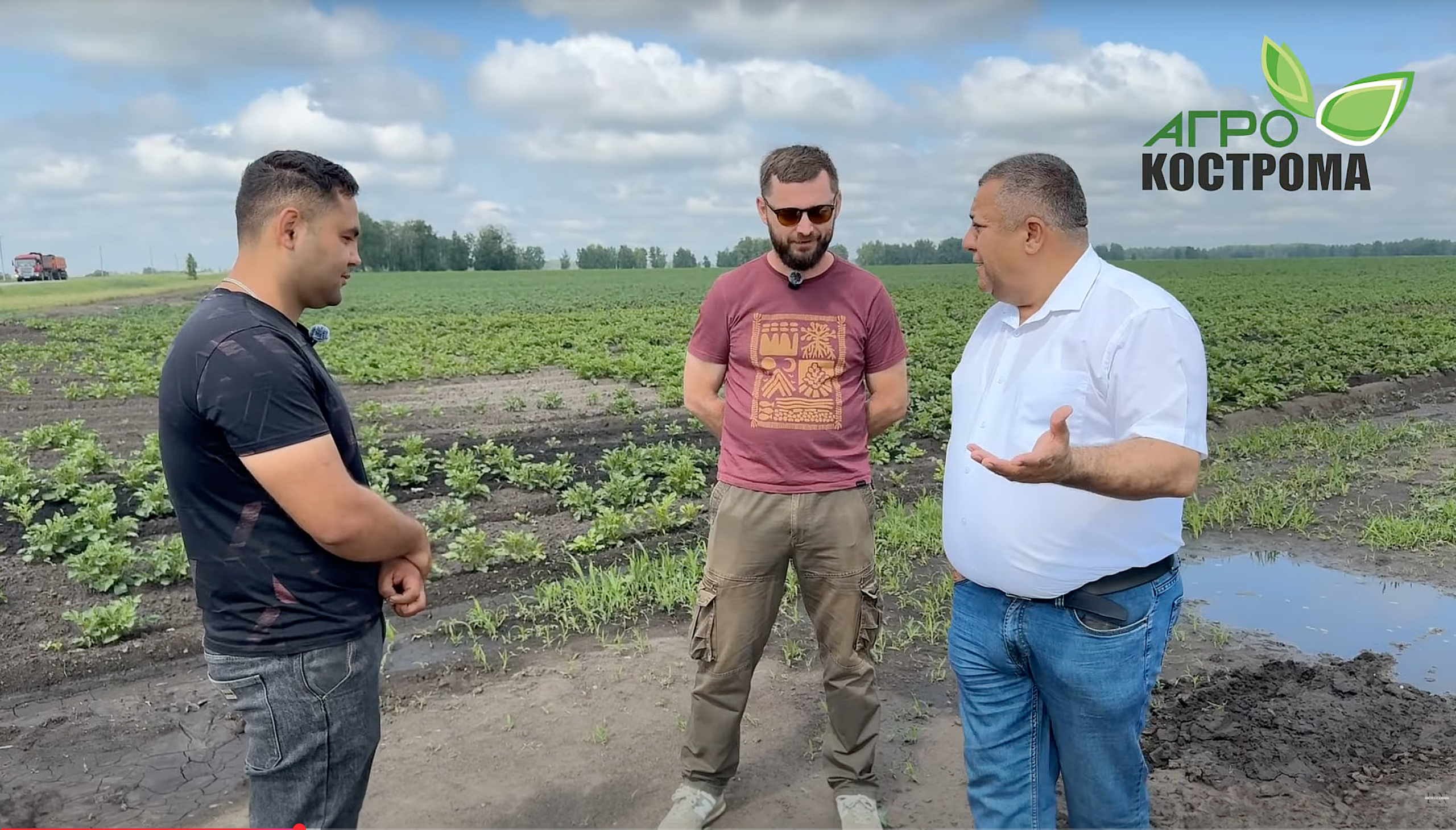
In Novosibirsk Oblast’s Ordynsky district, Dary Ordynska has grown from a 2010 start (40 ha of potatoes) into a diversified vegetable producer. The farm supplies regional retail chains on long-running agro-contracts and ships to distant regions by rail (Far East, Murmansk/Chukotka, northern Irkutsk). A major sales pillar is processing potatoes for chips at the Novosibirsk plant—valued for the ability to move large volumes right during harvest on a fixed schedule.


Crops, rotation, water
Beyond potatoes, the farm raises cabbage, beetroot, carrots, and field crops (buckwheat grown to organic standards but sold conventionally, peas, barley). Irrigation water comes from the local Orda river and wells, with additional pivots (U.S., Chinese, and Russian BSG units from Samara). The goal is to cover the critical June–July window when timely water drives both yield and quality.
People & pipeline
Labor tightens at harvest, so the farm partners with the Ordynsk agrarian college and the Novosibirsk State Agrarian University (they even sponsor a classroom). Each season 10–11 students join; many return after military service. Seasonal machine-operator pay starts around ₽80k+, and the fleet is steadily upgraded (A/C cabs, navigation), with a 2030 goal of zero “old” machines.
Storage, packing & processing
Legacy semi-underground stores are being complemented by new insulated blocks (e.g., 24×60 m modules) and a refrigerated cabbage store sized >2,000–2,500 t. The target is to hold product from harvest into late May–June, smoothing the gap to new crop. Post-harvest upgrades include washing and vacuum-pack lines; deeper processing (starch, etc.) is under evaluation to cut waste and add value.
Performance & targets
Typical table-potato yields are about 30 t/ha without irrigation and 40+ t/ha on irrigated ground. During the 2024–25 volatility, the farm leaned on chip contracts for stability and pushed loss-reduction: soil clods ≤5–8%, total storage/handling losses kept well under the ~13% norm, plus dedicated outlets for 10–30 mm smalls (up to ~1,000 t lots). By 2030, management aims to finish the storage build-out with full ventilation/refrigeration, close leases/loans, complete fleet renewal, and expand value-added lines.