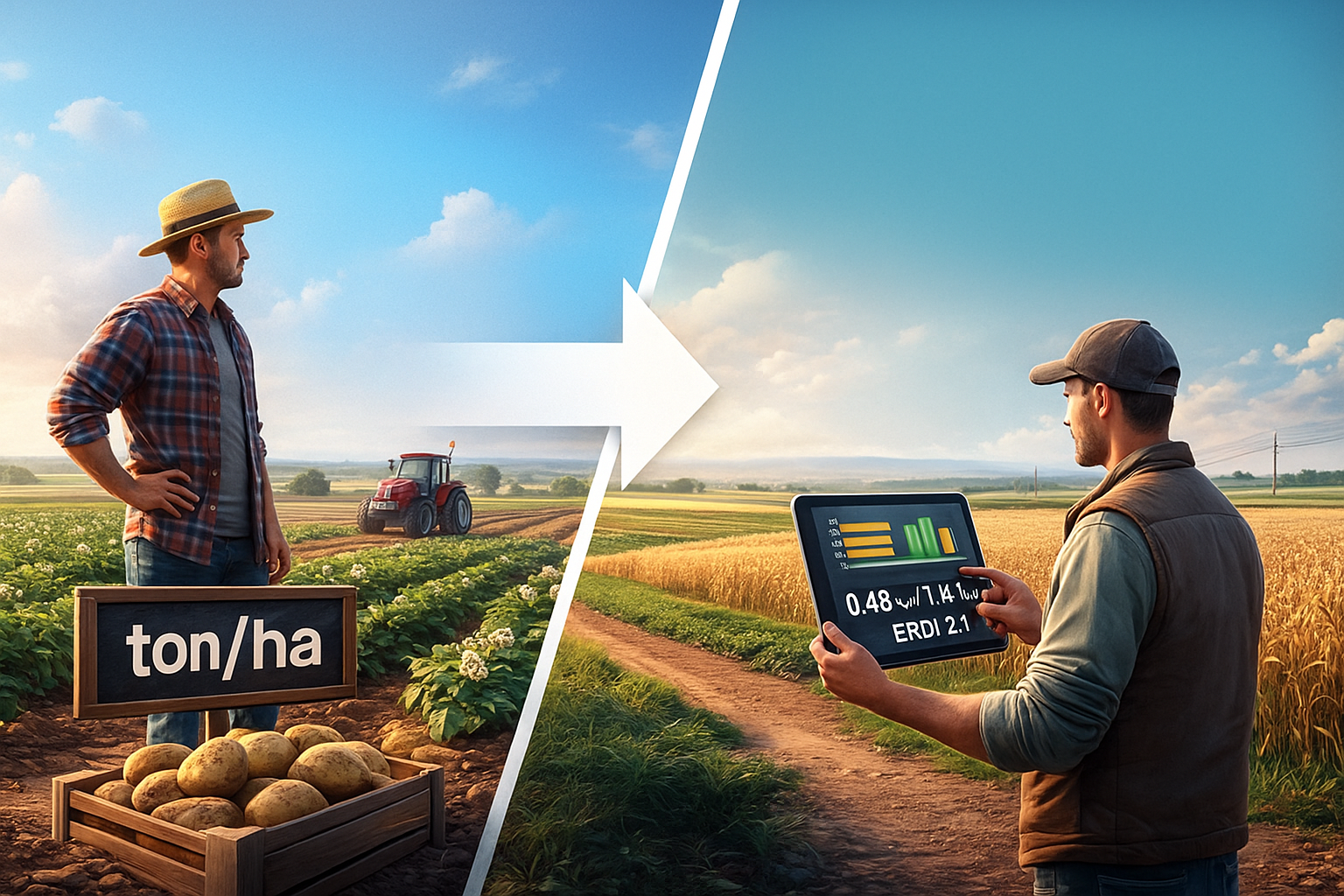
For decades, yield — tons per hectare — has been the dominant measure of success in agriculture. It is simple, intuitive and widely used. However, in the modern agri-food system this metric no longer reflects real efficiency.
Today, a much more important question is emerging:
How much energy does it take to produce 1 kilojoule of energy in food?
This shift from yield-based evaluation to energy-based assessment is becoming a global trend in agricultural analytics.
Why yield alone no longer works
Two farms may both harvest 40 t/ha of potatoes.
Yet one may spend twice as much diesel, nitrogen fertilizer and irrigation energy as the other.
Yield hides this difference.
Energy analysis reveals it.
Energy analysis: the essential idea
The method counts all external energy inputs:
- diesel and electricity
- mineral fertilizers (especially nitrogen)
- crop protection products
- machinery work
- seed material
- irrigation systems
- human labour (in energy equivalent)
And compares them with the energy stored in the harvested product.
Key metrics:
kJ of input per 1 kJ of food energy
(lower = better)
EROI — Energy Return on Investment
(how many kJ of food energy are produced per 1 kJ of external energy)
Energy efficiency of potatoes, maize, wheat and rice
Three scenarios were analyzed:
- Intensive systems – high use of fertilizers, fuel and irrigation
- Average farmer – balanced input levels
- Low-input systems – minimal fuel and agrochemicals
kJ input per 1 kJ output
| Crop | Intensive | Average | Low-input |
|---|---|---|---|
| Potato | 0.61 | 0.48 | 0.36 |
| Maize | 0.30 | 0.24 | 0.18 |
| Wheat | 0.53 | 0.41 | 0.31 |
| Rice | 0.23 | 0.18 | 0.14 |
EROI
| Crop | Intensive | Average | Low-input |
|---|---|---|---|
| Potato | 1.65 | 2.10 | 2.80 |
| Maize | 3.33 | 4.23 | 5.64 |
| Wheat | 1.90 | 2.42 | 3.23 |
| Rice | 4.27 | 5.43 | 7.24 |
What this means for the potato sector
- Potatoes are high-yielding but energy-intensive, especially due to nitrogen and irrigation.
- Energy inputs do not always convert proportionally into higher yield.
- Optimizing nitrogen rates, irrigation systems and mechanization can significantly improve EROI.
- Energy-based metrics provide a more accurate understanding of sustainability and profitability than yield alone.
Conclusion: energy efficiency is the new benchmark
As fertilizer, fuel and logistics costs rise globally, and climate risks intensify, the ability to measure and optimize energy efficiency becomes a strategic advantage.
Those producers who shift from “tons per hectare” to “energy per unit of food” will shape the future of sustainable agriculture.