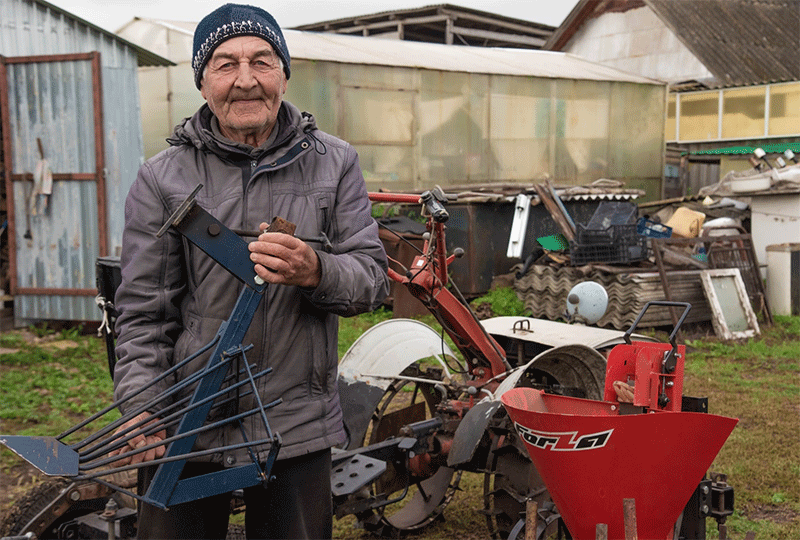
While agricultural giants focus on multi-million dollar precision technology, a quiet revolution is happening at the smallest scale. Valmir Khaziev, a 74-year-old retired welder from Tuyamazy, Russia, has single-handedly solved the labor crisis facing smallholder farmers through ingenious equipment modifications. His story isn’t just inspiring—it provides a blueprint for how practical engineering can extend productive farming lifespans and maintain food security in rural communities where youth outmigration and aging populations threaten agricultural continuity. With simple but effective adaptations to common implements, Khaziev has reduced his potato farming from weeks of manual labor to just a few days per year while achieving impressive yields.
The Scale of the Challenge and Khaziev’s Results
The context of Khaziev’s achievement highlights its significance:
- Labor Shortages: Rural areas globally face dramatic aging of agricultural workers. The average age of farmers in many European countries exceeds 60 years, with similar trends observed in Russia and North America.
- Smallholder Productivity: Khaziev’s yield of approximately 1.8 tons from 0.2 hectares (0.5 acres) translates to an impressive 9 tons per hectare, well above the global average for smallholders and comparable with many commercial operations.
- Time Efficiency: Reducing potato cultivation to “just a few days a year” represents a dramatic improvement over traditional methods, which typically require 40-50 person-hours per acre for planting, weeding, and harvesting.
The Engineering Innovations: Practical Solutions for Real Problems
Khaziev’s modifications demonstrate deep practical understanding of agricultural mechanics:
- Planter Modifications: Adding cleated spurs to his potato planter improved soil traction and planting depth consistency. This simple weld addresses a common problem with small-scale equipment—inadequate weight and traction for consistent operation.
- Harvester Improvements: Extending the width and height of his potato digger prevented soil and tuber mixing, a modification that directly addresses the primary challenge of potato harvesting—efficient separation of tubers from soil with minimal damage.
- Appropriate Scale: Using a mini-tractor rather than full-sized equipment allowed for operation on small plots without excessive soil compaction, maintaining soil health while achieving mechanization.
The Broader Implications: A Model for Adaptive Innovation
Khaziev’s approach offers valuable insights for the agricultural community:
- Cost-Effective Mechanization: While new high-tech solutions often require major investment, Khaziev’s modifications demonstrate how existing equipment can be adapted at minimal cost. This approach makes mechanization accessible to farmers with limited capital.
- Maintenance and Repair Expertise: His 40 years of experience as a welder and equipment repair technician highlights the critical importance of local mechanical expertise in agricultural communities—a resource that is disappearing in many regions.
- Appropriate Technology: The modifications represent “appropriate technology”—solutions perfectly matched to the scale, skill level, and economic reality of smallholder operations.
Scaling Homegrown Innovation
Valmir Khaziev’s story transcends one productive garden; it offers a model for addressing one of agriculture’s most persistent challenges—maintaining production on small plots with limited labor. His success demonstrates that the most valuable agricultural innovations aren’t always developed in corporate R&D departments but can emerge from the practical problem-solving of those working the land.
For agricultural engineers, his modifications provide blueprints for affordable small-scale implements. For extension services, his story highlights the value of fostering local mechanical skills and knowledge sharing. And for aging farmers worldwide, Khaziev’s example offers hope and practical strategies for extending productive farming years despite physical limitations. His homemade innovations represent exactly the type of appropriate technology that could help maintain global food security as farmer demographics continue to shift.

