

Who should read this: seed growers, ware producers, crop protection agronomists, inspectors, and service providers.
Data backbone: 65,450 Scottish seed potato lots in the SSPCS system (2009–2022) + new PLRV genomics from 2023–2024.
Key takeaways in one paragraph
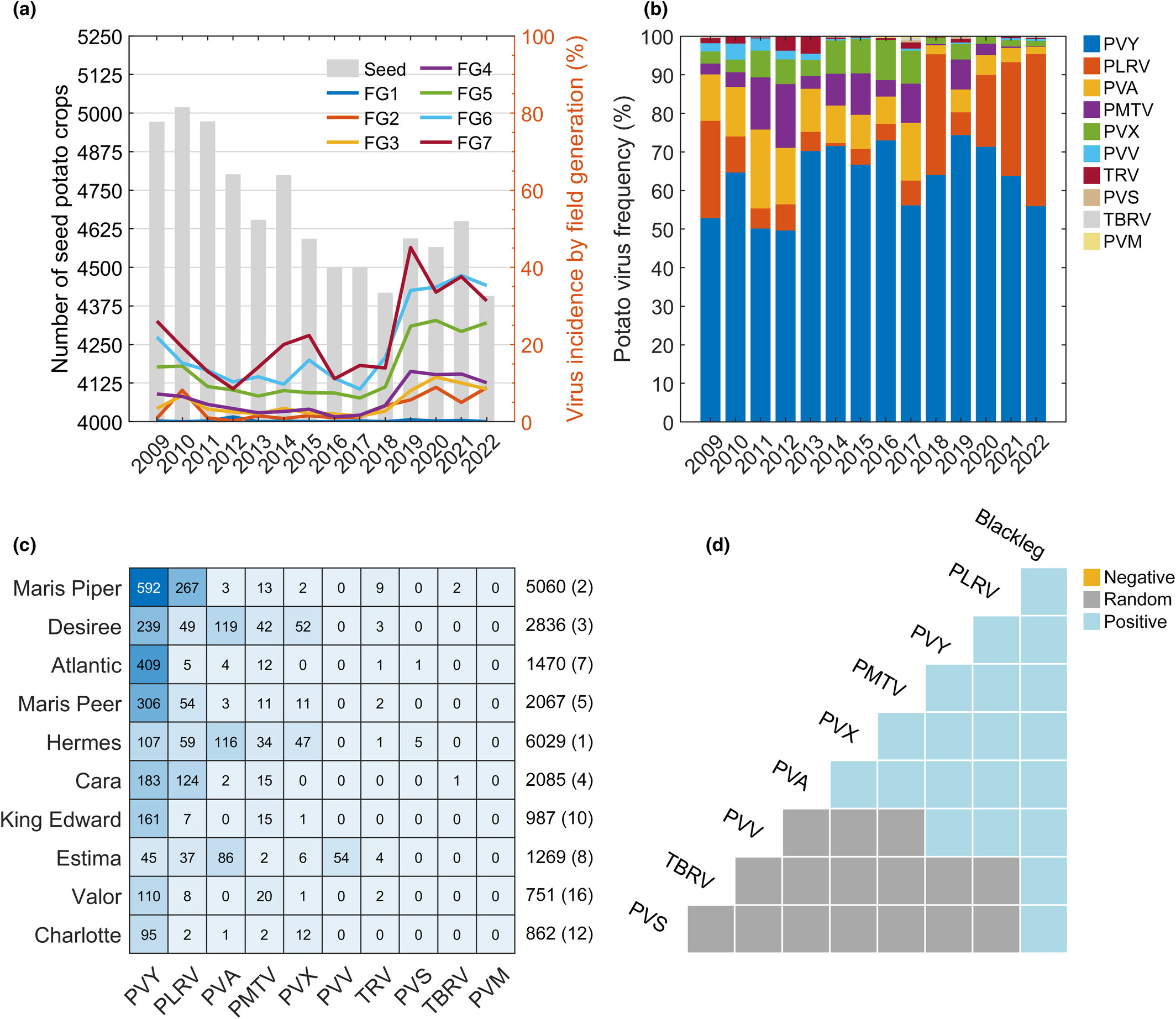
- The most frequent viruses are PVY, PLRV, and PVA. Since 2019 PVY has declined, while PLRV increased ~6× by 2022.
- Spatial analysis reveals persistent hotspots in the central east (Perth & Kinross, Angus) and coldspots in the north (Inverness area).
- Machine learning (Random Forest, AUROC 0.83) confirms the top predictor of PVY is the health of the mother seed stock, followed by blackleg, roguing practices, varietal resistance, proximity to other potato fields, temperature factors, and soil type.
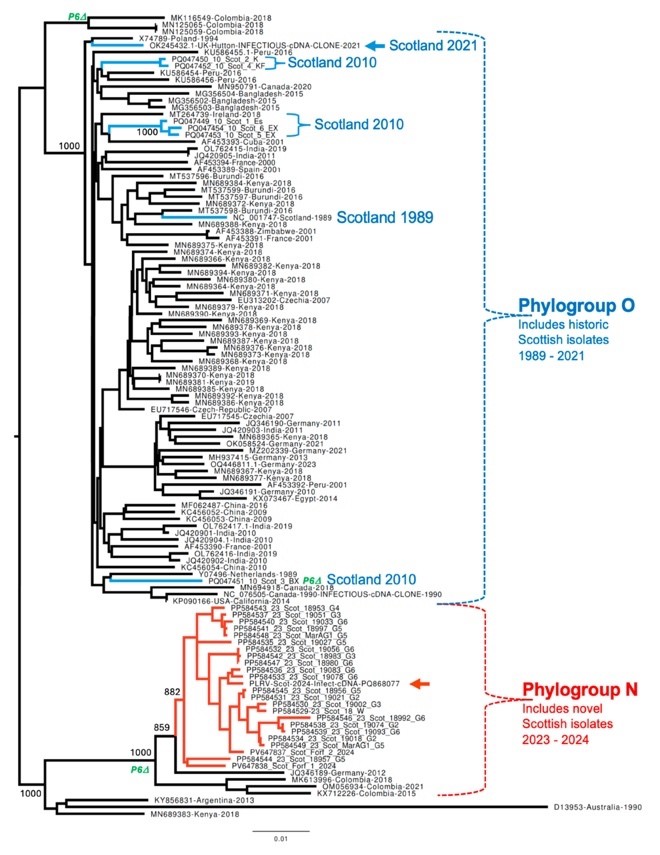
- In 2023–2024 a new dominant PLRV phylogroup (N) displaced the historic O type; the newcomer shows higher accumulation in plants and a genetic bottleneck in structural genes during aphid transmission.
What was studied and how
The Scottish Seed Potato Classification Scheme (SSPCS) runs a long-term virus survey on seed crops. The study aggregated 2009–2022 data on 10 viruses (PVY, PLRV, PVA, PVX, PVS, PVM, PVV, PMTV, TRV, TBRV).
Researchers then used ArcGIS to map hot/cold spots and interpretable machine learning (Random Forest) to weigh the roles of seed origins, mother-crop health, agronomy, topography, soils, weather, and surrounding potato density.
Geography of risk: where it’s hottest
- Persistent PVY hotspots anchor in the central belt of the east coast—Perth & Kinross, Angus—areas with dense potato plantings and an active ware sector.
- The north (Inverness) shows persistent coldspots (low PVY/PLRV), linked to a higher share of pre-basic seed classes and the northern effect (later aphid flights—plants have time to develop mature plant resistance).
- In Aberdeenshire (NE) during 2019–2022, hotspots shifted from PVY to PLRV—coinciding with mild winters and the loss of key aphicides (thiamethoxam/pymetrozine).
Mixed infections: who fuels them
Twelve virus pairs occurred more often than by chance. Notably, blackleg (Pectobacterium/Dickeya) is positively associated with eight viruses—a warning sign of cumulative issues as field generations lengthen.
What really predicts PVY outbreaks (model insights)
Top Shapley-ranked factors:
- PVY in the mother seed stock — the main driver of primary inoculum.
- Blackleg in the current and mother crops — a marker of deteriorating phytosanitary status.
- Roguing/pre-roguing (often flags hidden/mild infections).
- Varietal resistance to PVY (higher score = healthier class).
- Distance to the nearest seed and ware fields (shorter = higher risk).
- Temperature/wind (mild winters, gusty winds in the warm quarter = earlier aphid pressure and longer-distance dispersal).
- Soils (higher silt/clay, lower C:N — often tied to plant health vulnerability).
In practice: even an simplified pre-season model using just 4 features known before planting (PVY in mother crop, pre-roguing in mother crop, blackleg in mother crop, varietal resistance score) delivers AUROC 0.76—enough to color-code risk maps in advance and tighten control in “red” cells.
The new genetic reality of PLRV
In 2023–2024, PLRV-N became predominant in Scotland, displacing the long-standing PLRV-O (present since the late 1980s). Genome differences (~4% nt, 82 amino acid changes) cluster in the RTD (read-through domain) of the structural protein and include a truncated P6 in type N.
Clone-based assays found higher accumulation for PLRV-N; analysis across field generations showed a structural-gene bottleneck during aphid transmission (reduced diversity in early FG2–FG3) versus increasing diversity via tuber transmission in later FGs—consistent with adaptation to the aphid route.
What agribusiness can do now
Seed and genetics
- Tight gatekeeping of mother stocks: PCR screens for PVY/PLRV + blackleg; don’t rely on visual scouting alone.
- Choose varieties with high PVY resistance scores in “red” zones; reconsider long generation chains.
Spatial strategy
- Increase isolation distances between seed and ware; avoid shoulder-to-shoulder layouts with potato masses.
- Where possible, relocate seed blocks toward “cold” zones (north/west) and use buffer strips.
Monitoring and control
- Early aphid monitoring (local traps + regional bulletins), with special focus on May–early July (critical for PLRV).
- Mineral oils, straw mulching, careful insecticide tactics acknowledging resistance patterns.
- Roguing backed by rapid detection (hyperspectral/ML tools), because PVY/PLRV are often “silent”.
Analytics and forecasting
- Pre-season risk maps via the 4-factor model—decide where to tighten monitoring and post-harvest testing.
- Update the annual “virus frequency chart” and overlay with aphid/weather trends.
- Genomic surveillance of PLRV: track PLRV-N share and local variants.
Why this matters beyond Scotland
The landscape risk logic is universal: the denser the potato mosaic, the higher the infection background. For Russia, Kazakhstan, and neighbors this means:
- mapping potato density and seed field isolation;
- shortening generation chains in red zones;
- rolling out a fast pre-forecast based on mother-stock data and a few agronomic signals.
Bottom line
Combining hotspot maps with interpretable ML shifts the industry from reacting to symptoms to anticipating risk—before crops hit the field. The rise of a new PLRV variant underscores that viruses evolve; systematic monitoring + forecasting are the best insurance for seed quality.
Potatoes.News thanks the authors of the original studies and the SSPCS inspectors for the scope and openness of the data.
If you’d like a personalized risk map for your farm (field locations, seed origins, varieties), write to i@viktorkovalev.ru or WhatsApp +7 961 472-02-02 (note: “Potato Tour / risk map”).
More info at:
https://bsppjournals.onlinelibrary.wiley.com/doi/full/10.1111/ppa.13891
https://www.mdpi.com/1999-4915/17/10/1294