More than 30% of the Dutch sandy soils has a pH below the target value. This is evident from a recent inventory by Eurofins Agro of three crops: maize, grassland and ware potatoes. Too low a pH costs yield.
An important player in soil fertility is the acidity (pH) of the soil. Eurofins Agro recently inventoried and mapped the pH of sandy soil. Figures 1 to 3 show that there are areas where more than 30% of the plots have the pH below the target range. The target value for the pH on sandy soil depends on the soil type. Not all sand is sand. A rule of thumb is that the pH should be above 5.

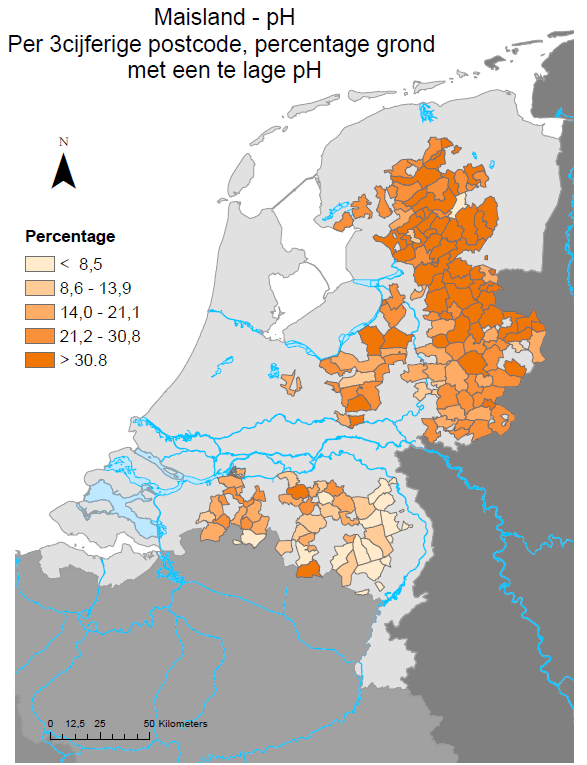


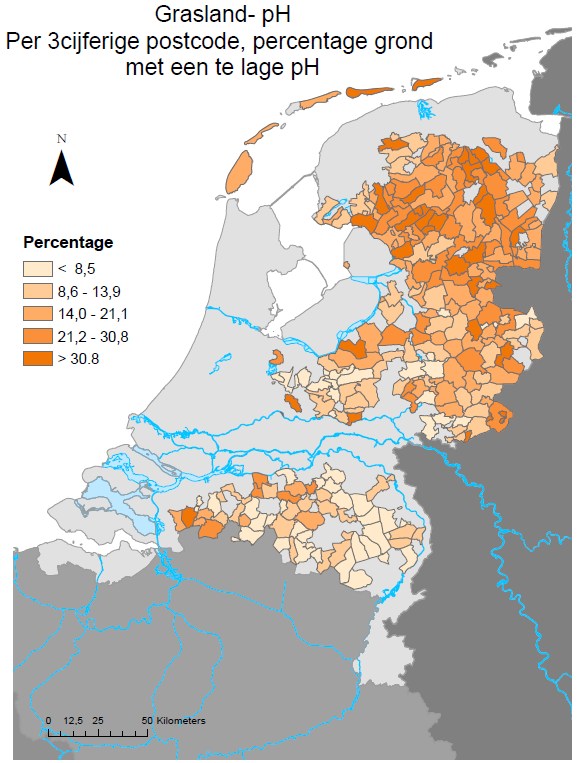
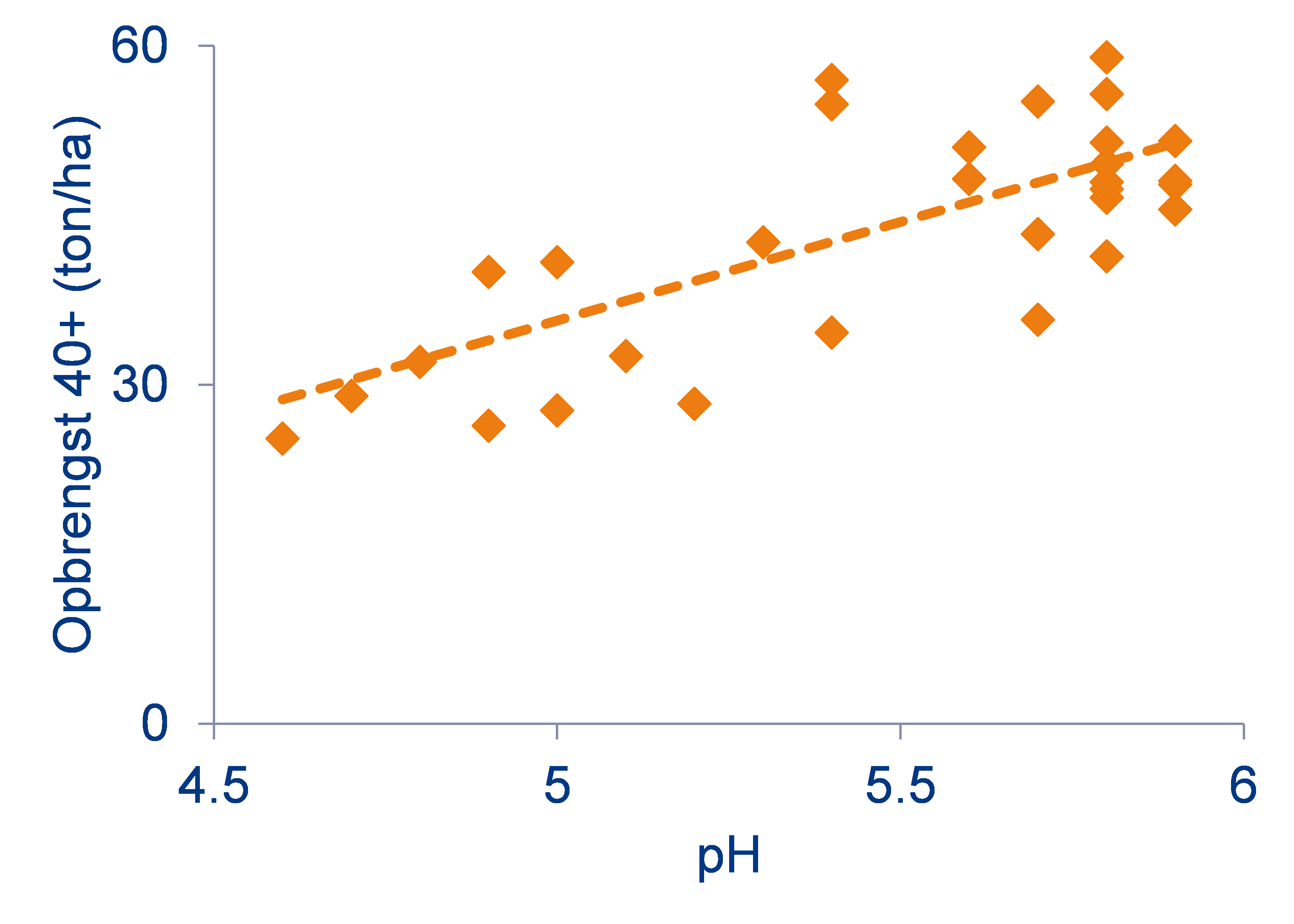
Research with potatoes shows a relationship between pH and yield (figure 4). Other crops, such as silage maize and grass, also show a similar relationship.

A pH that is too low is not necessary. It is fairly easy to raise with a maintenance liming. Too low a pH has an effect on both chemical and physical soil fertility.
pH and chemical soil fertility
The effect of pH on chemical soil fertility is probably best known. For example, a high soil pH ensures a low availability of manganese (Mn). The plant available stock is low because the soil retains the manganese extra. The crop is therefore unable to absorb enough of this trace element. Manganese is important in various enzymatic processes in the plant.
A low pH also has an effect on the availability of, for example, silicon (Si). Silicon is relevant because it plays a role in drought stress and the resilience of the crop. At very low soil pH values, the availability of aluminum (Al) can cause problems. The available aluminum is bad for the corn roots.
pH and physical soil fertility
In addition to chemical soil fertility, pH is also important for physical soil fertility. In particular the occupation of the cation exchange complex, the CEC , is closely related to the pH. A low pH creates many hydrogen atoms (H + ) in the soil solution. The agricultural effect of this is negative, because H + takes the place of relevant cations such as potassium (K), magnesium (Mg) and calcium (Ca) at the CEC.
pH and fertilization
Fertilizing the plots with animal manure and fertilizers has an acidifying effect on the soil. The pH gradually drops as a result. It is therefore important to regularly carry out liming in addition to fertilization. This contributes to a better CEC occupancy .
On clay soils, especially on young clay soils, a lot of carbonic lime is present. The carbonic lime weathers slowly and ensures natural liming of the grounds. As a result, you often see that the pH on clay soils is high and remains high.
Fertilization Guide Eurofins Agro provides insight into the pH of the soil and also how much lime should be applied. An improvement in the pH immediately results in a higher yield (figure 4). Such an investigation soon pays off!