Nitrogen is dizzyingly expensive. Anyone who neglects the basic nutrients now also slows down nitrogen uptake.
Extremely high fertilizer prices , especially for nitrogen – who doesn’t think about reducing it? This should be done with caution. The advisors of the Service Center for Rural Areas (DLR) from the Eifel recommend one more reason to carry out the upcoming nutrient requirement assessment a little more precisely and more extensively than before. Pay more attention to the basic nutrients. Anyone who neglects the basic nutrients when the nitrogen supply is reduced, accepts rapidly falling yields.
Lime: less nitrogen uptake if the pH is too low
For example lime : If the pH value slips below the site-specific optimum, nitrogen utilization quickly drops to 50 to 60 percent. Lime fertilizers can still be given as “ top fertilization ” in spring . The spreading width alone sets limits for tramlines wider than 15 m. The other main nutrients phosphorus, potash, magnesium and sulfur are often not given enough attention. It is mostly known how much nitrogen fertilizer the individual crops need for the typical yield.
How high is the withdrawal of phosphorus, potash and sulfur?
But how much phosphorus does grain require? Or how much potash do rapeseed or silage maize take in? What is the sulfur requirement of the plants?
Soil examinations are prescribed according to the Fertilizer Ordinance, but the results should be given more consideration when measuring the fertilizer application. Salary class C, the middle supply level, means that at least the withdrawal of the basic nutrients should be fertilized.
It should be noted that the nutrient uptake is often significantly higher than the withdrawal – for example, rapeseed has a requirement (intake) of 6 kg / dt with a potassium withdrawal of 1 kg / dt.
The need for basic nutrients in kg / ha is not insignificant, as the adjacent DLR table shows.
Phosphorus: Pay attention to water solubility
Twenty years ago, “rocking fertilization” was the general doctrine for phosphorus. Today it is viewed critically. Phosphorus is not washed out, but it is subject to an aging process. Over time it becomes less and less available to plants. When fertilizing with phosphate in spring, make sure that it is highly water-soluble. Phosphorus can hardly be moved in the soil and should definitely be incorporated before sowing in summer. In winter, fertilization with DAP is recommended. The phosphorus contained is water-soluble and the nitrogen is present as ammonium and is not washed out even with early fertilization.
Potassium: High demand and reduced availability
Potash is washed out on very light soils and set on very clay soils. Both of these reduce plant availability. Oilseed rape, maize and grassland in particular have a high potash requirement, which is often not met with moderate manure application. Depending on the soil supply, this source does not supply sufficient potash. Potassium strengthens winter hardiness, so give it preferably in autumn. But it also works well in a spring edition.


more on the subject Fertilizer prices drive costs up: Is growing grain still worthwhile?
Sulfur: Nmin as an indication of Smin
As a sulfate, sulfur can be washed out in a similar way to nitrate. Regular intake is therefore necessary. The sulfur content in organic fertilizers is usually overestimated and it is largely organically bound there. For the time being it is not available for the plants. The conversion of organically bound sulfur is slower than the release of nitrogen. Similar to nitrate, winter precipitation and sulfur shift are closely related. If it stays dry, there is less relocation than in wet winters. High Nmin values in spring are therefore an indication of high Smin values and vice versa.
The sulfur input via air and precipitation is almost insignificant and is not taken into account in the requirements planning. The higher the yield, the higher the sulfur requirement. A balanced sulfur fertilization improves nitrogen utilization and vice versa, a lack of sulfur leads to poor utilization of the nitrogen used. This is not only to be avoided for political reasons.
Elemental sulfur acts more slowly
Bacteria first have to convert elemental sulfur to sulfate (SO4) before plants can absorb it. This explains the low S-fertilizing effectiveness of granulated elemental sulfur. Powder and liquid products have a large surface and can therefore theoretically be converted more quickly. Other sulfur fertilizers in sulphate form show no difference in effectiveness. In addition to the application technology available in the company (liquid / solid), choose the sulfur fertilizer, especially according to its value for money, including the loss of lime.
Fertilize magnesium only when necessary
If there are high levels of magnesium in the soil, no additional magnesium should be fertilized. Then resort to magnesium-free sulfur fertilizers. If there is a need for magnesium, the addition of 1.5 to 2.0 dt / ha of kieserite is recommended for the classic fertilization strategy.
In the case of ASL solution, it is essential to pay attention to the pH value
At first glance, ASL (ammonium sulfate) solutions are very inexpensive and are often combined with AHL (ammonium nitrate-urea solution). At locations with a low pH value, it is essential to factor in the lime balance and, above all, to carry it out. For every 100 kg of N over an 8/8 ASL solution, 300 kg of CaO are necessary to maintain the pH value.
Recognize fertilizer errors: this is how it works


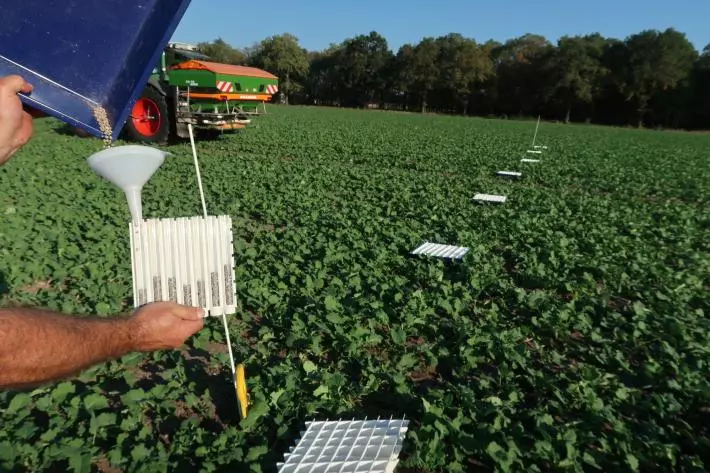
avoided with the use of test trays. Both spreading errors cannot be seen from the ground. Our tip: Simple drones for around 500 euros can help to identify the differences in color due to fertilization.

more fertilizer than the plants next to the tramlines. The setting of the spreader does not match the spreading properties of the fertilizer. The fertilizer was probably more airworthy than the average product. Large and heavy grains fly further than expected. Our tip: Some manufacturers of mineral fertilizer spreaders analyze submitted samples and provide the correct setting values.


distribution. Our tip: In this case, use liquid fertilizer nozzles instead of hoses.

field border (B) are frighteningly dark in color. This indicates an incorrectly set border spreading device. The lateral distribution is not correct here (C): Too much fertilizer falls in the overlapping area of the two spreading fans. Here, the lateral distribution would have had to be measured in advance by setting up litter
trays and the spreader had to be readjusted.


